In the quiet coastal village of Djirnda, where the tides of the Atlantic whispered secrets to the sands and the mangroves rustled like spirits of old, there lived a fisherman named Demba. He was young, broad-shouldered, and blessed with the kind of patience that only the sea could teach. His small canoe, painted in faded blue and white stripes, bore the name “Mbeuguel”, meaning love.
Demba lived alone in a small hut made of woven reeds and palm leaves. His parents had passed when he was still a boy, leaving him the family’s modest fishing gear and a deep respect for the sea. Though poor, Demba had a quiet contentment about him. He fished only what he needed and gave the rest to neighbors who had nothing.
But Demba had a dream—one that pulled at his heart as surely as the moon pulled the tides. He wanted to marry Aissatou, the beautiful daughter of the village healer. Aissatou had eyes like the stormy sea and a voice soft as rain. She, too, admired Demba, for his humility, kindness, and strong hands that smelled of salt and toil.
Her father, Papa Samba, was a stern man who believed that love alone could not fill an empty calabash. “If Demba wants to marry my daughter,” he said, “he must prove he can provide. Bring me the biggest fish caught in these waters before the new moon rises. Then, he may have Aissatou’s hand.”
Demba accepted the challenge without hesitation. He tied charms given to him by elders onto his net and paddled out farther than he ever had before—past the reef where dolphins played, past the islands where birds nested, and into the deep blue where the sea grew quiet and cold.
He fished for days and nights, casting his net in sacred silence. He sang to the waters in Wolof, whispered his hopes to the sky, and offered crushed kola nuts into the waves. But no fish came.
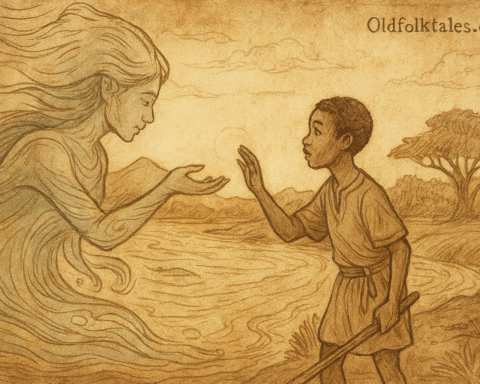
One evening, as the sun dipped low and the sky turned the color of tamarind, Demba saw a shimmer below the boat. The water parted, and out leapt a silver fish unlike any he had ever seen. It was massive, longer than a man, with glowing eyes and scales that sparkled like stars. But before he could throw his net, the fish spoke.
“Demba,” it said in a deep, musical voice, “do not catch me. I am Yaye Njaxum, guardian of the sea’s heart. I know your wish. Let me go, and I will grant you more than you seek.”
Demba’s hands trembled. “I want only Aissatou,” he said. “I promised her father I would bring the largest fish.”
“If you let me live,” Yaye Njaxum replied, “I will give you fish every day, more than you could ever carry, until your hut overflows. You will feed your village. And when the new moon comes, I will return, willingly, for your promise.”
Demba thought of Aissatou’s smile, of her father’s challenge, and of the honor his name would earn. Slowly, he lowered his net. The fish dipped below and disappeared with a flick of its tail.
The next morning, Demba awoke to find his canoe filled with fish—fat barracuda, red snapper, and sea bream shining in the morning light. The villagers gasped. He shared his bounty, just as he had always done.
Day after day, the miracle repeated. Demba became known as the blessed one. Papa Samba was impressed. “He must be chosen by the spirits,” he said proudly. He agreed to the marriage.
The village prepared for a grand feast. Calabashes of millet beer were brewed, dancers practiced their steps, and griots composed praise songs. But Demba’s heart grew heavy. The new moon was approaching.
On the eve of the wedding, under a sky pricked with stars, Demba sat alone by the water. He remembered the fish’s eyes, full of wisdom and promise. He remembered the deal.
He rose before dawn and walked to his canoe. The sea was calm, waiting. He paddled to the deep waters, to the place of their meeting.
And there, as promised, Yaye Njaxum rose.
“I am here, Demba,” it said. “Take me, if your word still holds.”
Demba looked into its shimmering eyes. “You kept your promise,” he whispered. “And now I must keep mine.”
With tears on his cheeks, Demba cast his net and let it sink. The fish made no effort to flee.
The wedding never happened.
Instead, Demba returned with the great fish draped across his canoe. He brought it to Papa Samba, who marveled at the size, but noticed Demba’s silence.
“I had to keep my word,” Demba said. “But I lost something dearer.”
The villagers feasted on the fish. But Demba did not eat.
The next morning, he was gone.
Some say he paddled back to the deep and never returned. Others say he walked into the mangroves and became part of the forest.
Aissatou never married.
And every year, when the new moon rises over Djirnda, the villagers leave offerings at the shore—a jar of palm wine, a calabash of rice, and the first fish caught that season.
In hopes that Yaye Njaxum still listens.
✧ Commentary
This poignant tale from Senegal speaks deeply to the themes of integrity, sacrifice, and the complexity of honor. Demba is a character shaped by his values—he doesn’t break his word, even when it costs him his deepest desire. His quiet, consistent goodness mirrors the virtues valued in many West African communities: respect, humility, and responsibility. The folktale also reveals the mystical relationship many coastal societies in West Africa have with the sea, often seen as a spiritual realm with its own guardians and codes of conduct.
✧ Moral
A true promise, once made, must be honored—even at great personal cost.
✧ Questions & Answers
1. Q: Who is Demba in the story? A: Demba is a humble fisherman from Djirnda who dreams of marrying Aissatou, the healer’s daughter.
2. Q: What challenge does Papa Samba give Demba? A: He must bring back the largest fish caught before the new moon to earn the right to marry Aissatou.
3. Q: Who is Yaye Njaxum? A: A magical guardian of the sea who offers Demba abundance in exchange for his life being spared—until the new moon.
4. Q: How does Demba become successful overnight? A: After sparing Yaye Njaxum, the sea rewards him with bountiful fish daily.
5. Q: Why does Demba ultimately lose Aissatou? A: He honors his promise and gives up the magical fish, losing the approval of Papa Samba and the chance to marry.