In the endless stretch of the Chott el Jerid, where the horizon blurs between sky and sand, there lived a wandering nomad named Youssef. He had spent his entire life following the rhythm of the desert, moving with the wind, resting where the stars felt kind, and carrying all that he owned on the back of his tired camel. Yet despite the vast beauty of the desert, Youssef’s heart was heavy. Since the passing of his father, he had felt lost, drifting from one dune to the next without purpose or peace. His father had been his guide, his compass, the voice that taught him how to listen to the whispers of the desert. Now, the silence seemed too wide to cross.
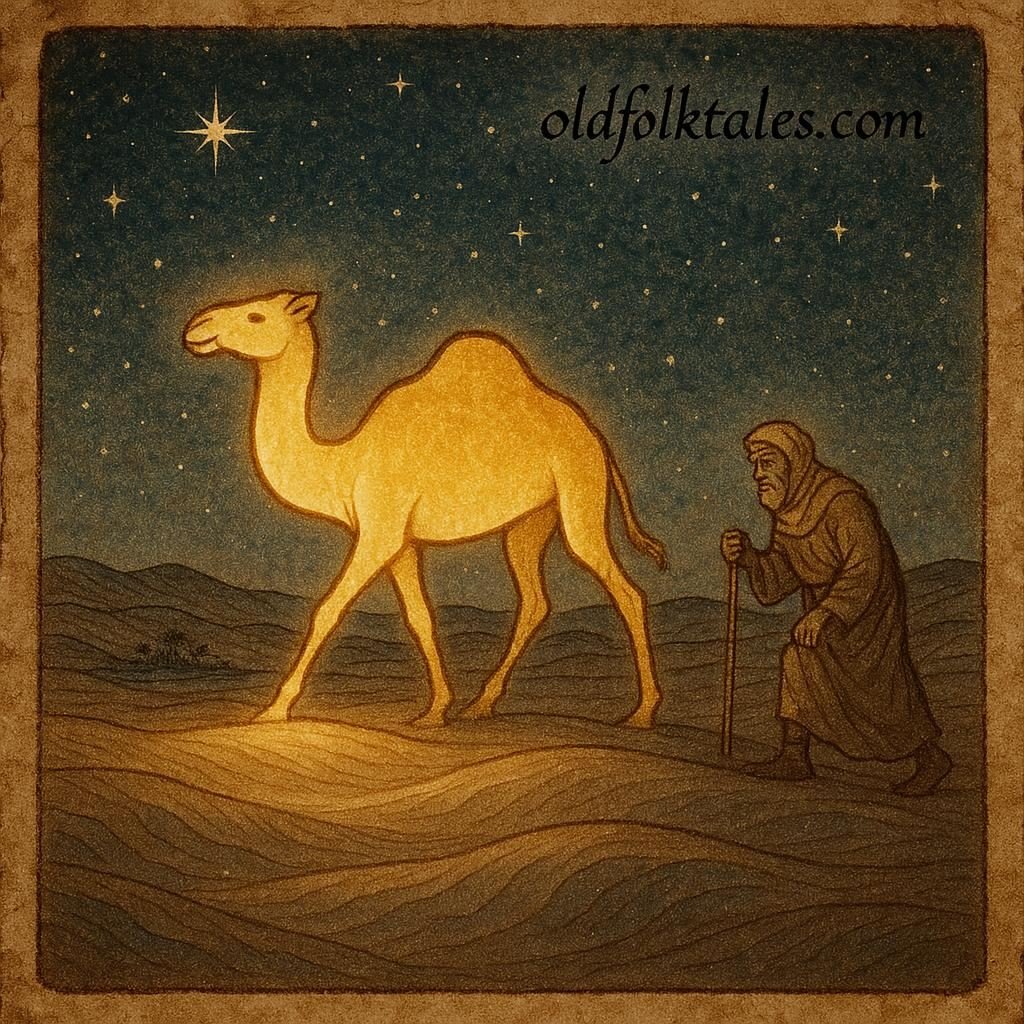
One scorching afternoon, as Youssef walked beside his camel, a strange shimmer appeared far in the distance. It was not the usual mirage that danced on the sand. This one moved with grace, almost alive. As he shaded his eyes, he saw it clearly a golden camel walking alone across the dunes, glowing as if lit from within. Its steps left no tracks. Its form shimmered in the heat. Youssef stopped in awe. “By the mercy of the Most High,” he whispered, “what creature walks without leaving a shadow?”
Want to dive deeper? Read more North African folktales today
Without thinking, he began to follow. His camel groaned softly, but Youssef pressed on. The golden camel moved steadily ahead, always at a distance, as if leading him somewhere unseen. The desert sun burned fiercely, and his water skin grew lighter with each passing hour. Yet every time he thought of turning back, the golden figure lifted its head and looked at him with eyes so gentle they filled his heart with strength.
By nightfall, the desert turned cold, and the stars opened wide above him. Youssef rested by a small fire, the golden camel still glowing faintly in the distance. He wondered if he was dreaming. “If this is a vision,” he said softly, “then may it bring me peace.” As he drifted into sleep, he heard a faint sound, a voice, deep and calm, like the hum of the desert wind. “Do not fear the path before you, my son. Follow the light, and you will find home.”
Youssef awoke with tears on his face. The voice had been his father’s. He stood at once and looked across the sand. The golden camel was waiting, its light brighter now beneath the stars. Youssef packed his things quickly and began to follow once more.
Days passed. The journey grew harder. Blinding winds rose and fell. His feet sank deep into hot sand. His lips cracked, and his strength faded. Yet no matter how far he walked, the golden camel stayed just ahead, never near enough to touch, never far enough to lose. Sometimes it turned its head as if watching him, urging him forward.
One night, a great storm rose from the west. The sky roared with thunder, and the dunes shifted under his feet. Youssef wrapped his cloak tight, shielding his face from the stinging sand. Through the chaos, he saw the golden camel still walking, calm and bright, cutting through the storm like a flame. Desperate not to lose it, he stumbled after it until his legs gave way. He fell to his knees, calling out, “Father, if your spirit guides me, do not leave me alone!”
The storm raged on, but the golden light drew closer until it stood right before him. Youssef blinked through the sand and saw the face of his camel glowing softly and within its eyes, he saw his father’s reflection smiling back. “My son,” the voice said gently, “you have not been lost. Every step you took was a step home.”
When morning came, the desert was calm again. Youssef awoke beside a small cluster of palms and a wellspring bubbling clear water. The golden camel was gone. Only his own camel stood nearby, chewing lazily as if nothing had happened. Youssef drank deeply, his heart filled with peace. He realized that his father’s spirit had guided him through the burning sand to this hidden oasis, a place of rest and renewal.
From that day on, Youssef stayed by the oasis. He built a small tent and lived quietly among the palms. Travellers who passed by often found water and shade there, offered by the kind nomad who asked nothing in return. They spoke of his calm eyes and his quiet smile, unaware that he once followed a golden camel through the heart of the desert. And on nights when the full moon painted the dunes silver, Youssef would sometimes see a faint golden glow far away on the horizon. He would smile and whisper, “Thank you, Father. I am home.”
Moral Lesson
The story teaches that love and guidance never truly leave us, even when those we cherish are gone. Faith, patience, and endurance help us see beyond despair. Youssef’s journey reminds us that the spirit of family lives on in every act of courage, and that sometimes, the hardest path leads us back to where our hearts belong.
Knowledge Check
Who is the main character in The Camel of the Burning Sand? The main character is Youssef, a wandering Bedouin nomad who travels through the Chott el Jerid desert.
What mysterious creature does Youssef follow? He follows a golden camel that glows with light and leaves no tracks on the sand.
What does the golden camel represent in the story? The camel carries the spirit of Youssef’s late father, guiding him toward peace and home.
How does Youssef find the hidden oasis? The golden camel leads him through storms and exhaustion until he reaches the oasis, symbolising his spiritual rebirth.
What is the central moral of the story? The story teaches that faith, endurance, and love from those who came before us can guide us even in our darkest moments.
Where does the story originate? It comes from Bedouin-Tunisian oral traditions of the Chott el Jerid desert.
Source: Bedouin-Tunisian oral legend from Chott el Jerid. Documented in Légendes du Désert by A. Laroui (1938).