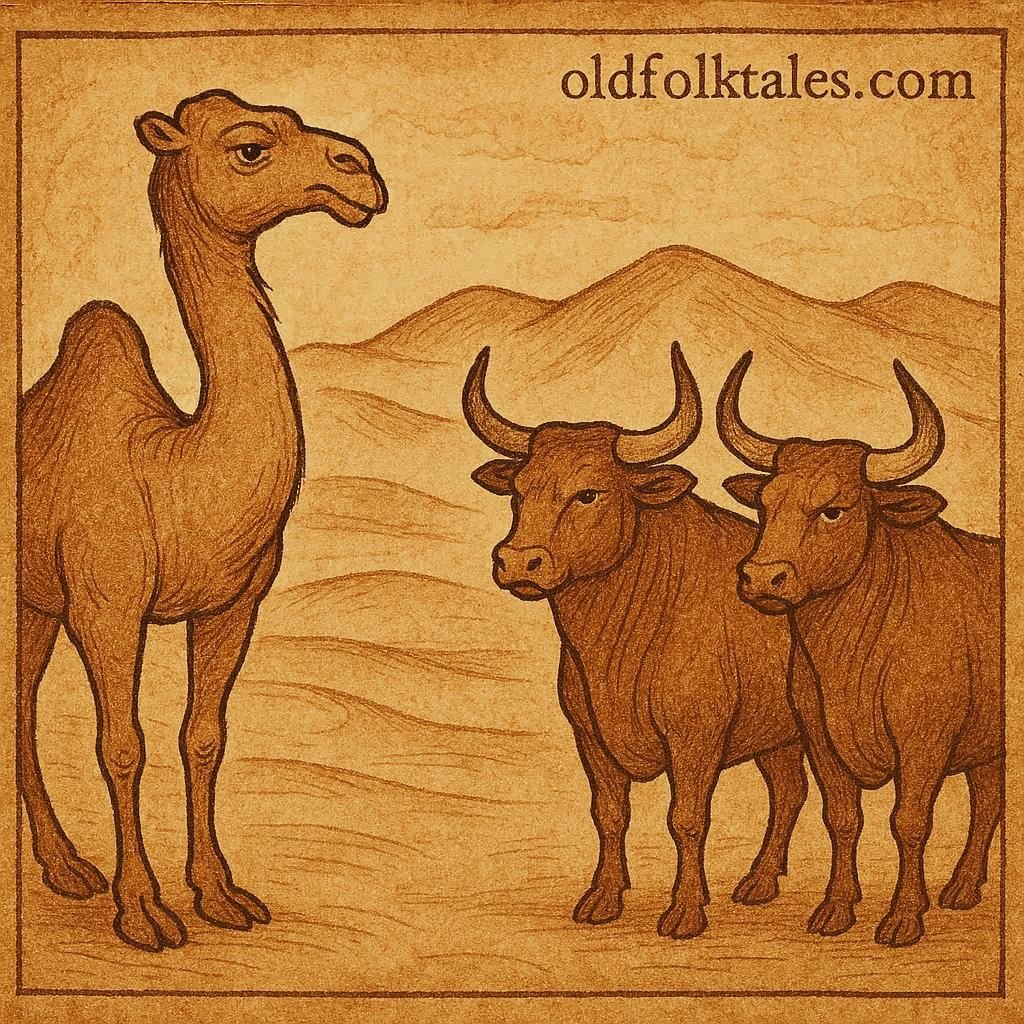
In the dry winds of the Moroccan desert, where the dunes rolled endlessly like waves of golden seas and the horizon blurred between earth and sky, there lived a camel whose pride was as tall as his long neck. The camel was strong, with legs made to wander across burning sands and a back broad enough to carry loads heavier than any other beast could bear. His thick hide protected him from the sun, and his endurance allowed him to go for days without water. To all who saw him, he was already a marvel of creation. But the camel did not see himself that way. His eyes often lingered on the oxen and the bulls, whose sharp horns gleamed in the sunlight, curling like weapons and marking them as animals of strength and authority. Even the goats, with their pointed horns, seemed to the camel to walk with greater dignity than he. And so envy crept into his heart.
“Look at them,” the camel muttered to himself as he gazed across the plains where the herds grazed. “They carry horns on their heads and all creatures respect them. I, though taller and stronger, appear bare and powerless without horns. How can I command fear? How can I be honored if I lack what they have?” His envy deepened day by day until it consumed him. One dawn, when the desert was still cool and the stars were fading into the pale light of morning, the camel lifted his face to the sky and spoke his desire aloud.
Fascinated by this tale? Discover more North African folktales
“O Lord of all creation,” he prayed, “you have made me strong and enduring, yet I stand hornless among the beasts. Give me horns like the bulls so that I may look mighty and feared. Then no creature will laugh at me, and all will know my greatness.”
The desert fell silent, and then a voice came from the heavens, steady and calm. “Camel, I have given you blessings that none other possess. You walk across endless sand where no ox can go. You carry burdens across lands where no goat can endure. You drink once and survive many days, while others thirst. Yet you desire what is not meant for you. Be content, for envy will rob you of what you already hold.”
But the camel was not satisfied. His pride burned brighter than the sun overhead. “I do not wish only to endure,” he cried. “I want horns upon my head so I may be feared as the bulls are feared. Grant me this, Lord, and I will be complete.”
The sky darkened as if with warning. The voice returned, no longer patient but stern. “Ungrateful one, you cannot see the wealth of what you are. Since you wish for more than was given, I will not grant you horns. Instead, I will take away a part of what you already have.”
At that instant, a sharp pain tore through the camel’s head. He shook himself, groaning, and hurried to the nearest pool of water to see his reflection. There, in the shimmering surface, he saw what had been taken: his long ears had been cut short. Where once they had swayed proudly in the desert wind, now they stood half-formed, forever marked.
The camel bellowed in despair, his heart heavy with shame. “What have I done?” he cried. “I sought horns to make me proud, and instead I have lost what was mine.” From that day on, camels bore their shortened ears as a reminder of their ancestor’s folly. And though they still walked tall, bearing burdens with unmatched strength, they no longer dreamed of horns.
The other animals looked upon the camel with pity and caution. The oxen said, “He wanted what was not his and lost what he had.” The goats whispered, “Let his ears remind us all that envy leads to loss.” And the camel lowered his head, carrying his shame as he carried his loads, a living lesson written into his very body.
Thus, when travelers cross the deserts of Morocco and see camels with their half ears and bare foreheads, they tell the old story again: the one who begged for horns but lost instead. It is a tale of pride, greed, and the wisdom of accepting one’s gifts without envy.
Moral Lesson
The story of the camel teaches that greed and envy blind us to our blessings. In seeking what others have, we risk losing the gifts already entrusted to us. True wisdom lies in gratitude, for pride and discontent often end in regret.
Knowledge Check:
What special gifts did the camel already have before asking for horns?
Answer: The camel had endurance to survive without water, strength to carry heavy loads, and the ability to walk across deserts where no other animals could endure.Why did the camel envy the oxen and bulls?
Answer: He envied them because they had horns, which he believed made them look powerful, respected, and feared.How did God warn the camel before punishing him?
Answer: God reminded the camel of his unique blessings and cautioned him that envy would cause loss, but the camel ignored the warning.What punishment did the camel receive for his greed?
Answer: Instead of being given horns, the camel lost part of his long ears, leaving camels with shortened ears forever.What lesson did the other animals learn from the camel’s fate?
Answer: They learned that desiring what does not belong to you can lead to losing what you already have, and they repeated this as a warning about envy.What is the central moral of The Camel Who Asked for Horns?
Answer: The moral is that greed and envy can strip away blessings, while gratitude brings peace and contentment.
Source: Amazigh folktale, Morocco. Recorded in Hans Stumme, Märchen der Berbern (1895).