Long ago, in the lands of the Zande people of South Sudan, there flowed a river unlike any other. By day, it glittered under the sun, a place where women fetched water and children played at its banks. But by night, when the moon painted the waters silver, the river sang. The elders called it Nzinga, the Spirit River, for they believed powerful beings lived beneath its depths. Some said they had seen glowing eyes beneath the surface. Others swore they had heard voices whispering in the current.
The people of the nearby village respected the river, offering millet and tobacco leaves at its banks during full moons. For generations, no one dared cross without showing reverence. But there came a time when the village had a new chief, a man named Gbudwe. He was strong and fearless, yet prideful. He believed the Spirit River was nothing but flowing water, and he mocked those who feared it.
One season, the rains failed, and the crops withered in the fields. The people grew hungry, and their voices trembled with worry. “Chief Gbudwe,” they pleaded, “we must go to Nzinga. We must offer gifts and ask the spirits for rain.”
But the chief only laughed. “Do you expect me, your leader, to bow before water? No river spirit feeds us. We will plant again, and the rain will come on its own.” His words silenced the council, but unease stirred in their hearts.
One evening, an old diviner, Nyakang, stood before the chief. His face was painted with ash, and his staff rattled with charms. “Gbudwe,” Nyakang said, “I dreamed of the river last night. The spirits called your name. They say if you come with humility, rain will return. But if you mock them again, the land will suffer more.”
Gbudwe narrowed his eyes. “Old man, your dreams are smoke. I will show my people there is no power in that river.”
So, on the night of the full moon, the chief gathered the villagers by Nzinga. The drums stopped, and the night grew still. Instead of millet or tobacco, Gbudwe lifted a spear. “If spirits live here, let them face me. I am Gbudwe, son of hunters, stronger than any river ghost!”
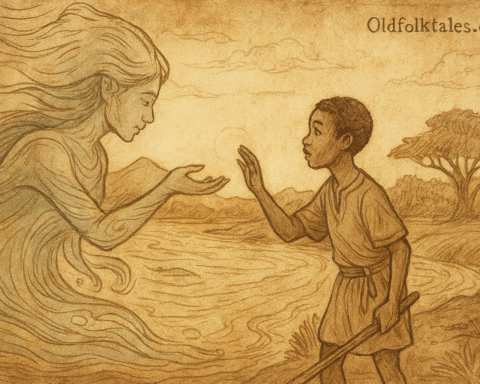
The water rippled though no wind blew. The people trembled, and some whispered prayers. Suddenly, the river rose, not with waves, but with mist. Out of it appeared a woman cloaked in light, her eyes like dark pools. She spoke, her voice deep as the current. “Chief Gbudwe, why do you mock what you do not understand?”
Gbudwe held his spear high. “Because I fear nothing!”
The spirit’s gaze hardened. “Then you will learn what fear is.” She raised her hand, and the river surged. The ground shook, and the spear slipped from Gbudwe’s grasp. Before he could speak, the waters wrapped around him, pulling him to the river’s heart. The villagers cried out, but no one dared step forward.
For three nights, Gbudwe was gone. The village mourned, and the fields grew drier. On the fourth night, as the moon rose, the river calmed. From its center, Gbudwe stumbled onto the bank, his clothes heavy with water, his face pale. He knelt before the people, no longer proud. “I have seen the river’s heart,” he whispered. “The spirits live, and they showed me visions. I saw our ancestors watching, and I saw fields blooming with rain, but only if we live with respect.”
That night, Gbudwe himself laid offerings at the river: millet, tobacco, and his finest beads. He spoke with humility, asking for forgiveness. The next morning, dark clouds gathered, and rain fell upon the thirsty land. The people rejoiced, and the chief bowed his head.
From then on, Gbudwe became a wiser leader. He listened to the elders, respected the diviners, and never mocked the unseen again. The Spirit River remained sacred, a reminder that arrogance blinds even the strongest, while humility opens the way to blessings.
Moral Lesson:
The Chief and the Spirit River teaches that pride leads to downfall, but humility restores balance. Knowledge and power are not found in mocking tradition, but in respecting it. The story reminds us that leaders must walk with reverence toward the forces beyond their control, for true strength lies in humility before the unseen.
Knowledge Check
- What lesson does The Chief and the Spirit River teach about humility?
The story shows that humility before spiritual forces brings blessings, while arrogance leads to hardship and loss. - Why did the Zande villagers respect the Spirit River in the folktale?
They believed powerful spirits lived in the river, and offerings were made to ensure balance, rain, and prosperity. - What happened when Chief Gbudwe mocked the Spirit River?
The spirit appeared, pulled him into the water for three nights, and taught him the dangers of pride. - How did the rain return to the Zande village after the drought?
The rain returned only after Gbudwe humbled himself, offered gifts to the Spirit River, and asked for forgiveness. - What role did the diviner Nyakang play in The Chief and the Spirit River?
Nyakang warned the chief of his dream, advising him to approach the river with humility, though Gbudwe ignored him at first. - What cultural values of the Zande people are reflected in this folktale?
The tale reflects Zande values of respect for spirits, humility in leadership, reverence for tradition, and harmony with unseen forces.
Cultural Origin: Zande folktales, South Sudan