The story begins in the household of a chief, a man of authority and power. Among his wives was one who became pregnant. One day, she stepped into the backyard to relieve herself, and as she squatted beneath the blazing sky, a hawk flew overhead, circling and crying out with piercing calls.
Startled, the woman raised her head and asked, “My hawk, why do you cry out at me so noisily?”
The hawk answered in words that carried a heavy truth:
“What lies in your belly is greater than you; greater than your master; greater than your husband; greater than his master.”
Confused and unsettled, the woman carried this message back to the chief. Instead of wonder or joy, the chief reacted with suspicion and pride. His voice was sharp and final:
“There shall not be in my compound what is greater than I. Gather your clothes and your baggage. Leave at once. I divorce you.”
Banished and brokenhearted, the woman departed. She walked under the merciless heat of the sun until her body could endure no more. In the wilderness, surrounded by thorny bushes and red dust, she gave birth to her child. But with the birth came wonders. Food appeared where none had been. Slaves, money, kola nuts, and all manner of wealth manifested at her side. Slowly, a little village began to grow around her and her miraculous child.
The Boy’s Power Revealed
Time passed, and one day a hunter from the chief’s town stumbled upon the village. He was astonished to see the woman, her wealth, and her beautiful children. When he returned, he reported everything to the chief.
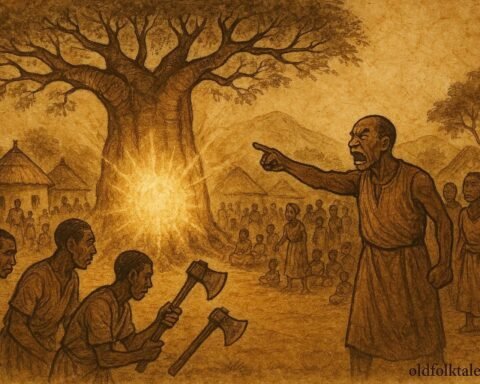
The chief, still ruled by his pride, sent one hundred horsemen to seize the children and bring them back to him.
But the miraculous boy, already full of strength beyond his years, saw the dust of their approach rising against the horizon. He began to sing a refrain in the Mandinka tongue, his song echoing across the bush. Then, with swift and terrifying might, he struck the horsemen one by one. He broke the legs of their horses, blinded their eyes, and crippled the riders. Only one man was spared. The boy told him, “Go back and warn your chief. Tell him we are not ordinary.”
READ THIS: The Hunter and His Dogs
The Chief Humbled
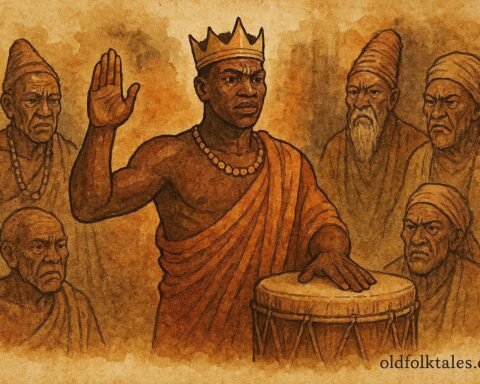
The humbled messenger returned, and the chief, troubled but determined, decided to come himself with his attendants. As they drew near the village, the boy once again sang. His song carried the same unshakable power, and the earth seemed to tremble with it.
This time, however, the chief spoke differently. His voice was no longer filled with arrogance but with humility:
“Father, I ask your pardon. We come in peace.”
The boy welcomed them, and together they shared food and kola. Then, in a call-and-response performance, the boy recounted his story. His voice was steady and commanding:
“Father, move here; I move here.”
Step by step, he repeated the hawk’s prophecy, the expulsion from the compound, his mother’s suffering in the bush, and the miracles that followed. Finally, he declared:
“We are greater than you; greater than your superior; greater than my mother; greater than her superior.”
Shame washed over the chief as the truth settled upon him. His body began to change, twisting and contorting, transforming into a monkey under the weight of his disgrace. But the boy stopped him, saying firmly:
“No, father. Do not change.”
Instead, the boy bestowed honor upon him:
“The village is yours, for you are the chief, and we are your children.”
Thus, harmony was restored.
Ending formula: A tale of lies—there it is going; there it is coming back.
Moral Lesson
This Mandinka folktale teaches that pride and arrogance blind us to truth, but humility opens the door to reconciliation. The story also reminds us that destiny cannot be denied; what is meant to be will always find its way, no matter the obstacles.
Knowledge Check
Q1: Who is the main character in The Chief’s Divorced Wife folktale?
A1: The main character is the chief’s miraculous son, born after his mother was expelled.
Q2: What prophecy did the hawk deliver to the chief’s wife?
A2: The hawk said her unborn child would be greater than her, her husband, and even the chief’s master.
Q3: Why did the chief divorce his pregnant wife?
A3: Out of pride, he rejected the idea that anything greater than himself could exist in his household.
Q4: What happened when the boy faced the chief’s horsemen?
A4: The boy crippled the horses and blinded the men, sparing only one to carry a warning back to the chief.
Q5: What lesson does the Mandinka folktale teach about pride and humility?
A5: The tale warns against pride, showing that humility and acceptance of destiny bring peace and reconciliation.
Q6: What is the cultural origin of The Chief’s Divorced Wife?
A6: The story originates from Mandinka folklore, rooted in West African oral tradition.
Source: Ethiopian folktale