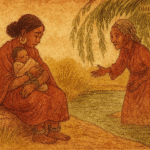
In a lush village tucked between golden hills and tangled forest in present-day Burkina Faso, lived a girl named Sira. She was the youngest of three daughters born to a humble weaver and his wife. Unlike her older sisters, who were known for their beauty and sweet songs, Sira was remembered for her quick tongue, clever mind, and fierce loyalty to truth.
She could weave baskets tighter than a drum, and her laughter made the birds stop to listen. But she was also curious—so curious that elders would sometimes shake their heads when she asked why the moon didn’t fall from the sky or how baobab trees held secrets in their trunks.
The people of the village lived well, except for one shadow that returned every year: the time of the Choosing.
Each season, when the first rains fell late and thunder growled across the skies, the villagers would leave a gift of fruit and cloth at the forest’s edge. It was a pact—an old one—between the people and the Leopard King, a spirit said to rule the deep forest. If they failed to leave tribute, or if the Leopard King was displeased, he would come and take one maiden as his bride. That girl would vanish into the forest, never seen again.
Most said it was a curse passed down from the days of the ancestors. Others believed it was a legend used to keep girls obedient and villagers humble. But whatever it was, no one dared to test it.
That year, the rains delayed longer than ever. The crops curled in thirst, and water in the village well turned brown. Fear gripped the people’s hearts, and the chief called for the Choosing.
The names of every maiden were placed into a woven calabash. The village elder stirred them with a feather. Eyes closed, he reached in.
“Sira.”
Gasps spread like wind through tall grass. Sira stood tall, though her hands trembled.
Her mother wailed. “No, not my child!”
But Sira raised her hand gently. “If this is what fate has chosen, then I will go. But let it be known—I will return. And I will not return empty-handed.”
No one had ever dared say such a thing.
Her father embraced her. Her sisters gave her a pouch of dried okra and a smooth stone for luck. Then, Sira wrapped her head with a red cloth, tucked her sandals tight, and walked toward the forest, alone.
The forest was quiet. Too quiet. Even the insects seemed to pause their songs as Sira walked under the arch of vines and leaves.
Then she heard him. His voice came from all around.
“You walk with bold steps, girl.”
Sira did not stop. “I do not fear shadows. Show yourself, Leopard King.”
And he did.
From behind a wall of mist and fern, he emerged—a creature like no other. His eyes glowed amber, and though he stood like a man, his skin was marked with black rosettes. His long fingers held no weapons. He did not need them. His presence alone could silence thunder.
“You are not like the others,” he said, circling her. “They cried. You question.”
“I will cry if you give me a reason,” she replied. “But first, I want to know—why take us? Why make us disappear?”
He paused. His smile was sorrowful. “Because I am bound. This forest is mine, but it withers without a bond. A bride each year keeps my power alive. Without her, the trees rot, the animals fall ill, and the land dies.”
“And what of the brides?” Sira asked. “Do they live in joy, or are they sacrificed for your survival?”
He said nothing.
“I thought so,” she whispered.
He led her to his palace—a strange realm between dream and waking, where roots formed walls and vines shimmered like gold thread. It was beautiful and tragic. The silence felt heavy.
Days passed. Sira was given fine robes, but she wore her village wrap. She was offered golden bowls of food, but she preferred to cook yam pottage herself. The Leopard King watched with curiosity. Never had he taken a bride who dared to be herself.
One evening, beneath the moonlight, Sira saw a figure pass through the trees—another girl, pale and dazed.
“Who are you?” Sira called.
The girl looked back with empty eyes and faded into the forest.
That night, Sira asked the Leopard King, “Where are the other girls?”
He did not lie. “They live in the woods now. Lost between two worlds. The bond drains them slowly. They become spirits who forget their names.”
Sira stood. “Then I will break this curse. I will not fade into leaves.”
He sighed. “Try, if you wish. But none before you succeeded.”
Sira spent her nights studying the stars and days learning the language of the forest. She listened to birds, spoke to monkeys, and even followed a clever ground squirrel who led her to a grove of whispering trees.
There, beneath the oldest baobab, she found it—a stone, buried halfway in earth, pulsing faintly like a heartbeat.
She touched it and saw visions: of the Leopard King once a man, betrayed by a jealous rival shaman who cursed him to become a beast and steal brides for power.
Tears filled her eyes. “He is a prisoner, too.”
Just then, the Leopard King appeared. “You found it.”
“I did,” she said. “But I will not destroy you. I will release you.”
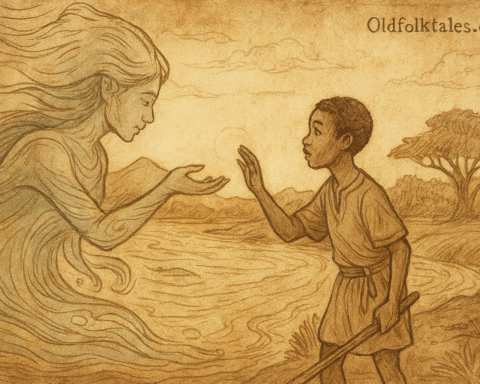
She pressed both hands to the stone and whispered words of compassion: “Return not as beast, but as man. Let no bride be stolen again.”
A great wind tore through the forest. The stone cracked.
The Leopard King cried out—but not in pain. His fur melted away. His face softened. He stood as a tall, dark-skinned man with eyes full of sorrow and peace.
Sira collapsed to her knees, exhausted.
He caught her. “You’ve done what no one dared.”
Together, they returned to the village. The people could not believe their eyes.
Some screamed. Others wept.
The elder declared, “Let this curse be ended. No more shall we give daughters to the forest. This man is no longer a king of beasts, but a guardian of peace.”
Sira and the man, once the Leopard King, remained in the village as protectors of the land. They taught the people to live with balance—between forest and field, heart and mind.
And under their care, the rains returned. The crops grew. The forest bloomed.
But more than anything, girls grew up knowing that courage was not just about strength—but about daring to ask questions, and daring to show compassion, even to the most feared.
✧ Commentary
This folktale from Burkina Faso shows how courage, intelligence, and compassion can defeat fear and transform even the most ancient curses. Sira represents a new kind of heroine: bold, questioning, and unafraid to face danger with both strength and empathy. The Leopard King is a symbol of misunderstood power—dangerous when unchecked, but capable of redemption when met with understanding.
✧ Moral
Compassion and courage together can break even the oldest chains.
✧ Questions & Answers
1. Q: Why was Sira chosen by the village? A: Because her name was drawn in the Choosing, a tradition to appease the Leopard King.
2. Q: How did Sira respond to being chosen? A: She accepted with bravery, vowing to return and not become a victim.
3. Q: What did Sira discover about the Leopard King’s curse? A: It was tied to a magic stone and an old betrayal that turned him into a beast.
4. Q: How did Sira break the curse? A: By finding the stone and using compassion instead of violence to release the curse.
5. Q: What change came to the village after Sira’s return? A: The curse ended, no more girls were taken, and the land thrived in peace.