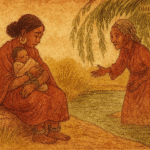
Long ago, in a small village near the great river, there lived a woman named Amina. She was known far and wide not only for her kindness but for her sharp mind. Villagers often came to her with problems, for Amina’s wisdom was like a calm river—deep and steady.
One season, the rains were late, and the crops were failing. To make matters worse, a mighty elephant had begun destroying fields and frightening the villagers. No one dared to face the giant, for he was fierce and powerful.
The village elders called a meeting. “We must drive the elephant away,” they said. “But who is brave enough?”
None answered. Fear held their tongues.
Then Amina stood and spoke softly, “I will go, but not with weapons or force. I will use my wits.”
The elders hesitated but agreed.
Amina walked to the edge of the forest where the elephant was last seen. She carried a small, brightly colored pot filled with honey.
She waited patiently. When the elephant appeared, his great trunk swinging and eyes gleaming, she did not run.
Instead, she spoke gently. “Mighty Elephant, why do you trouble us?”
The elephant stopped, surprised that a human spoke without fear.
“I am hungry,” he rumbled. “This forest offers little, and the crops taste sweet.”
Amina nodded. “I understand your hunger. But destroying our crops leaves us with nothing to eat. What if I bring you something sweeter and more plentiful?”
The elephant’s eyes twinkled. “If you can do this, I will leave your fields unharmed.”
Amina smiled. “Wait here.”
She ran back to the village and gathered pots of honey, fruits, and grains. She returned and placed them before the elephant.
The elephant tasted the honey, his great mouth filling with delight. “This is better than any crop I have eaten!” he trumpeted.
From that day on, the elephant came peacefully to the village edge, where the people left food offerings. In return, he guarded the village from other dangers.
The rains came, and the crops grew tall and strong. The village prospered once more.
And Amina? She was remembered as the woman whose courage and cleverness saved her people.
✧ Commentary
This Gambian folktale celebrates wisdom over strength and the power of peaceful solutions. Amina’s bravery lies not in fighting but in understanding and negotiation, a lesson deeply rooted in many West African traditions. The story teaches that empathy and intelligence can solve even the most daunting problems.
✧ Moral
True courage is knowing when to use your mind instead of your might.
✧ Questions & Answers
1. Q: Why did Amina decide to face the elephant without weapons? A: She believed wisdom and kindness could solve the problem better than force.
2. Q: What did the elephant want? A: He was hungry and destroying crops because food was scarce.
3. Q: How did Amina convince the elephant to stop destroying the fields? A: She offered him sweeter, plentiful food like honey and fruits.
4. Q: What agreement did Amina make with the elephant? A: If he left their crops alone, she would bring him food.
5. Q: What does this story teach us about problem-solving? A: That empathy, understanding, and cleverness can overcome fear and conflict.