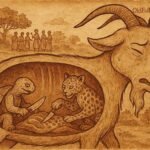
In the deep forests of Equatorial Guinea, where daylight filters gently through thick green canopies and night hums with the sound of unseen wings, there lived a creature called Ndemi, the Bat. Ndemi dwelled quietly with his mother, Vyadu the Antelope, in a small clearing away from other animals. Their days passed peacefully, until fate carried sorrow to their home.
One morning, Vyadu fell gravely ill. Her eyes dimmed, her breathing grew heavy, and her body weakened. In despair, Ndemi called for Antelope, a trusted elder among the beasts. “Please,” Ndemi begged, “make medicine for my mother.” Antelope studied Vyadu carefully, his wise eyes searching for answers. Finally, he sighed.
“There is only one who can heal her,” he said. “Joba, the Sun himself. No medicine but his can save her.” With that, Antelope returned to his home, leaving Ndemi filled with both hope and fear.
The very next morning, Ndemi set out to find Joba. But, true to his nature, he rose late, only leaving at seven. By the time he met Joba on the path at eleven, the Sun was already blazing in the sky. Ndemi pleaded, “Please, come and make medicine for my mother.”
Joba shook his radiant head. “I do not stop once I have set out. If you wish me to help, meet me in my house at dawn. Then I will listen.” Ndemi returned home with heavy wings.
READ THIS: Why Dog Lost His Human Speech: A Folktale from Equatorial Guinea
The following morning, he again left late, and again he met Joba already far on his daily journey. And once more, Joba refused, reminding Ndemi, “If you seek me, rise earlier.”
For five more days, the same misfortune repeated. Each time, Ndemi’s lateness cost him the chance to bring Joba’s healing power to his mother. Finally, on the seventh day, Vyadu breathed her last. Ndemi’s heart broke, and he cried out, “It is Joba who killed my mother! Had he come to us, she would have lived!”
Grief spread across the land. From dawn until the next day’s morning, beasts gathered for Kwedi, the mourning of the dead. They wailed and lamented until their voices grew hoarse. At last, Ndemi declared, “Let us take her to the grave.” He called on the beasts to help him carry Vyadu’s body. Together, they lifted her gently and walked to the burial place.
But when they reached the grave, the beasts paused. “Before burial, we must look upon the face,” they said. They opened the coffin and studied Vyadu carefully. Then the beasts shook their heads.
“This one does not belong to us. True, she has teeth like ours, and a head like ours. But she also has wings. That makes her a bird. Call the birds instead.” And they walked away, leaving Ndemi bewildered.
So Ndemi called the birds. From the skies came pelicans, eagles, herons, and countless others, gathering in great numbers. “Here is my mother,” Ndemi said. “She is like you, with wings.”
The birds studied Vyadu with keen eyes. “Yes, she has wings,” they agreed. “But look at those teeth. We have no teeth. This one is not ours.” And with that, they too stepped aside.
As the debate dragged on, the driver ants, Hako, arrived. Small but relentless, they swarmed over the body. By the time Ndemi turned back, they had claimed what was left. His mother’s body was gone, consumed, and no burial was possible.
The beasts and birds left, muttering, “You should not have delayed. If you had buried her sooner, this would not have happened.” Ndemi stood alone, his heart crushed.
In his sorrow, he swore, “This is the fault of Joba. Had he given medicine, my mother would still be alive. I, Ndemi, shall never look upon Joba again. When he rises, I will hide. I will never meet his gaze.” From that day forward, Ndemi flew only by night, crying in the darkness for his mother, avoiding the daylight that reminded him of Joba.
And so, even now, the bat is neither bird nor beast, shunned by both, living in twilight with a voice full of grief.
Moral Lesson
This tale reminds us of the cost of delay and negligence. Ndemi’s tragedy teaches that opportunities, once missed, cannot always be regained. It also reflects on identity, how belonging can be questioned when one carries traits of many worlds. In mourning and in exclusion, the bat found its fate, showing us that timeliness, responsibility, and acceptance are essential to life and community.
Knowledge Check
Why did Ndemi seek out Joba the Sun?
Because only Joba could make medicine strong enough to heal his mother.
What mistake did Ndemi repeat for several days?
He always started late, meeting Joba on the road instead of at his house at dawn.
Why did the beasts reject Vyadu’s body?
They said her wings made her resemble a bird, not a beast.
Why did the birds also refuse to claim Vyadu?
Because she had teeth, unlike any bird.
What role did the ants play in the story?
They consumed Vyadu’s body before it could be buried.
What cultural lesson does the story highlight?
The importance of timeliness, responsibility, and community identity in Equatorial Guinean tradition.
Source: Equatorial Guinean Folktale