
In the time when birds ruled their own kingdoms and settled disputes through war and cunning, two powerful sultans governed their respective peoples. Koongooroo, the proud sultan of the crows, commanded his black-feathered subjects with authority, while Mwayway, the sultan of the kites, led his own fierce warriors with equal confidence. These two leaders were destined for conflict, and it would take more than brute strength to determine the victor.
One morning, Koongooroo sat in his council chamber and composed a brief but commanding letter to Mwayway. The message was simple and direct: “I want you folks to be my soldiers.” He dispatched this letter with one of his swiftest messengers, expecting that the kites would recognize the wisdom of serving under his rule.
But Mwayway was not a sultan who bent easily to another’s will. When he received Koongooroo’s presumptuous demand, he read it aloud to his advisors, and they all laughed at the audacity. Without hesitation, Mwayway penned an equally brief response: “I should say not.”
Click here to discover more legendary tales from West Africa
When this curt refusal reached Koongooroo, his pride was wounded. How dare the sultan of the kites dismiss his command so casually! Determined to force Mwayway’s submission, he sent another message, this one carrying a threat: “If you refuse to obey me, I’ll make war upon you.”
Far from being intimidated, Mwayway welcomed the challenge. His reply came swiftly: “That suits me perfectly. Let us fight, and if you beat us, we will obey you. But if we are victors, you shall be our servants.”
And so the stage was set for battle.
The two bird armies assembled on a great field between their territories. The sky darkened with wings as crows and kites took to the air, their war cries echoing across the land. Talons clashed, beaks struck, and feathers fell like black and brown rain. The battle raged with fierce intensity, each side fighting with all their strength and cunning.
But as the sun climbed higher in the sky, it became painfully clear that the crows were losing. The kites were stronger fighters, more agile in the air, and their talons struck with devastating precision. Crow after crow fell from the sky, and those still flying were exhausted and wounded. Koongooroo watched in growing desperation as his forces dwindled.
It was then that Jeeooosee, an old and weathered crow known for his practical wisdom, flew close to his sultan and croaked urgently, “We must flee! If we stay here, we will all be killed!”
The suggestion cut against Koongooroo’s pride, but he was wise enough to recognize truth when he heard it. “Retreat!” he commanded, and the crows abandoned the battlefield, leaving their homes behind. They flew far away to a distant territory where they established a new settlement, nursing their wounds and their damaged pride.
The victorious kites, led by Sultan Mwayway, entered Crowtown with triumphant cries. Finding it deserted, they claimed it as their own, settling into the abandoned nests and perches. They had won the war and gained new territory—or so they believed.
But Koongooroo was not finished. In his new settlement, he called his people together for an important council meeting. The crows gathered anxiously, wondering what their sultan would say. When silence fell, Koongooroo stood tall and addressed them with unwavering determination.
“My people, listen carefully to what I command you, and all will be well,” he began, his voice steady and strong. “I need you to pluck out some of my feathers and throw me into the town of the kites. Then return here and wait until you hear from me.”
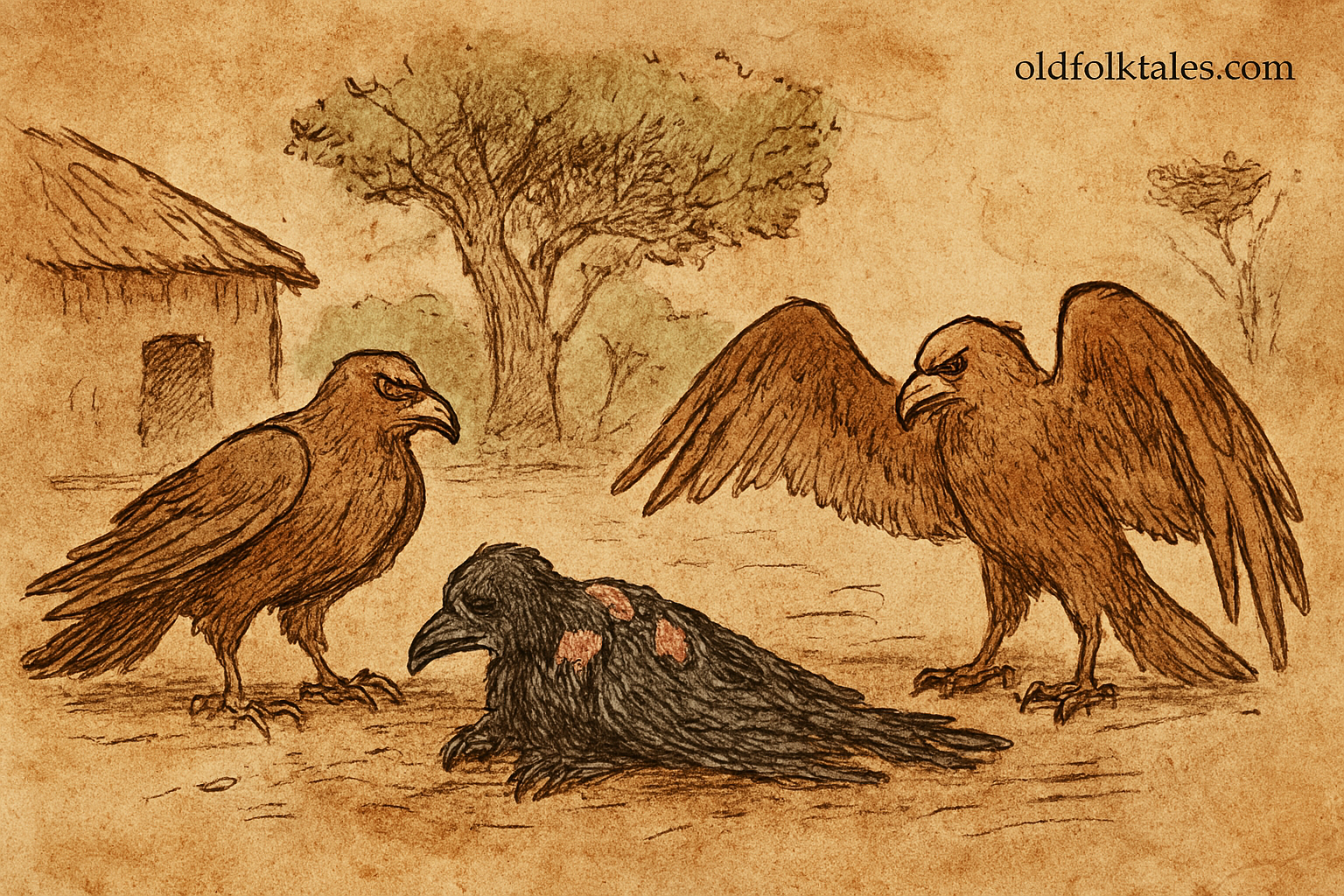
The crows exchanged uncertain glances. The request seemed strange, even mad, but they had learned to trust their sultan’s judgment. Without argument or questioning, they did as commanded, pulling feathers from Koongooroo’s body until he looked battered and bedraggled. Then they carried him to the outskirts of their old town and left him lying in the street.
Koongooroo lay motionless in the dust, looking every bit the defeated and abandoned bird. Before long, several kites on patrol spotted him and approached with suspicion and hostility.
“What are you doing here in our town?” they demanded, their voices sharp with threat.
Koongooroo let out a pitiful moan. “My own companions have beaten me and cast me out,” he said weakly. “I advised them to obey Mwayway, your rightful sultan, and for speaking this truth, they attacked me and drove me from their settlement.”
The kites were intrigued by this unexpected turn of events. They lifted the battered crow and brought him before Sultan Mwayway, explaining how they had found him and the remarkable story he had told.
“Repeat your statement,” Mwayway commanded, studying the pathetic creature before him.
Koongooroo told his tale again, adding with seeming conviction, “Much as I have suffered for my beliefs, I still hold firmly to my opinion that you, great Mwayway, are my rightful sultan.”
These words pleased Mwayway immensely. Here was a crow with sense enough to recognize superior leadership! “You have more wisdom than all the rest of your tribe put together,” the sultan declared. “You may stay here and live with us.”
Koongooroo expressed profound gratitude and settled into life among the kites, playing the role of the humble refugee perfectly.
Days passed, and Koongooroo became increasingly accepted by his former enemies. One day, his kite neighbors invited him to accompany them to their place of worship. When they returned home after the service, they asked eagerly, “Tell us, Koongooroo, who has the best kind of religion—the kites or the crows?”
The crafty crow didn’t hesitate. “Oh, the kites, by long odds!” he exclaimed with great enthusiasm. “There is simply no comparison!”
This answer delighted the kites beyond measure. They congratulated themselves on recognizing a bird of remarkable discernment and good taste. Koongooroo’s reputation among them grew even stronger.
Nearly a week passed in this manner, with Koongooroo carefully observing the kites’ routines and customs. Then one night, when darkness covered the land and all the kites were sleeping, he slipped away silently. He flew through the darkness to the crow settlement and immediately summoned his people to council.
“Tomorrow,” he announced, his voice filled with quiet intensity, “is the great annual religious festival of the kites. Every single one of them will go to church in the morning. I need you to gather wood and fire tonight, and wait near our old town until I call you. When I give the signal, come quickly and set fire to the church.”
The crows understood immediately. Their sultan had devised a plan for revenge, and they would carry it out without mercy. Koongooroo hurried back to Mwayway’s town before his absence could be noticed.
Throughout that night, the crows worked with silent determination. By dawn, they had gathered an abundance of dry wood and kindling, along with torches and fire-starting materials. They positioned themselves in hiding places near their former town, waiting for their sultan’s signal.
Morning arrived, and as Koongooroo had predicted, every kite in the town prepared to attend the special religious festival. The entire community would be gathering in their church—every man, woman, and child. The kites called at Koongooroo’s dwelling to invite him along.
They found him lying down, groaning pitifully. “Why, Koongooroo!” they exclaimed with surprise and concern. “Are you not coming to church today?”
“Oh, how I wish I could,” he moaned, clutching his stomach. “But I have such terrible pains in my belly that I cannot move even a feather!” He groaned dramatically, his face twisted in apparent agony.
“Poor fellow!” the kites said sympathetically. “You will be more comfortable resting in bed. We will pray for your swift recovery.” And with expressions of genuine concern, they left him alone and went on their way to church.
The moment every kite had disappeared from view, Koongooroo leaped up with sudden energy. He flew swiftly to where his soldiers waited in hiding and cried out urgently, “Come on! They’re all in the church—every last one of them!”
The crows moved quickly but quietly, creeping toward the church where all their enemies sat gathered in worship, completely unaware of the danger closing in around them. Some crows piled the dry wood high against the doors and windows, while others stood ready with fire.
At Koongooroo’s signal, they applied flame to the kindling. The wood caught readily, crackling and smoking as the fire grew. The flames burned with fierce intensity, climbing higher and higher, fed by the dry wood and fanned by the morning breeze.
Inside the church, the kites continued their worship, singing and praying, until smoke began seeping through the cracks in the walls. At first, they thought little of it, but soon the smoke grew thick and choking. Tongues of flame shot through the gaps in the wooden structure, and panic erupted.
The kites rushed toward the doors, only to find them blocked by burning wood. They tried to escape through the windows, but these too were ringed with fire. Some managed to break through, but their wings were singed and smoking, rendering them unable to fly. They stumbled on the ground, easy prey for the waiting crows.
The greater part of the kites, however, were suffocated by the thick smoke or burned to death as the church became an inferno. Among those who perished was Sultan Mwayway himself, who died alongside his people in the flames he never saw coming.
When the fire finally burned itself out and only ashes remained, Koongooroo and his crows returned to their old town, victorious at last. They had reclaimed what was rightfully theirs through cunning rather than strength, through patience rather than immediate force.
The Moral of the Story
This powerful tale warns us that deception, though sometimes effective in achieving victory, carries a heavy moral weight especially when it results in the destruction of an entire community. While Koongooroo’s intelligence and strategic thinking allowed him to overcome a militarily superior enemy, his method was ruthless and unforgiving. The story teaches that winning through trickery may bring practical success, but it also reveals the darker side of revenge and the devastating consequences of war. It reminds us that leaders bear responsibility for the lives lost in conflicts they initiate, and that cleverness without mercy can lead to terrible tragedies.
Knowledge Check
Q1: Who is Koongooroo and what role does he play in this Ivorian folktale? A: Koongooroo is the sultan (leader) of the crows who serves as the central character in this Ivorian tale. He plays the role of a cunning strategist who uses deception and patience to defeat a militarily superior enemy. After losing a battle to the kites, he infiltrates their society by pretending to be a loyal supporter, then orchestrates their destruction through a carefully planned act of revenge.
Q2: Why do the crows lose the initial battle against the kites? A: The crows lose the initial battle because the kites are stronger, more agile fighters with superior combat abilities. As the battle progresses, it becomes clear that the crows are being badly beaten and face complete annihilation if they continue fighting. Old Jeeooosee wisely suggests retreat, which saves the crows from total destruction and allows them to live to fight another day.
Q3: What strategy does Koongooroo use to gain the kites’ trust? A: Koongooroo uses a masterful deception strategy. He has his own people pluck out his feathers to make him appear beaten and abandoned, then lies to the kites, claiming his fellow crows attacked him for suggesting they should serve Sultan Mwayway. This false story of loyalty to the kites’ leader gains him sympathy and trust, allowing him to live among them while planning their destruction.
Q4: What is the significance of the religious festival in the story? A: The religious festival serves as the crucial element in Koongooroo’s revenge plan. He learns that during their great annual festival, all kites attend church together, leaving no one behind to guard their town. This knowledge allows him to trap the entire kite population in one place, making them vulnerable to his attack. The use of a religious gathering for destruction adds a particularly dark dimension to his revenge.
Q5: What does this Ivorian tale teach about leadership and warfare? A: This tale presents complex lessons about leadership: it shows that intelligence can overcome superior force, that strategic thinking and patience are powerful weapons, and that effective leaders must sometimes make difficult decisions (like retreating) to save their people. However, it also reveals the brutal nature of revenge and the moral costs of using deception to achieve total victory, raising questions about the ethics of warfare and the responsibilities of leaders.
Q6: Why do kites fly away from crows “from that day to this”? A: The ending explains the observed behavior of these birds in nature kites avoid crows because of the ancient conflict described in the story. This etiological element (explaining natural phenomena through folklore) is common in African oral traditions. The tale suggests that the historical trauma of the crows’ devastating attack created a lasting fear that kites still carry, causing them to flee whenever crows appear.
Source: Ivorian (Ivory Coast) folktale from West Africa

