
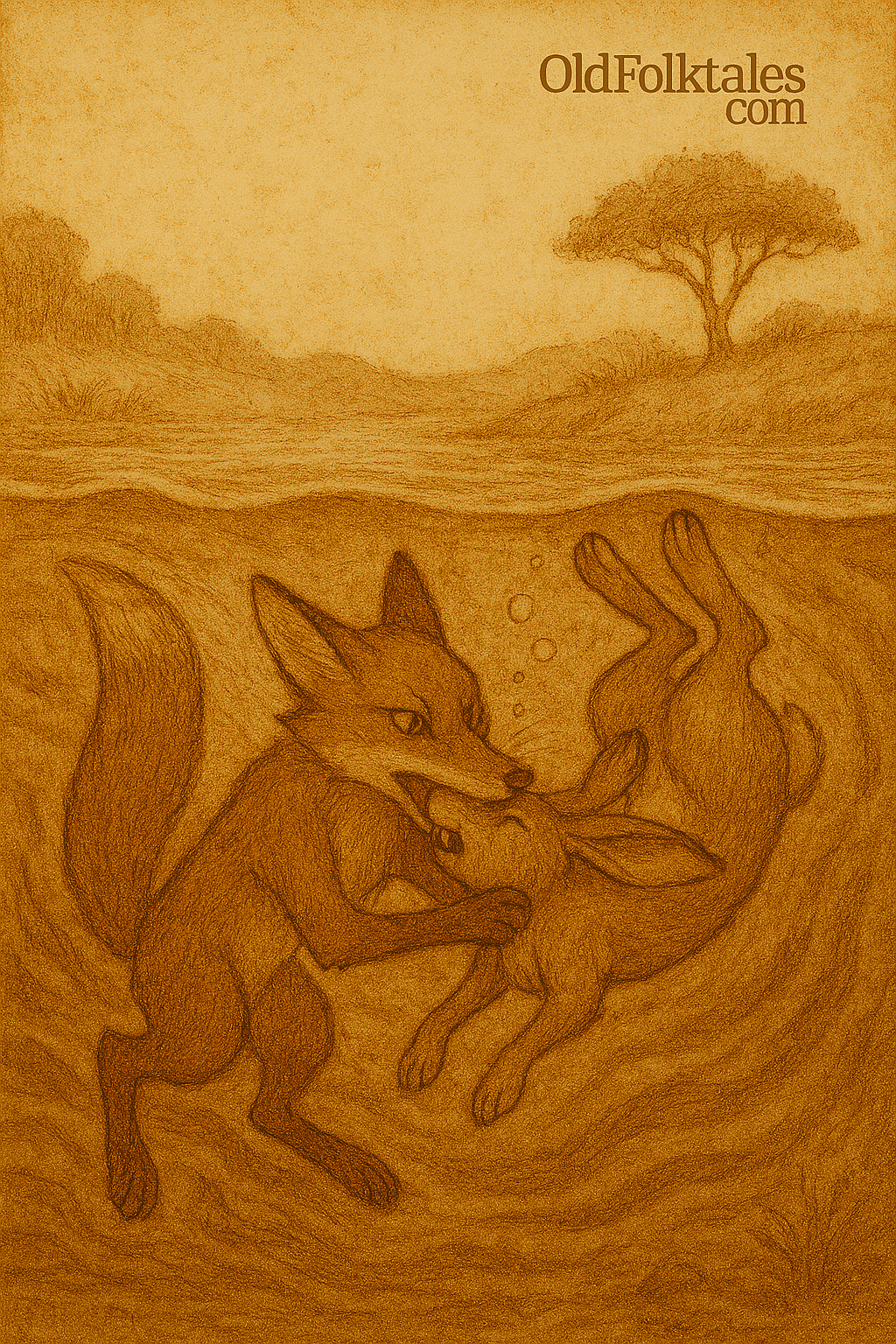
In the heart of Senegal, where the great rivers wind through ancient landscapes and carry the wisdom of generations, there lived a fox whose cunning was matched only by his appetite. This fox possessed a silver tongue that could weave words into snares as effective as any hunter’s trap, and on one particular day when the rains had stirred the river into a churning, muddy torrent, he set his sights on a most unsuspecting victim.
The rabbit, gentle and trusting by nature, had always been the kind of creature who saw friendship where others might see opportunity. His soft brown eyes held no suspicion, no wariness of the world’s darker intentions. When the fox approached him with what seemed like a generous proposition, the rabbit’s heart was immediately open to the possibility of companionship and shared adventure.
“My dear friend,” the fox said, his voice smooth as honey and twice as sweet, “let us venture to the river today and try our luck at fishing.” His amber eyes gleamed with an inner light that the rabbit mistook for enthusiasm. “Look how the recent rains have stirred up the waters they’re thick and muddy, perfect for our purposes. In such murky depths, we’ll surely catch ‘Me’ and make a fine meal of him.”
The rabbit’s ears perked up with genuine interest. The idea of fishing together appealed to his social nature, and he had always enjoyed the thrill of diving beneath the surface to search for food. The muddy water, he reasoned, would indeed provide excellent cover for their hunting expedition.
“What a wonderful idea!” the rabbit exclaimed, his whiskers twitching with anticipation. “I agree completely. Let us go at once and see what fortune awaits us in the depths.”
Together, they made their way to the riverbank, where the water ran dark and thick as chocolate, swirling with sediment from the upstream rains. The surface was opaque, revealing nothing of what lay beneath, creating perfect conditions for the fox’s sinister plan. The afternoon sun filtered through the clouds above, casting shifting shadows on the turbulent water.
Without hesitation, both animals plunged into the murky depths. The water enveloped them in its brown embrace, immediately separating them in a world of limited vision and muffled sounds. The rabbit, focused on his task, began groping through the mud and silt at the river bottom, his paws searching blindly for any sign of fish or other prey.
Meanwhile, the fox moved with calculated purpose through the murky water. His superior cunning guided him as he navigated the darkness, not truly seeking fish at all, but rather waiting for the perfect moment to spring his carefully laid verbal trap. His keen senses helped him track the rabbit’s movements even in the complete obscurity of the muddy river.
As fate would have it, in that world of swirling darkness where neither could see the other, the fox’s searching paw brushed against the rabbit’s soft fur. The contact was brief but unmistakable warm, living flesh rather than the cold scales of fish or the rough texture of river stones.
“Who is there?” the fox called out through the water, his voice taking on a tone of curious inquiry, though his heart raced with the thrill of his approaching victory.
The rabbit, innocent and unsuspecting, responded with the honesty that defined his character. He had no reason to suspect deception, no cause to choose his words carefully. In his trusting nature, he saw the question as merely a friend trying to identify him in the murky depths.
“It is me,” the rabbit replied simply, his voice carrying clearly through the water to the fox’s waiting ears.
The fox’s eyes blazed with triumph as he heard those fateful words. His plan had worked exactly as intended. The verbal snare he had so carefully constructed was now complete, and his prey had walked willingly into the trap.
“Ah, that is precisely who I was seeking!” the fox declared with predatory satisfaction. “I came to these muddy waters specifically looking for ‘Me’ and now I have secured my food for today!”
Before the rabbit could comprehend the terrible wordplay that had sealed his fate, before he could understand how his innocent response had been twisted into a death sentence, the fox’s jaws closed around him. The clever predator’s linguistic trap had succeeded perfectly, turning the rabbit’s own honest words into the key that unlocked his doom.
In the muddy waters of that Senegalese river, the fox’s cunning had triumphed over the rabbit’s trust, and he consumed his prey with the satisfaction of a plan flawlessly executed.
Moral Lesson
This Wolof folktale serves as a powerful reminder that words can be wielded as weapons by those with malicious intent. The story warns us to be cautious of those who use clever speech and ambiguous language to deceive others. It teaches that while honesty and trust are admirable qualities, we must also cultivate wisdom and discernment to protect ourselves from those who would exploit our good nature. The tale emphasizes that not all who approach us with friendly proposals have our best interests at heart, and that sometimes the most dangerous traps are hidden within seemingly innocent conversations.
Knowledge Check
Q1: Who are the main characters in this Wolof folktale from Senegal? A: The main characters are a clever, cunning fox and a trusting, innocent rabbit who becomes the victim of the fox’s wordplay trap.
Q2: What cultural significance does this folktale hold in Wolof tradition from Senegal? A: This Wolof folktale from Senegal serves as a traditional teaching tool, passing down wisdom about the dangers of deception and the importance of being cautious when dealing with those who use clever words to mask harmful intentions.
Q3: What does the muddy river symbolize in this West African folktale? A: The muddy river symbolizes confusion and limited perception, an environment where deception can thrive because victims cannot clearly see the truth or danger approaching them.
Q4: How does the fox use language as a weapon in this Senegalese story? A: The fox creates a verbal trap by suggesting they hunt for “Me,” then uses the rabbit’s innocent response of “It is me” to justify attacking him, demonstrating how ambiguous language can be manipulated for harmful purposes.
Q5: What is the primary moral lesson of this Wolof folktale? A: The primary moral teaches that while trust and honesty are virtues, we must also develop wisdom and discernment to protect ourselves from those who would exploit our good nature through deceptive language and false friendship.
Q6: Why is the rabbit’s character important to the folktale’s message about trust and deception? A: The rabbit represents pure innocence and trust, making his tragic fate more impactful and emphasizing how those with good intentions can become vulnerable to manipulation by more cunning individuals who exploit their honesty.

