In the rolling hills of ancient Swaziland, where the morning mist clung to emerald slopes and crystal streams wound their way through valleys dotted with traditional kraals, there lived a powerful chief whose heart harbored a darkness that would bring great suffering to his own household. This chief ruled over vast territories, commanding respect from neighboring tribes and wielding authority over countless warriors. Yet despite his worldly power, he possessed a fatal flaw that would ultimately bring shame upon his lineage.
The chief had taken two wives, as was the custom among men of his standing, and each had blessed him with a daughter. However, where a father’s love should have flowed equally to both children, his heart played cruel favorites. His first daughter, Mapindane, was the apple of his eye cherished, pampered, and showered with every luxury the kingdom could provide. She wore the finest beadwork, slept on the softest kaross furs, and never knew a moment’s want or worry.
But his second daughter, Kitila, suffered under the weight of her father’s inexplicable hatred. Though she possessed a gentle spirit and kind heart, the chief could barely stand to look upon her. She was relegated to the servants’ quarters, dressed in rough cloth while her half-sister wore silk, and forced to perform menial tasks that should never have been demanded of a chief’s daughter. The injustice of her treatment weighed heavily upon the entire household, yet none dared challenge their leader’s cruel favoritism.
Also read: The Enchanted Rooster King
As Kitila grew into a young woman of remarkable inner beauty and grace, the chief’s resentment only deepened. Unable to bear the sight of her dignity in the face of his cruelty, he devised a plan so wicked that it would forever stain his reputation among the ancestors. In his twisted mind, he conceived of a humiliation so complete that it would satisfy his malicious heart once and for all.
“Go forth into the wilderness,” he commanded his most skilled hunters, his voice cold as winter wind. “Seek out the creature known as Nya-nya Bulembu, the moss-green beast that haunts the deep pools of our land. Bring me its hide, for I have need of it.”
The hunters, though puzzled by this strange request, dared not question their chief’s orders. They set out across the vast landscape, following ancient paths that led to the most remote and mysterious places in the kingdom. Their search took them through dense forests where sunlight barely penetrated the canopy, across windswept plains where only the hardiest creatures survived, and finally to the sacred pools where legend said the Bulembu dwelt.
At the first pool, whose waters gleamed blue as a summer sky, they performed the ancient chant their grandfathers had taught them. The water began to ripple and bubble, and slowly, a creature emerged from the depths. But this Bulembu was ancient and decrepit, its hide bare of the moss that gave the species its fearsome reputation, its few remaining teeth yellowed with age. Disappointed, the hunters moved on.
The second pool yielded another Bulembu, but this one too was a pathetic specimen weak, small, and equally unsuitable for their chief’s mysterious purposes. Growing frustrated but determined to fulfill their duty, the hunters pressed deeper into the wilderness, following whispered legends to a hidden pool whose waters shimmered green as jade.
Here, when they sang the summoning chant, the very earth seemed to tremble. The water churned violently, and from its depths rose a creature of true terror, a massive Nya-nya Bulembu whose hide was covered in thick, moss-green fur that seemed to move with a life of its own. Its eyes blazed with primordial fury, and its roar echoed across the landscape like thunder. This was indeed a beast worthy of legend, and though it took all their skill and courage, the hunters managed to slay it and strip away its monstrous hide.
When they returned to the chief’s kraal bearing their grisly trophy, the household sensed that something terrible was about to unfold. The chief’s eyes gleamed with malicious satisfaction as he examined the moss-green pelt, running his fingers over its coarse texture while a cruel smile played across his lips.
“Bring me Kitila,” he commanded, his voice barely containing his anticipation.
When the innocent young woman appeared before him, confusion and fear evident in her gentle eyes, the chief’s smile widened into something truly monstrous. “You shall wear this skin as your garment,” he declared, “and you shall wear it always.”
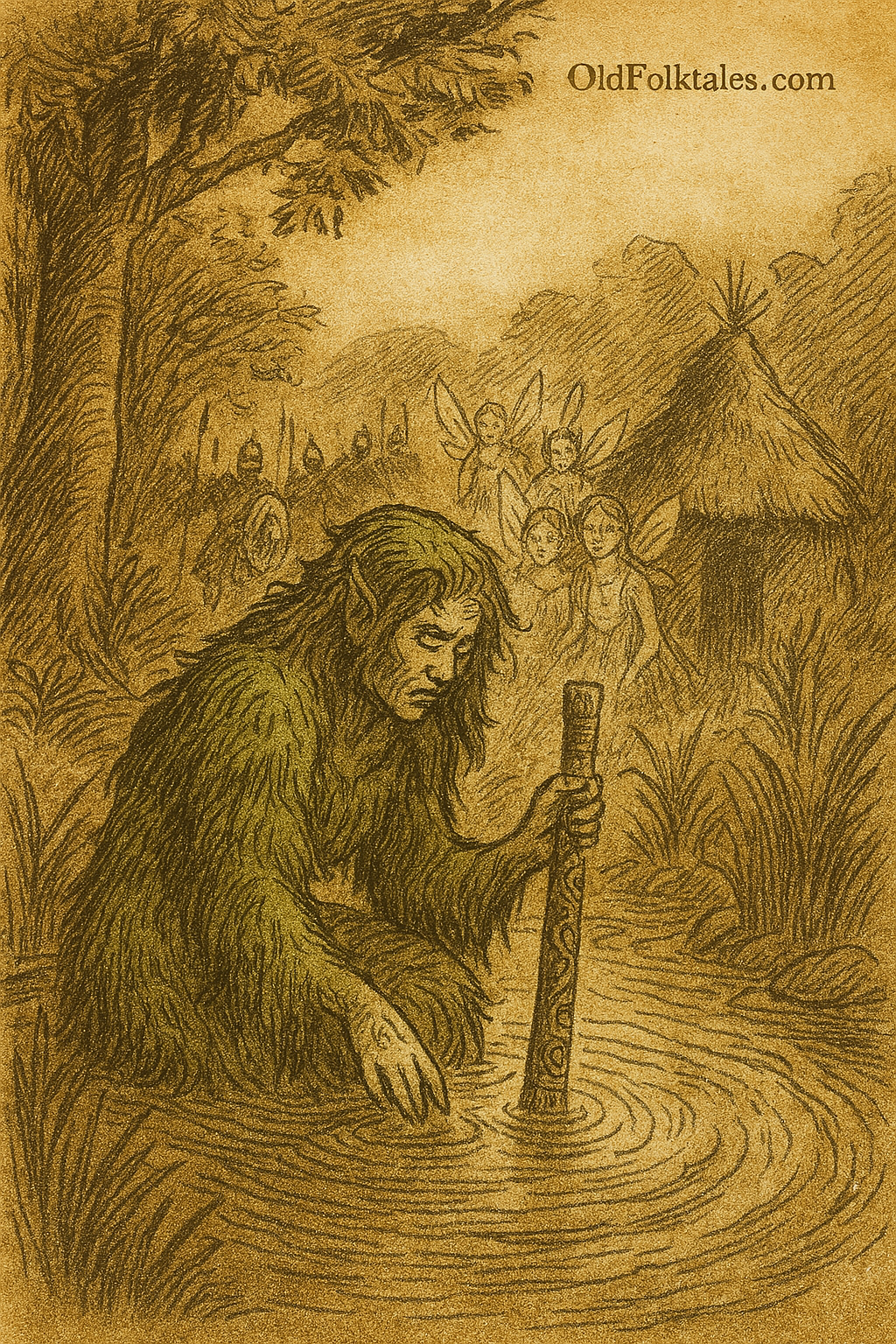
Despite Kitila’s protests and pleas, the chief’s warriors wrapped the cursed hide around her trembling form. The moment the skin touched her body, a terrible magic took hold. The hide fused with her flesh, becoming part of her very being, transforming her appearance into that of the dreaded Bulembu. Her beautiful human features were hidden beneath the creature’s monstrous visage, and no amount of pulling or clawing could remove the cursed covering.
From that day forward, Kitila was forced to live as the household’s most despised servant. Her monstrous appearance terrified children and disgusted adults, and even the kindest souls in the kraal could barely bring themselves to look upon her. She slept in the cattle enclosure, ate scraps thrown to her like a wild animal, and endured the constant fear and revulsion of everyone around her. Yet through all this suffering, her gentle spirit remained unbroken, though it was hidden beneath the terrible exterior her father had forced upon her.
Days blended into weeks, weeks into months, and Kitila’s situation seemed hopeless. But the ancestors had not forgotten her plight, and compassion still existed in the world, even for one so seemingly cursed.
One evening, as she made her solitary way to the river to drink and wash as best she could, a figure emerged from the twilight shadows. It was a fairy man, one of the magical beings who dwelt in the hidden places of the world and watched over those who suffered unjustly. His eyes held ancient wisdom and infinite kindness as he gazed upon the transformed girl.
“Child of sorrow,” he said, his voice like wind chimes in a gentle breeze, “your suffering has not gone unnoticed. Though I cannot completely break the curse that binds you, I can offer some relief.”
From within his robes, he produced a carved stick of remarkable beauty, its surface covered with intricate designs that seemed to shift and dance in the fading light. “Take this,” he said, pressing it into her clawed hands. “When you bathe in the river, hold it close, and remember that true beauty can never truly be destroyed—only hidden.”
From that night forward, whenever Kitila descended to the river to bathe, magic would stir in the flowing waters. As she entered the stream holding the fairy’s gift, other fairy folk would emerge from the reeds and rocks, surrounding her with their ethereal presence. In their company, the cursed skin would loosen and fall away like old clothing, revealing her true form, a young woman of extraordinary beauty, her skin glowing with inner light, her eyes bright with unquenched hope.
These precious moments of freedom became Kitila’s salvation, brief respites from her daily torment when she could remember who she truly was beneath the monster’s hide. Though she always had to return to her cursed state when she left the water, these times of transformation sustained her spirit and kept alive the flame of hope in her heart.
One fateful evening, as Kitila bathed in the moonlit river surrounded by her fairy companions, a young prince from a distant kingdom happened to be traveling through the area. He had stopped to water his horse at the riverbank when he glimpsed a sight that struck him like lightning, a woman of such breathtaking beauty that his heart immediately recognized its destined mate.
Though Kitila fled when she realized she had been seen, and though she was forced to resume her monstrous appearance the moment she left the water’s embrace, the prince’s love had been ignited by something far deeper than mere physical beauty. He had seen into her very soul during that brief encounter, and no external curse could diminish what he had witnessed there.
Against all advice and despite the horror of her household, the prince declared his intention to marry the creature known as Kitila. His love was so pure and unwavering that he cared nothing for her appearance, seeing only the gentle spirit that shone through her monstrous exterior.
On the morning of their wedding, as had become her custom, Kitila went to the river for her ritual bath. But this time, as she entered the sacred waters with the fairy’s carved stick in her hand, something miraculous occurred. The cursed skin, weakened by months of true love’s devotion and the consistent intervention of fairy magic, finally lost its power entirely.
As the sun rose over the Swazi hills, painting the sky in shades of gold and crimson, the Bulembu hide dissolved away like morning mist. Kitila emerged from the water in her true form, never again to be hidden beneath a monster’s guise. Her beauty now shone not just in her physical appearance, but in the strength of character that had sustained her through the darkest of trials.
The prince and princess lived together in perfect happiness, ruling their combined kingdoms with wisdom and compassion. And it is said that they made special care to protect all children from the cruelty of those who should have loved them, ensuring that no other innocent soul would suffer as Kitila had suffered.
The Moral Lesson
This powerful Swazi folktale teaches us that true beauty lies in the character of the heart, not in outward appearance. Kitila’s inner goodness could not be destroyed by her father’s cruelty or the monster’s hide he forced upon her. The story reminds us that genuine love sees beyond surface appearances to recognize the soul beneath, and that patience and faith can ultimately triumph over even the most terrible injustices. It also warns against the destructive power of favoritism and cruelty within families, showing how such behavior ultimately brings shame upon those who practice it.
Knowledge Check
Q1: Who is Kitila and why does her father, the chief, treat her cruelly in this Swazi folktale? A: Kitila is the chief’s second daughter who suffers from her father’s inexplicable favoritism. While he cherishes her half-sister Mapindane, he despises Kitila without clear reason, ultimately cursing her with the Bulembu hide to humiliate her completely.
Q2: What is the Nya-nya Bulembu and what role does it play in the story? A: The Nya-nya Bulembu is a legendary moss-green monster that lives in deep pools. The chief orders his hunters to find one and skin it, then forces Kitila to wear the cursed hide, which transforms her appearance into that of the monster.
Q3: How do the fairies help Kitila in her time of suffering? A: A fairy man gives Kitila a carved stick, and when she bathes in the river holding it, fairy folk surround her and the cursed skin temporarily comes off, allowing her to appear in her true beautiful form and providing hope during her darkest hours.
Q4: What enables the prince to see past Kitila’s monstrous appearance? A: The prince glimpses Kitila’s true beauty during one of her river transformations, but more importantly, his love is based on recognizing her inner goodness and gentle spirit, not just physical appearance, which allows him to love her despite the curse.
Q5: How is Kitila’s curse finally broken permanently in this Swazi tale? A: On her wedding morning, when Kitila goes to bathe in the river as usual, the combination of true love’s devotion and the sustained intervention of fairy magic finally breaks the curse completely, and the Bulembu skin dissolves away forever.
Q6: What does this folktale teach about the nature of true beauty and love? A: The story demonstrates that true beauty comes from within from character, kindness, and strength of spirit and that genuine love recognizes and values these inner qualities over physical appearance, ultimately having the power to overcome even magical curses.
Source: Swazi folktale, Swaziland (Eswatini)