Not every danger announces itself with noise or warning. Sometimes, it arrives quietly, with a polite voice and a respectful greeting, carrying nothing that would cause suspicion. In such moments, it is not strength that is tested, but judgment.
There was once a household known for its warmth and generosity. The head of the home was a man who believed deeply in the value of kindness. His door was rarely closed to travelers, and his table was always open to those in need.
His family shared this way of life. They welcomed visitors, offered food without hesitation, and treated strangers with respect. In their home, hospitality was not simply a custom. It was a duty.
One day, as the sun was lowering and the air was beginning to cool, a stranger approached the household.
He greeted the man of the house with humility, explaining that he had traveled a long distance and needed a place to rest. His voice was calm, his manner respectful, and his appearance gave no reason for doubt.
Want to dive deeper? Read more North African folktales today
The man welcomed him without hesitation.
“You are safe here,” he said. “Come inside and rest.”
The stranger entered the home and was treated as any guest would be. He was given food, water, and a place to sit. The family spoke with him, asking about his journey, and he answered in a way that seemed open and sincere.
At first, nothing seemed unusual.
But as time passed, small things began to change.
The stranger observed everything. His eyes moved carefully around the house, noticing where items were kept, how the family arranged their belongings, and how they moved about their daily routines.
He asked questions that seemed harmless, yet each one revealed his interest in details that others would not normally consider important.
The members of the household began to feel a quiet unease.
It was not something they could easily explain. The stranger had done nothing openly wrong. He continued to speak politely and behaved as expected.
Yet there was something beneath the surface that did not sit well with them.
The head of the household noticed this change.
He watched the stranger more closely, paying attention not only to his words, but to his actions. He began to see what others had felt but could not express.
The stranger’s attention was not that of a simple traveler. It was careful, deliberate, and purposeful.
That night, the family prepared to rest.
The guest was given a place within the house, as was customary. The man of the house lay awake longer than usual, listening to the quiet sounds of the night.
At first, everything was still.
Then, faintly, he heard movement.
He remained still, allowing his breathing to appear as though he slept. Through the silence, he listened as the movement continued. It was slow and cautious, the kind of movement made by someone who did not wish to be heard.
The man understood then that his concern had not been without reason.
Without drawing attention to himself, he rose quietly and followed the sound.
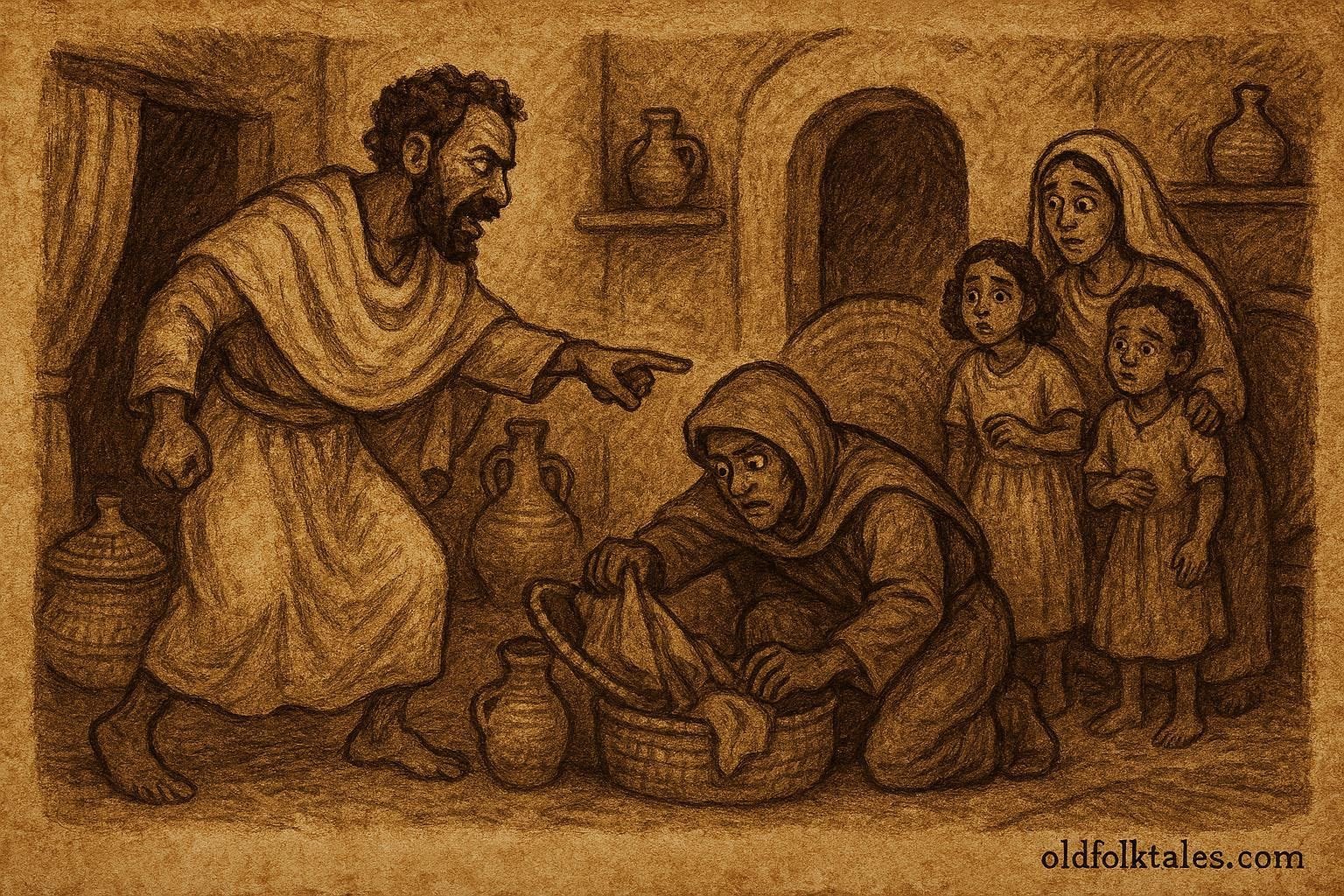
In the dim light, he saw the stranger moving through the household, examining objects, lifting items, and placing them back carefully. It was clear that he was searching for something.
The man stepped forward.
“Why do you move in another man’s house as though it were your own?” he asked calmly.
The stranger froze.
For a moment, there was no answer.
Then the stranger turned, attempting to regain his composure.
“I could not sleep,” he said. “I was only looking around.”
But his words did not carry the same confidence they had before.
The man of the house did not raise his voice.
“In this house,” he said, “a guest is trusted. That trust is not given lightly. If you have come here with honesty, you have nothing to fear. But if your purpose is hidden, it will not remain so.”
The rest of the family, awakened by the exchange, gathered quietly.
The atmosphere in the room had changed. What had once been a place of comfort was now filled with tension.
The stranger realized that he could no longer continue as before.
His actions had been seen. His intentions could no longer be disguised by polite words.
Slowly, he lowered his head.
He admitted that he had entered the household not as a simple traveler, but with the intention of finding something of value to take. He had chosen the home because of its reputation for hospitality, believing that such kindness would make it easier to act without suspicion.
The confession brought a deep silence over the room.
The family looked at one another, not with anger alone, but with disappointment. Their kindness had been used against them.
The man of the house spoke again.
“Hospitality is given with trust,” he said. “When that trust is broken, it does not only harm the one who gives it. It weakens the bond that holds people together.”
The elders of the community were called to address the matter.
They listened to what had happened and considered it carefully. The wrongdoing was clear, but so was the importance of the lesson it carried.
The stranger was required to make amends and was warned against repeating such actions.
For the household, the experience brought change.
They did not abandon their tradition of hospitality, but they became more aware. They learned that kindness must be accompanied by wisdom, and that trust must be given with understanding.
The story of the deceptive guest spread through the community.
It was told not to discourage generosity, but to remind people that not all who appear sincere are as they seem. It taught that true character is revealed not only in words, but in actions.
From that time onward, people welcomed strangers with open hands, but also with open eyes. They understood that trust is a valuable gift, and that it must be protected as carefully as it is given.
Don’t stop yet! See our complete East African folktales collection
Moral Lesson
Kindness must be guided by wisdom. Trust is valuable, and it should not be given without awareness.
Knowledge Check
- Who was the deceptive guest in the story?
A stranger who entered a household pretending to be a traveler. - What did the guest do wrong?
He secretly searched the house with the intention of stealing. - How was the deception discovered?
The head of the household noticed suspicious behavior and caught him at night. - What lesson did the household learn?
To balance kindness with awareness and caution. - Why is hospitality important in the story?
It reflects cultural values of generosity and trust. - What is the main message of the folktale?
Trust should be given wisely, not blindly.
Source
Eritrean folktale, Tigrinya narrative. Collected by Enno Littmann in Publications of the Princeton Expedition to Abyssinia (1910).