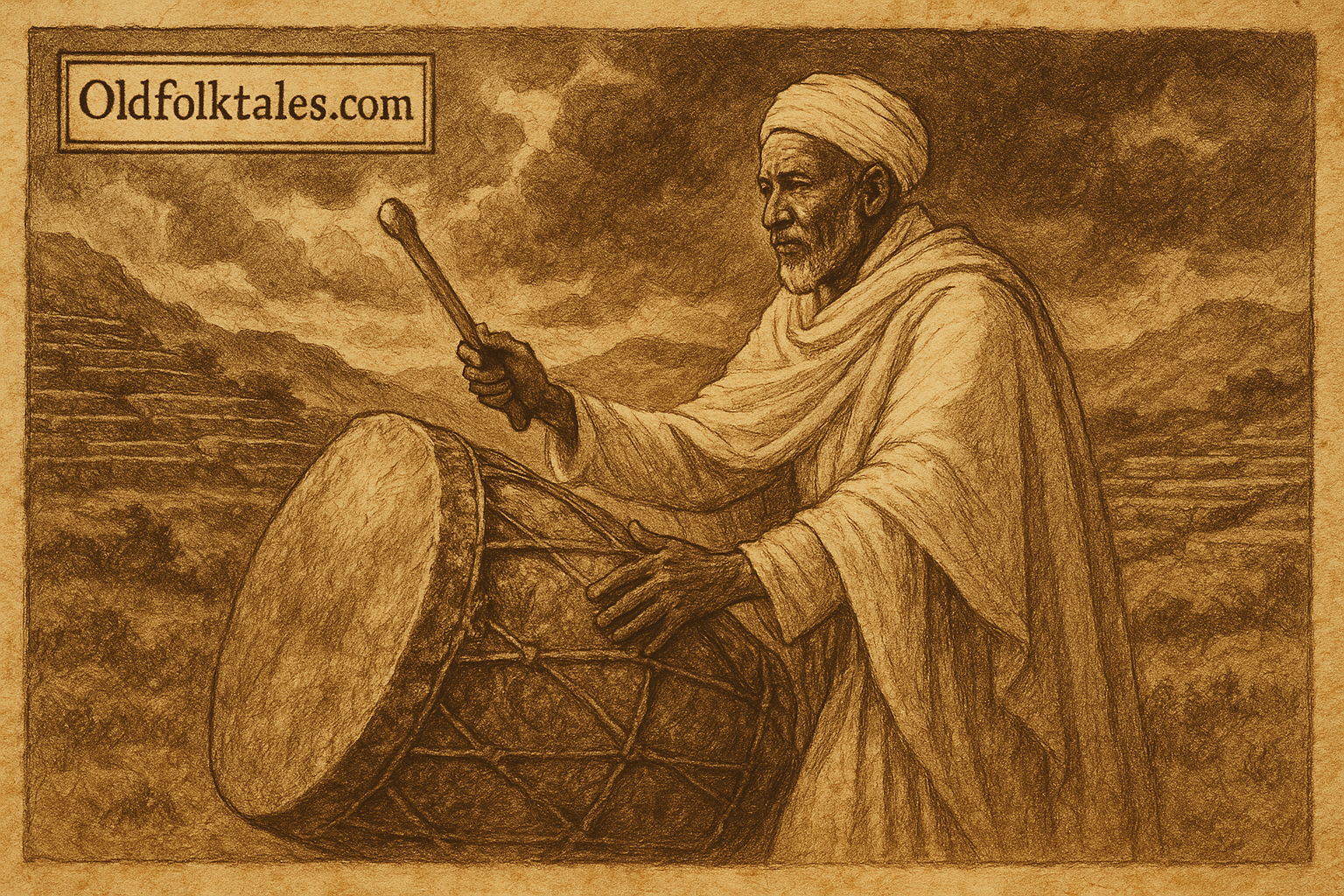
Long ago, when the world was still young and the Orisa walked openly among mortals, there lived a humble drum maker named Akinlabi in the town of Oyo. His hands were skilled, his heart steady, and his ears sharp for the music of the land. From hollowed iroko trunks and stretched antelope skin, he made drums that could sing, whisper, and cry.
One season, the rains failed. The yam vines curled in thirst, the streams shrank to dusty beds, and the people prayed to Sango, the Orisa of thunder, for rain. On the third day of the dry wind, a tall figure cloaked in cloud appeared at Akinlabi’s doorway. His eyes flashed like lightning.
“Drum maker,” the figure said in a voice that rumbled through the earth, “I am Sango. Make me a drum worthy of the sky’s voice. It must call the clouds, stir the wind, and command the rain.”
Akinlabi bowed low. “Orisa, I will make it.”
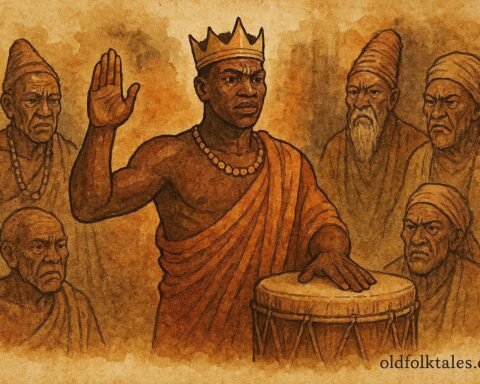
For seven days and nights, he worked without rest. He carved the drum from the heart of an ancient iroko tree, polished its sides until they gleamed, and stretched the skin so tight that even the wind might tremble at its tone. Into its hollow, he placed sacred stones, feathers of the grey parrot, and a strand of lightning struck grass. When it was done, the drum seemed alive.
Sango returned, his staff crackling with fire. He struck the drum once — KPOOM! The sky split, thunder rolled across the hills, and the first drops of rain fell. The people danced in the streets, singing praise to Sango and the skill of the drum maker.
Sango gave Akinlabi a warning. “This is the Drum of Thunder. It belongs to me. Never beat it without my command, for its voice is not for mortal ears alone.”
Akinlabi agreed. But in the days that followed, word of the Drum of Thunder spread. Chiefs sent messengers with gifts, asking for its sound at their feasts. Hunters wanted its beat to bless their journeys. Each time, Akinlabi refused, remembering Sango’s words.
Then came a day of great insult. A rival drum maker, jealous of Akinlabi’s fame, mocked him in the marketplace. “You speak of this mighty drum, yet you hide it away like a coward. Perhaps it cannot sing at all!”
The crowd laughed. Akinlabi’s pride burned hotter than the noonday sun. That night, when the moon was high and the town slept, he brought the Drum of Thunder into the courtyard.
He struck it once. KPOOM! The ground shook. Clouds boiled over the moon. He struck it again. KPOOM! Lightning split the sky. The wind rose, tearing leaves from the trees.
Then a third time — KPOOM!
The storm that came was unlike any the people had seen. Thunder roared like a hundred drums, rain lashed the earth, and fire fell from the clouds. Roofs tore away, palm trees split, and the great market of Oyo flooded. Amid the chaos, a single lightning bolt struck Akinlabi’s courtyard.
When the light faded, Sango stood there, his face dark with anger. “I warned you,” he said, his voice like the crack of heaven’s whip. “You let pride guide your hand. Now you will pay.”
The Drum of Thunder rose into the air, spinning as if struck by invisible hands. Then it vanished into the clouds. Sango raised his staff, and a bolt of lightning struck Akinlabi’s right hand. From that day forward, his fingers could no longer hold a drumstick.
Yet Sango was not without mercy. He allowed Akinlabi to live and pass on his craft, but never again would he touch a drum. And the Drum of Thunder? The people say it still beats in the heart of storms, calling rain to the earth when Sango rides the clouds.
Moral Lesson of The Drum of Thunder
Pride can blind even the most skilled hands to wisdom. In the Yoruba tradition, sacred gifts are not for selfish display but for service to the community and respect for the Orisa. Akinlabi’s fall reminds us that breaking a promise for the sake of pride can bring disaster not just to oneself but to everyone around. The Drum of Thunder teaches that true honor lies in humility, obedience, and using our gifts with care.
Knowledge Check: The Drum of Thunder
- What is the main lesson in the Yoruba folktale “The Drum of Thunder”?
The main lesson is that pride and disobedience can destroy even the most talented person’s blessings, while humility and respect preserve them. - Who asks Akinlabi to make the Drum of Thunder in the folktale?
Sango, the Yoruba Orisa of thunder, lightning, and justice, commissions the drum to call rain and command storms. - What warning does Sango give Akinlabi about the Drum of Thunder?
Sango warns him never to play the drum without permission, as its power is sacred and dangerous. - What happens when Akinlabi plays the Drum of Thunder out of pride?
A massive storm destroys parts of Oyo, Sango becomes furious, and he takes the drum away forever. - What cultural tradition does “The Drum of Thunder” reflect?
It reflects Yoruba beliefs about sacred drums, divine authority, and the role of the Orisa in natural forces. - Where is the Drum of Thunder said to be now, according to the folktale?
The drum is believed to rest in the clouds, beating during storms when Sango calls the rain.
Cultural Origin: Yoruba tradition, southwestern Nigeria