In a coastal Mpongwe village of Central Africa, where mangroves met the restless Atlantic winds and life moved in rhythm with tides and seasons, there stood a sacred object that no one took lightly.
It was not a weapon, nor a treasure of gold or stone.
Continue your journey: Read more East African folktales
It was a drum.
But this was no ordinary drum.
Carved from ancient wood and stretched with carefully treated hide, it was said to hold something far more powerful than sound. The elders believed it carried memory itself, the echo of every word ever spoken in its presence since the time of its making.
Nothing was forgotten.
Nothing was erased.
Every truth, every lie, every oath, every whisper, lived within it.
Because of this, the drum was not played casually. It was not struck for celebration or dance. It was kept in a quiet space at the center of the village, guarded by tradition and respect.
And when disputes arose, the elders would gather around it.
They would sit in silence.
Then, one by one, they would ask it to remember.
And the drum would speak.
Not in words, but in sound, recreating voices from the past, repeating exactly what had been said, revealing truth as it once existed.
In this way, justice was guided.
And for many generations, the village lived knowing that nothing spoken could truly disappear.
Among the villagers was a young man known for his sharp mind and restless ambition.
He was clever, persuasive, and always eager to prove himself. But unlike the elders, who valued balance and patience, he believed that strength came from control, and control came from knowledge.
The drum fascinated him.
Not because of what it represented, but because of what it could do.
If it remembered everything, then it could be used.
Not just for justice.
But for advantage.
At first, he only observed.
He watched as elders approached the drum with reverence. He listened as it revealed forgotten truths, conflicts resolved, misunderstandings corrected, hidden actions brought to light.
He noticed something important.
The drum did not judge.
It only remembered.
And that, to him, meant it could be influenced.
One day, a dispute arose in the village.
Two families argued over land near the riverbank. Each claimed ownership, each insisting their memory was correct.
The elders prepared to consult the drum.
But the young man saw an opportunity.
If he could guide what was remembered, or at least shape how it was heard, he could shift the outcome in favor of those who would reward him.
That night, when the village was quiet, he approached the sacred space where the drum rested.
He was not supposed to be there alone.
But ambition often ignores boundaries.
He stood before the drum.
For a moment, he hesitated.
The silence felt heavy, as though the air itself was aware of his intention.
Then he spoke.
Not to ask.
But to influence.
He whispered carefully chosen words, words meant to frame the dispute, to tilt memory in a favorable direction, to reshape perception before truth was summoned.
Then he stepped back, satisfied.
He believed he had acted wisely.
The next morning, the elders gathered.
The two families stood before them, tension hanging in the air like a storm waiting to break.
The drum was placed at the center.
The village fell silent.
The eldest among them struck it once.
The sound that followed was not ordinary.
It was layered.
Deep.
Unfolding.
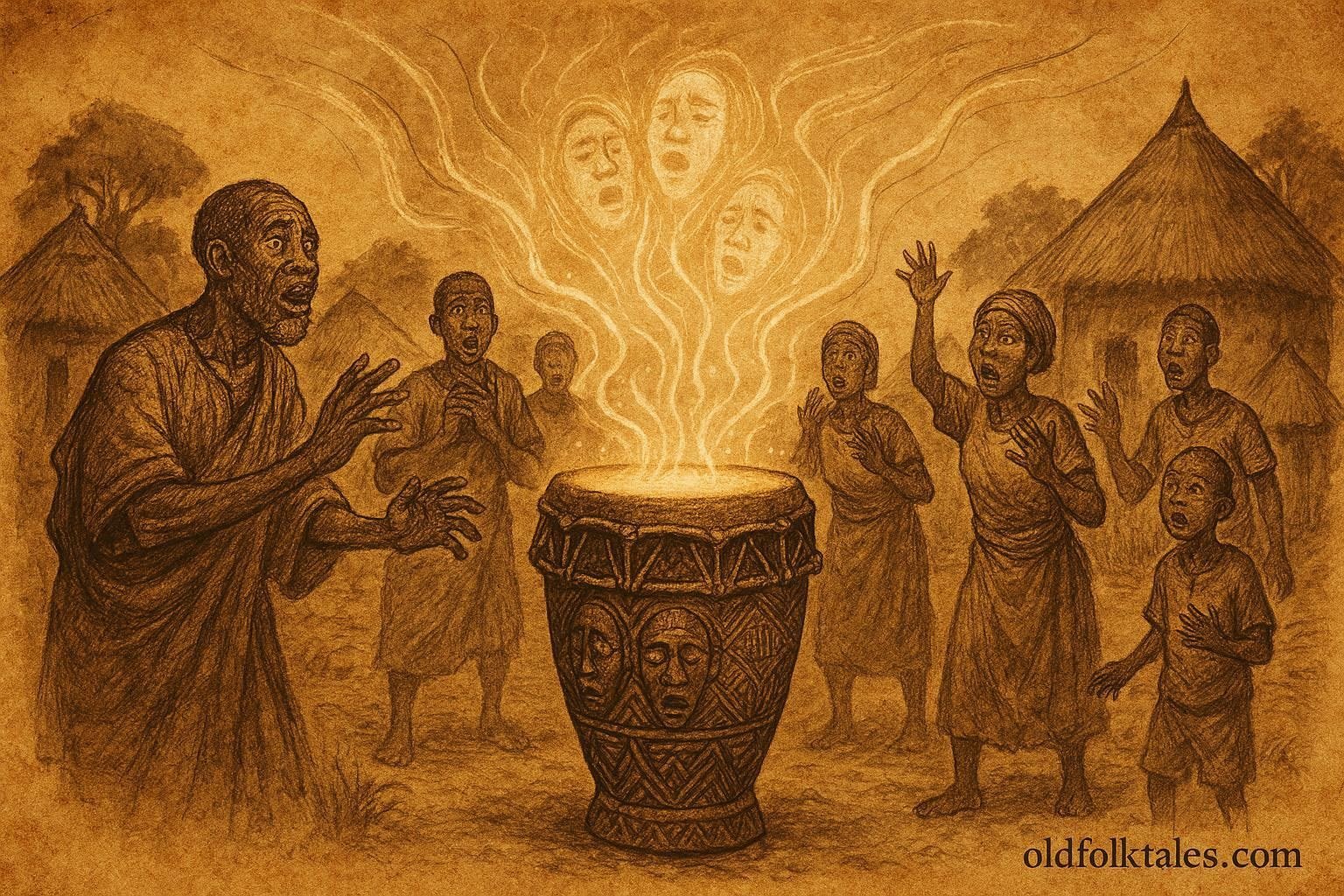
And then, the drum began to speak.
At first, it repeated the present dispute, voices arguing, claims made, accusations exchanged.
But then something changed.
The sound deepened further.
And the drum began to reveal more than the argument at hand.
It began to remember.
Voices from years before surfaced, old agreements, forgotten boundaries, past decisions made by ancestors long gone. Then, more recent voices appeared, conversations never meant for public ears, private intentions spoken in confidence.
The village stirred.
People looked at one another uneasily.
The drum continued.
And then it reached the young man’s whisper from the previous night.
Clear.
Undeniable.
Every word he had spoken in secrecy was now carried through the air for all to hear.
Silence fell sharply.
The young man froze.
His plan had not only failed, it had been exposed completely.
But the drum did not stop there.
It continued to remember.
It revealed moments no one had asked for.
A long-hidden debt between families.
A promise broken years ago and never confessed.
A theft long buried beneath silence.
A kindness forgotten by those who received it.
One by one, truths surfaced, not just about the dispute, but about the entire village.
Gasps rose.
Some stepped back.
Others lowered their gaze.
The weight of shared history pressed heavily on everyone present.
Because the drum did not separate convenient truth from inconvenient truth.
It remembered everything equally.
The elders sat in silence as the final echoes faded.
No one spoke immediately.
There was nothing to add.
Only truth, fully revealed.
The young man stepped forward, his confidence gone.
“I did not mean,” he began.
But the elder raised a hand.
“No,” he said quietly. “The drum remembers intention as well.”
The young man stopped.
For the first time, he understood what the drum truly was.
Not a tool.
Not a weapon.
But a mirror of everything spoken, whether meant for good or harm.
The dispute between the families was eventually resolved, not through manipulation, but through the full understanding of what had been revealed.
And the young man was not punished by force.
He was corrected by exposure.
His actions were now part of the village memory, not as rumor, but as recorded truth.
In the days that followed, something changed in the village.
People spoke more carefully.
Not out of fear alone, but awareness.
Words were no longer seen as temporary.
They were seen as lasting.
As living.
As part of the drum itself.
The young man, humbled, returned to the drum later.
He did not whisper this time.
He simply stood before it.
“I understand now,” he said softly. “You do not forget.”
The drum did not answer.
It did not need to.
From that time forward, the drum remained in the center of the village, as it always had.
But it was treated with even greater respect.
Because everyone now understood something essential:
A community is never only shaped by what is done.
It is shaped by what is said, and remembered.
If you liked this story, see our Central African folktales collection
Moral Lesson
Truth cannot be controlled or selectively used. When communities preserve memory and accountability, integrity becomes the foundation of justice, and hidden actions will eventually come to light.
Knowledge Check
- What is the main lesson of “The Drum That Remembered Everything”?
The story teaches that truth cannot remain hidden and that accountability is essential in a community. - What special ability did the sacred drum have?
It could remember and reproduce every word ever spoken in its presence. - How was the drum used in the village?
Elders used it to resolve disputes by revealing past spoken truths. - What did the young man attempt to do?
He tried to manipulate the drum’s memory by speaking secretly to influence a dispute. - What was the consequence of his actions?
The drum exposed his deception along with other hidden truths in the village. - What cultural themes are reflected in this Gabonese folktale?
Themes include truth, justice, communal accountability, memory, and the power of spoken words.
Source: Derived from oral traditions referenced in Stephen Belcher, African Myths of Origin (2005)
Cultural Origin: Mpongwe oral storytelling traditions of coastal Central Africa, particularly Gabon