High in the rolling hills of Burundi, where mist clings to the earth in the early morning and the wind moves softly across terraced slopes, there once stood a village known for its order and tradition.
At the heart of this village rested something no one dared to treat lightly.
Want more? Read more West African folktales now
A sacred drum.
It was not an ordinary instrument made for celebration alone. It was an Ingoma, a royal drum, believed to carry the authority of truth and the weight of justice. Among the Kirundi-speaking people, such drums were more than objects, they were symbols of moral order, tied deeply to the balance of the community.
The elders said the drum did not simply produce sound.
It responded.
In this village, the drum had one unusual and respected power.
Whenever a lie was spoken in its presence, it would sound on its own.
No hand would strike it. No drummer would approach it. Yet the sound would rise, clear, undeniable, cutting through silence like truth made audible.
Because of this, disputes in the village rarely lasted long.
False claims were exposed. Hidden intentions were revealed. And those who spoke dishonestly quickly learned that the drum could not be deceived.
It was not feared as a weapon.
It was respected as a witness.
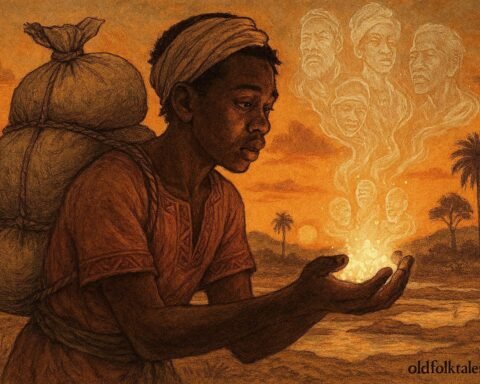
Among the children of the village was a young boy known for his quiet nature.
He was not loud, nor boastful. He helped his family, respected the elders, and kept mostly to himself. Though young, he understood the importance of honesty, especially in a place where even silence could be questioned by tradition.
One season, however, something happened that changed everything.
A small theft occurred in the village.
A bundle of grain had disappeared from a storage hut. It was not much, but in a place where every harvest mattered, even small losses carried weight.
Whispers began to spread.
People asked questions.
And slowly, suspicion began to form.
The village gathered to address the matter.
As always, the sacred drum was brought to the center of the meeting space.
It stood quietly, its carved wooden body worn by time but still strong, its presence commanding attention without effort.
The elders sat in a circle.
One by one, villagers were asked to speak.
Each person stood before the drum and declared their innocence.
And each time truth was spoken, the drum remained silent.
No sound.
No reaction.
Only stillness.
Then the young boy was called.
He stepped forward hesitantly.
Confusion had already begun to spread in the village. Earlier that day, someone had claimed to have seen him near the storage hut.
The accusation was not proven.
But suspicion often does not wait for proof.
The boy stood before the drum.
His hands trembled slightly.
He looked at the elders, then at the gathered villagers.
“I did not take it,” he said clearly.
For a moment, nothing happened.
The drum remained still.
A few villagers murmured.
But then, it sounded.
A deep, resonant tone filled the air.
Not struck by human hands.
Not triggered by ritual.
It simply responded.
The sound was unmistakable.
The boy stepped back, stunned.
Gasps spread through the crowd.
The elders exchanged glances.
The meaning seemed clear.
The drum had spoken.
And it did not favor the boy’s words.
The accusation hardened.
The boy tried to explain, but his voice was drowned beneath the certainty of the sound that had already been heard.
In the eyes of many, the matter was settled.
The drum had confirmed it.
And the drum, they believed, never lied.
But not everyone was convinced.
One of the elders, older than most, raised a hand.
“Let us not rush,” he said. “Truth revealed is not always truth understood.”
His words slowed the gathering, but did not erase the tension.
Still, the boy was no longer trusted as he once had been.
He returned home that day with a burden heavier than accusation alone.
It was the weight of doubt.
Days passed.
The village remained unsettled.
The missing grain was not recovered.
And the drum remained silent once more.
But the boy lived under the shadow of what had happened.
He avoided gatherings. He spoke less. Even those who once greeted him warmly now looked at him differently.
Yet deep within him, one thought remained constant:
I did not take it.
One morning, something unusual occurred.
While the village was carrying out its daily routines, a loud sound suddenly echoed from the center of the village.
The drum had sounded.
But no one had approached it.
No gathering had been called.
People rushed toward it.
And as they arrived, they heard it again.
A deep tone.
Followed by another.
And another.
The drum was responding, but not to speech this time.
It was responding to presence.
Soon, villagers began to notice something strange.
Whenever certain people passed near the drum, it remained silent.
But when others approached, especially those speaking casually, arguing, or denying small truths in everyday life, the drum would sound faintly.
It was as if it was no longer reacting only to formal declarations.
It was reacting to dishonesty itself.
The elders gathered once more.
“This is beyond accusation,” one said. “The drum is revealing more than the theft.”
Another nodded slowly.
“It is revealing truth in all its forms.”
The village fell into uneasy reflection.
For if the drum responded not only to major lies but to all dishonesty, then no one was entirely unseen.
No one entirely unmeasured.
The young boy, still carrying the weight of accusation, observed carefully.
He noticed something others did not.
The drum did not sound near him anymore.
Not once.
Not even when others spoke of him unfairly.
Instead, it remained quiet.
Calm.
Still.
As though recognizing something unchanged within him.
One day, a sudden realization struck a few villagers.
The boy had been accused based on a claim.
But the drum had not reacted to his denial alone.
It had reacted at a moment when others had been speaking around him, repeating assumptions, spreading uncertainty, shaping belief without proof.
The sound had not confirmed guilt.
It had revealed imbalance.
The elders called for one final gathering.
The drum was placed at the center once again.
This time, the entire sequence was replayed.
Each person involved in the accusation stepped forward.
Each statement was spoken again.
And as the truth unfolded in layers, something became clear.
The grain had been taken not by the boy, but by someone who had first shifted blame to avoid suspicion.
When that person spoke before the drum,
It sounded.
Strong.
Undeniable.
Silence followed.
The boy stood motionless as understanding spread through the crowd.
He had been wronged.
Not by the drum.
But by human assumption before truth was fully known.
The elders lowered their heads.
And the accusation was lifted.
The boy did not celebrate loudly.
He simply breathed, deeply, quietly, as if something heavy had finally been set down.
The drum remained still.
No longer revealing guilt.
No longer correcting error.
Only resting in its role as witness.
From that day onward, the village changed in subtle but lasting ways.
People became more careful with their words, not out of fear alone, but awareness.
They understood now that truth was not only something spoken during judgment.
It lived in everyday speech.
In assumptions.
In silence.
In intention.
The boy grew older, carrying with him the memory of what had happened.
And whenever he passed the sacred drum, he did not look at it with fear.
He looked at it with respect.
Because it had not condemned him.
It had revealed what others could not see clearly.
Looking for more? Explore the magic of East African folktales here
Moral Lesson
Truth is not always immediate or obvious, but it always emerges when examined fully. Justice requires patience, integrity, and the willingness to look beyond first impressions.
Knowledge Check
- What is the main lesson of “The Drum That Spoke Truth”?
The story teaches that truth eventually reveals itself and justice requires careful understanding, not assumptions. - What special power did the sacred drum have?
It would sound on its own whenever lies or hidden dishonesty were present. - Why was the boy accused of theft?
He was accused based on suspicion and mistaken observation near the storage hut. - How did the drum help reveal the real thief?
It responded during the final gathering, exposing the actual person responsible when they spoke. - What role does the drum play in the community?
It serves as a symbol of justice, truth, and moral accountability in the village. - What cultural themes are reflected in this Burundian folktale?
Themes include truth, justice, communal responsibility, integrity, and traditional authority systems.
Source: Oral traditions documented in regional folklore collections such as Folktales from Burundi compiled by local historians (1970s)
Cultural Origin: Kirundi-speaking communities of Burundi, where royal and ceremonial drums (Ingoma) symbolize authority and moral order