Long ago, in a Luba village nestled near the thick forests of what is now the Democratic Republic of Congo, there lived a young drummer named Kazi. He was known throughout the village for his talent, beating rhythms that could summon laughter, tears, and celebration. Yet, despite his skill, Kazi longed for something more, a rhythm that could speak to the heart of the forest itself.
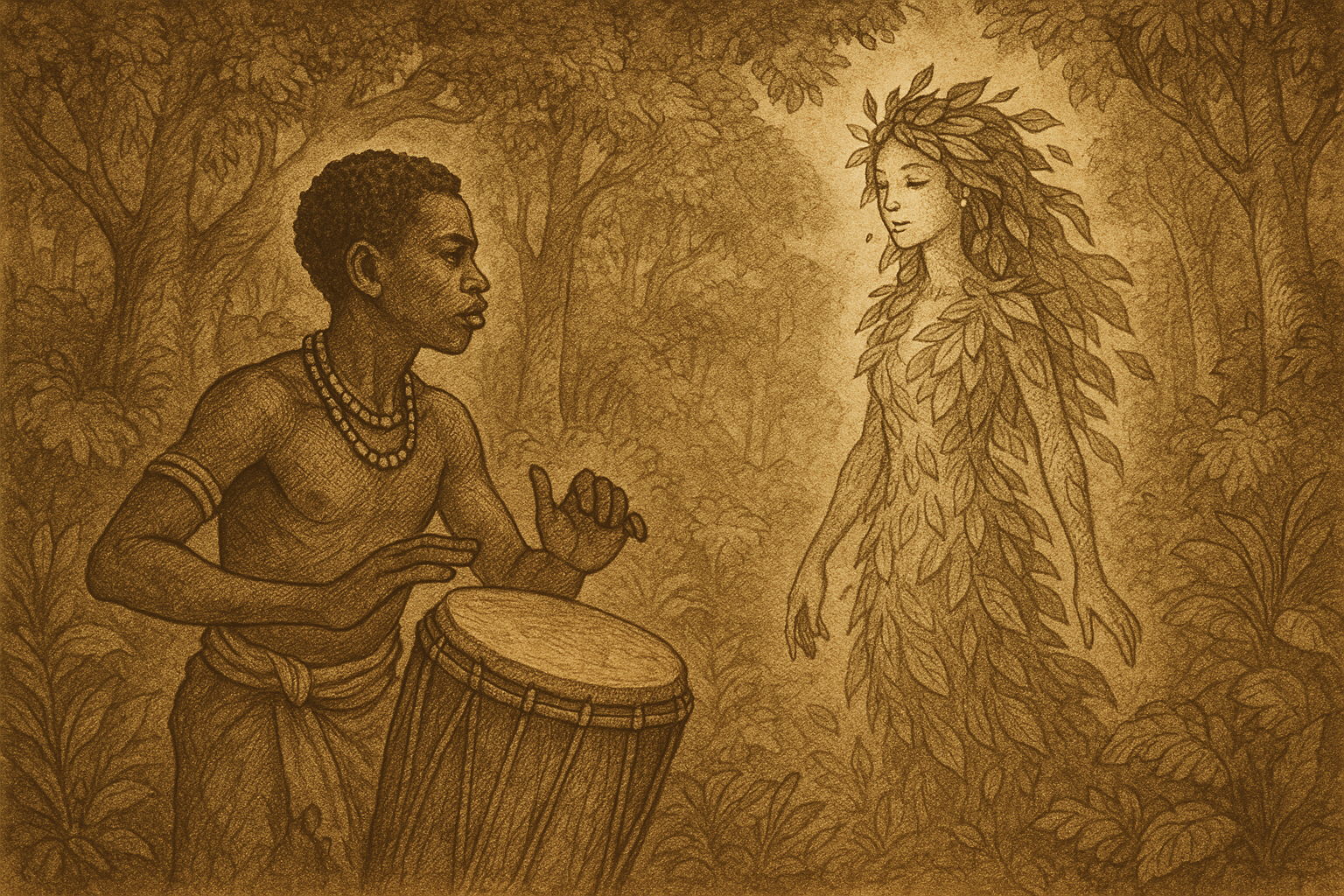
One evening, as the sun sank behind the tall trees, Kazi wandered deep into the forest, carrying only his drum. He had heard whispers from the elders that the forest was alive, inhabited by spirits who could teach knowledge beyond human understanding. Kazi, brave but respectful, tapped gently on his drum, hoping to attract attention without angering the unseen guardians.
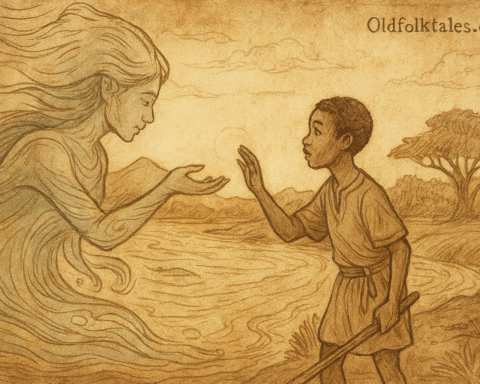
Suddenly, the leaves rustled, and a soft light appeared among the branches. From the glow emerged a spirit, neither fully human nor fully animal, with eyes like molten gold and a presence that filled the clearing with quiet power. “Kazi,” the spirit said, “I am the guardian of this forest. Why do you beat your drum among the trees where humans do not belong?”
Kazi bowed, keeping his drum close. “Great spirit, I seek your guidance. My hands can summon joy and sorrow among people, but I wish to learn the forest’s own rhythm, so I may honor the land and my people.” The spirit studied him, eyes narrowing with both curiosity and caution. “If you wish to learn, you must first prove your patience and respect. One who beats too quickly, who seeks to control rather than listen, will only summon misfortune.”
The spirit gave Kazi a challenge. He must spend three nights in the forest, following the rhythm of the animals, the rustling leaves, and the flowing streams. Each night, he was to drum only when the forest allowed, listening carefully to the subtle changes in wind, bird song, and water. The forest would judge him.
The first night, Kazi struggled. He tapped eagerly, his fingers flying over the drum, but the birds scattered and the winds grew sharp, tossing branches toward him. The spirit appeared and shook its head. “You are too eager, young drummer. Slow your heart. Hear before you act.” Kazi knelt, closed his eyes, and let the forest fill his senses. He felt the gentle flow of a creek, the sway of the tall grass, and the quiet pulse of hidden creatures. When he next struck his drum, the rhythm flowed naturally, matching the heartbeat of the forest.
The second night, Kazi faced a greater challenge. A leopard prowled nearby, its eyes gleaming in the darkness. Fear gripped him, but he remembered the spirit’s words: patience and respect. He tapped softly, following the rhythm of his own steady breath and the measured steps of the animal. The leopard paused, circled, and then retreated, leaving the forest undisturbed. The spirit appeared again, nodding slowly. “You begin to understand. Courage and listening are one.”
On the third night, a heavy storm swept through the forest. Rain pelted the ground and winds bent the trees, threatening to break them. Kazi could barely see, yet he continued drumming, not to force the storm, but to move with it. His rhythms rose and fell with the water, the wind, and the shouts of distant animals. Finally, the storm softened, the rain turning gentle, and a calm settled over the forest. The spirit appeared, shimmering through the last drops of rain.
“Kazi,” the spirit said, “you have listened, watched, and moved with the forest. You have earned its rhythm. Take this knowledge back to your village, and let your drum speak not only to people but to the land itself. Remember, the forest shares its rhythm only with those who respect its voice.”
Kazi returned to his village at dawn, soaked and tired but joyful. He drummed, and his music carried the depth of the forest. The villagers gathered, enchanted by the new rhythms that seemed to echo through the trees and rivers themselves. He taught the children to drum with patience, teaching them to feel before striking, to observe before creating. The villagers understood that the drum was more than a musical instrument; it was a bridge between humans and the living forest.
From that day onward, Kazi became the keeper of the forest rhythms. Each beat reminded the people of patience, respect, and the harmony between humans and nature. Travelers and neighboring villages came to hear his drum, learning that music was not merely sound, but a teacher of wisdom, courage, and understanding.
Moral Lesson
The story of The Drummer and the Forest Spirit teaches that true mastery comes not from force or haste, but from patience, observation, and respect. Whether in music, work, or life, those who listen carefully and act with understanding can achieve harmony with the world around them. Courage alone is not enough; wisdom and humility guide our actions and allow us to honor both people and nature.
Knowledge Check: The Drummer and the Forest Spirit
1. Who is Kazi in the Luba folktale The Drummer and the Forest Spirit?
Kazi is a young drummer from a Luba village who learns the secret rhythms of the forest from a guardian spirit.
2. What challenge did the forest spirit give Kazi?
He had to spend three nights in the forest, drumming only when allowed and learning to follow the natural rhythms of animals, wind, and water.
3.Why did Kazi struggle on the first night?
He was too eager and tried to force his drumbeats, which disturbed the forest instead of moving with it.
4. How did Kazi show courage on the second night?
He calmly drummed in the presence of a prowling leopard, listening and respecting its movements instead of panicking.
5.What lesson did Kazi learn from the forest spirit?
He learned that patience, observation, respect, and humility are essential to understanding and mastering life’s rhythms.
6.What is the moral of The Drummer and the Forest Spirit?
The folktale teaches that wisdom and patience, paired with courage and respect for nature, are more powerful than force, and that listening carefully allows humans to harmonize with the world around them.
Cultural Origin: Luba Folktales, DR Congo