In the vast expanse of ancient Africa, where golden grasslands stretched endlessly beneath the scorching sun and mighty rivers carved their paths through untamed wilderness, there ruled a king whose domain was so immense that a traveler could walk for days without reaching its borders. His city rose like a jewel from the earth, its walls encompassing countless dwellings, bustling markets, and granaries overflowing with grain. Herds of cattle dotted the landscape like dark clouds upon the savanna, so numerous that even the most skilled counters had never determined their exact number.
Yet for all his magnificent wealth his gleaming ivory, his stores of gold, his armies of warriors adorned in leopard skins this king possessed a heart consumed by an insatiable hunger for more. Greed flowed through his veins like poison, driving him to seize whatever caught his envious eye, regardless of justice or honor. It was this fatal flaw that would ultimately bring about his downfall, as you shall hear.
One scorching day, when the heat shimmered above the dry earth like dancing spirits, the king summoned his finest hunting party. “Go forth,” he commanded his bravest commander, “and bring me otter-skins for my royal bodyguard. Let them be the finest pelts you can find, worthy of my most elite warriors.” These soldiers were indeed the crown jewel of his forces magnificent men who wore the coveted otter-skins as a mark of their supreme status, their heads crowned with towering plumes of ostrich feathers that swayed majestically as they marched.
Also read: The Cursed Princess and the Moss Monster
The hunting expedition proved wonderfully successful. Day after day, the warriors tracked their prey along the winding river, striking by moonlight when the sleek otters gathered beneath the great overhanging rocks. The nights were warm and pleasant, filled with the sounds of rushing water and the calls of night birds, and they traveled ever deeper into unknown territory, following the river’s course far from familiar lands.
But as so often happens in the wild places of Africa, the weather turned with frightening swiftness. Dark clouds rolled across the hills like an advancing army, and soon a bone-chilling rain began to fall. The temperature plummeted, and the warriors found themselves drenched and shivering, with no shelter to be found in the barren landscape. Desperately, they attempted to kindle a fire, rubbing dry wood together until their hands were raw, but the persistent rain had soaked everything. Even their flint stones proved useless, for their precious tinder had turned to soggy pulp.
Growing more desperate by the hour, they decided to climb the highest hill in sight, hoping to spot some distant dwelling where they might find warmth and fire. From that lofty vantage point, their keen eyes detected a single thin column of smoke rising from the center of a vast plain that stretched to the horizon. With renewed hope, they set off across the grassland, their feet squelching through mud and their sodden clothing clinging uncomfortably to their bodies.
After hours of arduous travel, they finally arrived at the gates of the most extraordinary settlement any of them had ever seen. Hundreds upon hundreds of circular huts surrounded an enormous cattle kraal, and within the enclosure grazed magnificent herds of oxen, goats, and sheep whose numbers seemed beyond counting. Yet something was profoundly wrong with this picture of prosperity not a single human soul could be seen anywhere.
As the bewildered warriors explored the strange city, they discovered that the only inhabitants were fowls of every conceivable variety. Roosters strutted importantly through the streets, hens pecked busily at the ground outside doorways, and chickens of all sizes and colors seemed to be conducting the daily business of a thriving community. The commander and his men exchanged puzzled glances, wondering if they had somehow stumbled into a dream.
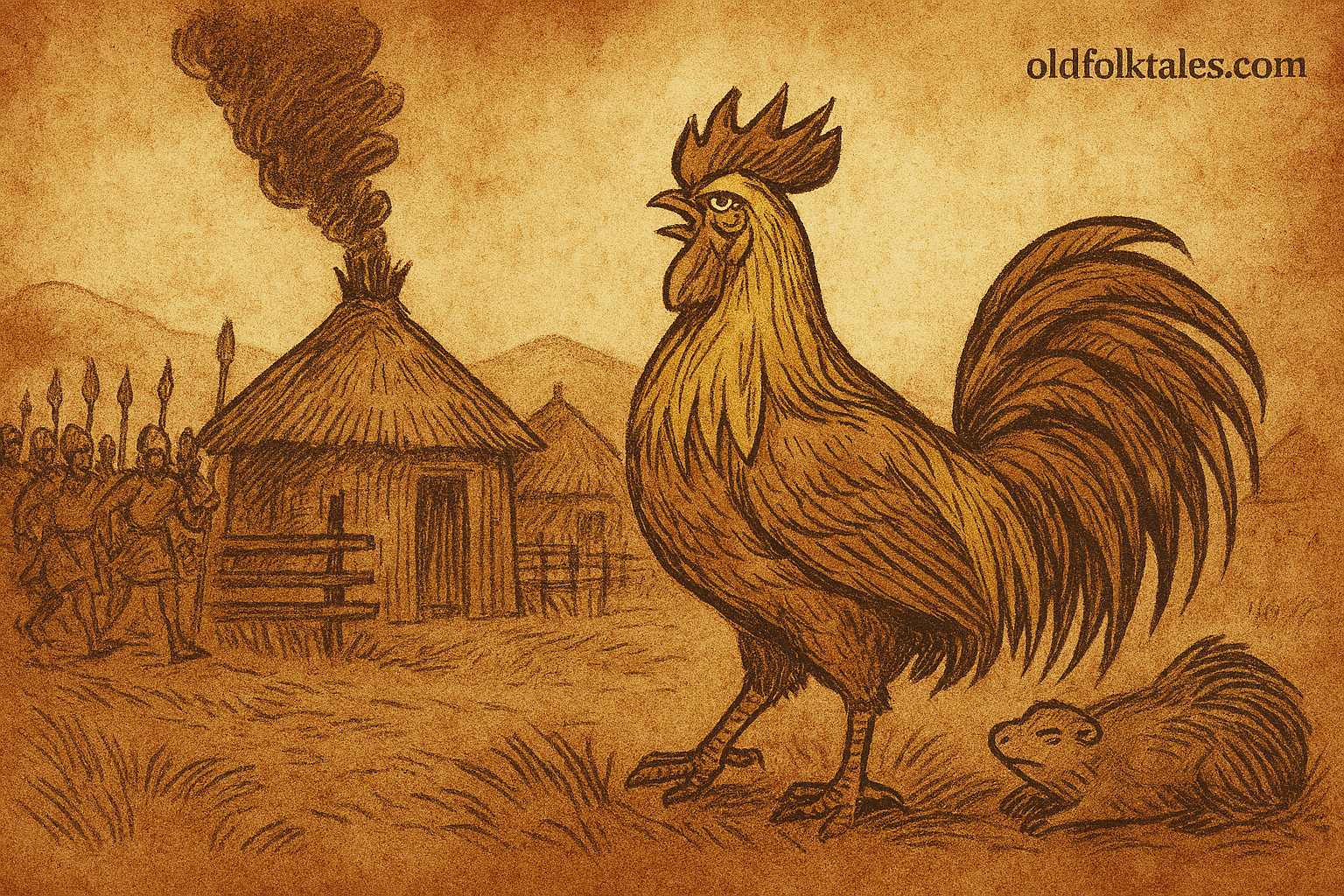
Their confusion deepened when they reached the main entrance to the cattle kraal, where a magnificent golden rooster perched regally upon the wooden fence. This was no ordinary bird, his feathers gleamed like burnished metal in the afternoon sun, and his bright yellow eyes held an intelligence that seemed almost human. As the warriors approached, he regarded them with calm dignity, showing no fear whatsoever.
“What brings you to our city?” the golden rooster inquired, his voice carrying the unmistakable tones of a man. “Do you seek shelter from the storm?”
The warriors stood slack-jawed with amazement, scarcely believing their ears. Their commander, recovering first from his shock, stepped forward respectfully. “Great Rooster,” he said, “we seek only fire to warm ourselves and cook our food. We are far from home and caught in this bitter weather.”
“You shall have all that you require,” the golden rooster replied with gracious hospitality. “I am indeed a man, just as you are, though you see me in this form. A wicked king, more powerful than I, worked dark magic upon me and all my people. This tyrant was a cannibal who dared to demand my daughters’ hands in marriage for his own sons. When I refused to allow my children to be joined with such evil, his sorcerers transformed my entire kingdom myself, my warriors, my subjects all of us became the fowls you see before you.”
“Is there no way to break this terrible curse?” asked the commander with genuine sympathy.
The golden rooster’s eyes grew sad, and he lowered his magnificent head. “Only by defeating a king more powerful than myself can we regain our human forms. But as you can see, this presents considerable difficulty in my current state.”
Despite his transformed condition, the golden rooster proved to be a host of extraordinary generosity. He led the hunting party to comfortable huts, provided them with the finest food and drink, and when they prepared to depart, he gave them a specially prepared smoldering stick that would burn for many hours without being extinguished. Grateful beyond measure, the warriors made their way back to their otter-hunting camp, where they were finally able to warm themselves and cook their food.
Upon returning to their king’s city, the hunting party recounted every detail of their remarkable adventure. They spoke of the golden rooster’s courtesy, his tragic transformation, and most notably, his vast herds and obvious wealth. The moment the king heard of these riches, his eyes blazed with avarice, and he began pacing his throne room like a caged leopard.
“What fools I have for servants!” he roared, his voice echoing off the stone walls. “Why did you not seize those cattle immediately? How could you fail to overcome a mere collection of roosters and hens?”
“Great King,” the commander replied with quiet dignity, “we received no orders to conquer. The golden rooster gave us everything we needed freely why should we have repaid his kindness with theft?”
“You missed the opportunity of a lifetime!” the king snarled. “But I shall remedy your failure immediately.”
Without delay, he summoned one of his finest regiments and ordered them to march upon the enchanted city. His greed had completely overwhelmed any sense of honor or gratitude, and he could think of nothing but claiming those vast herds for himself.
The regiment found the path easily enough and, after several days of hard marching, arrived within sight of the remarkable fowl-city. The golden rooster stood at his customary post by the cattle kraal, and his keen eyes immediately recognized the approaching soldiers’ hostile intent. Swiftly, he called to his herds, and they obediently filed into the protective enclosure. Then, flying to the great central hut, he released a cry that echoed throughout the settlement.
“Come out, come out, my people!” he called urgently. “Warriors have come to steal our cattle! Come out and defend your homes!”
The response was immediate and overwhelming. From every corner of the city, fowls of all descriptions came streaming forth thousands upon thousands of roosters, hens, and chickens, until the very air seemed to darken with their numbers. Each bird took position at the door of a hut, their eyes fixed upon the approaching invaders.
The moment the regiment entered the city, chaos erupted. Every fowl selected a target and launched into furious attack, wings flapping, talons slashing, and beaks striking with deadly precision. The assault was so fierce and coordinated that within minutes, each warrior had been blinded by the relentless pecking. Such was the strength and ferocity of the enchanted birds that only two or three soldiers escaped alive from the entire regiment.
When news of this disaster reached the king, his fury knew no bounds. His face turned purple with rage, and he immediately summoned his most elite force the royal bodyguard itself. These were the finest warriors in all his domain, clad in their prestigious otter-skins and crowned with magnificent black ostrich plumes. At their head, he placed his own beloved son, a prince renowned for his courage and skill in battle.
“Bring me that rooster’s head,” the king commanded, “and drive his cattle back to our city. Let none survive who dares to defy me!”
Day after day, the king waited for news of victory. Each evening as the sun painted the sky crimson, he climbed to his highest tower, expecting to see his triumphant army approaching through clouds of golden dust, vast herds of captured cattle lowing before them. But the horizon remained empty, and days stretched into weeks without word.
Finally, as darkness was falling one evening, a single figure appeared on the distant road a lone survivor, barely able to walk, his magnificent plumes gone, only tattered fragments of otter-skin still clinging to his body. He collapsed before the king’s throne, gasping for breath.
“Great King,” he wheezed between agonized groans, “I am all that remains of your royal bodyguard.”
The king’s face went white as bone. “My son?” he whispered. “Tell me my son yet lives!”
“Great King, the prince is dead, along with every one of our warriors. No mortal force can withstand the fury of those enchanted fowls. The golden rooster spared only me, that you might learn the fate of your army. He bade me tell you that he still awaits your answer.”
For the first time in his reign, the greedy king found himself completely defeated. His shoulders sagged as the full weight of his losses crashed down upon him. “How can I continue this fight?” he said in a broken voice. “My finest warriors are dead, my beloved son is gone. Let the golden rooster keep his city and his herds, I am beaten.”
The moment those words of surrender left the king’s lips, a miraculous transformation began in that distant enchanted city. The golden rooster’s form shimmered and grew, his feathers melting away to reveal the noble bearing of a true king. Throughout the settlement, every fowl underwent the same magical change, until once again human voices filled the air and human hands took up the work of the day.
The transformed king for that is what the golden rooster had always been now ruled over his restored kingdom with wisdom and justice. He had won his victory through courage and righteousness, defeating a far more powerful enemy not through superior force, but through the strength that comes from protecting one’s home and people.
The Moral Lesson
This powerful folktale teaches us that greed and the abuse of power ultimately lead to downfall, while courage, hospitality, and justice triumph in the end. The greedy king’s insatiable desire for wealth cost him his army and his son, while the golden rooster’s noble character shown through his kindness to strangers and his determination to protect his people earned him victory and the restoration of his rightful form. The story reminds us that true strength comes not from what we can take from others, but from how we treat those who are vulnerable and how we stand up for what is right.
Knowledge Check
Q1: Who is the golden rooster and why was he transformed in this African folktale? A: The golden rooster is actually a king who was transformed by a more powerful cannibal king’s magic. He was cursed along with all his people when he refused to let his daughters marry the cannibal king’s sons.
Q2: What character flaw drives the greedy king’s actions throughout the story? A: The greedy king is consumed by avarice and an insatiable desire for wealth. Despite his vast riches, he can never have enough and doesn’t care about gaining things justly, which ultimately leads to his downfall.
Q3: How does the golden rooster demonstrate good character before the conflict begins? A: The golden rooster shows hospitality and generosity by providing shelter, food, drink, and fire to the lost hunting party without asking for anything in return, despite being in a transformed and vulnerable state.
Q4: What happens to the greedy king’s armies when they attack the enchanted city? A: Both armies are destroyed by the coordinated attack of thousands of enchanted fowls who peck out the warriors’ eyes. Only a few survivors escape each assault, including the king’s son who dies in the second attack.
Q5: What breaks the transformation curse on the golden rooster and his people? A: The curse is broken when the golden rooster defeats a more powerful king in fair combat. The moment the greedy king admits defeat and surrenders, the golden rooster and all his people regain their human forms.
Q6: What does this folktale teach about the consequences of greed and abuse of power? A: The story demonstrates that greed and unjust use of power lead to destruction and loss. The greedy king’s avarice costs him his armies, his son’s life, and ultimately his defeat, while righteousness and protecting others leads to victory and restoration.
Source: Swazi folktale, Eswatini (Swaziland)