Once there was a man named Obang, a respected elder who had grown weak with age and sickness. He lay alone in his hut, his body frail and his breath shallow, aware that his days on earth were numbered. As he gazed at the familiar walls of his home, he thought to himself, “Soon I will be gone. Who will care for my wives and children when I am no longer here?”
Outside, life continued as usual. The smoke of cooking fires curled into the sky as his wives prepared food. His children’s voices rang out with laughter as they played. But Obang’s heart grew heavy with worry.
Then, through the air, he caught another sound, the carefree voice of his only son. The young man was laughing loudly with his companions in the middle of the day.
“That is my son,” Obang thought bitterly. “Why does he waste his time with laughter and idle talk? Why is he not working as a man should?”
Soon after, a figure appeared at the doorway of the hut.
“Who is it?” Obang called out.
“It is I, your old friend,” came the reply. The man entered and sat beside the dying elder.
Obang’s face softened with relief. “Ah, my dear friend. I am glad to see you. Will you help me?”
“Yes, of course,” his friend answered with loyalty.
Obang spoke with a trembling voice: “I am dying. My body is failing, and my time is short. But it is not death that troubles me, it is the fate of my family. Who will provide for them after I am gone?”
“You have a son,” his friend replied gently. “Surely he can care for them.”
READ THIS: The Man, the Buffalo, and the Gift of Spears: Anuak Folktale from Ethiopia
But Obang shook his head. “My son is lazy and weak. Every day he runs about with his friends, eating, drinking, and wasting time. He does not know the value of work. But I have a plan, and you must be the one to carry it out. You must become his teacher.”
“How will I teach him?” his friend asked.
Obang’s eyes shone with determination. “When I die, burn everything, my huts, my food stores, my clothes, my tools. Burn them all. I cannot take these things with me into the afterlife, and if they remain, my son will continue in his idleness. Only through hardship will he learn to work.”
The friend hesitated. “But …”
“Please,” Obang interrupted. “Promise me this one thing.”
His friend bowed his head. “I promise.”
Weeks later, Obang passed away. The people mourned him, remembering him as a good and wealthy man. But they shook their heads at his son. “He is not like his father,” they whispered.
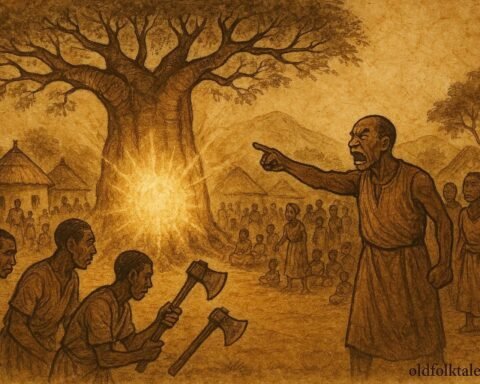
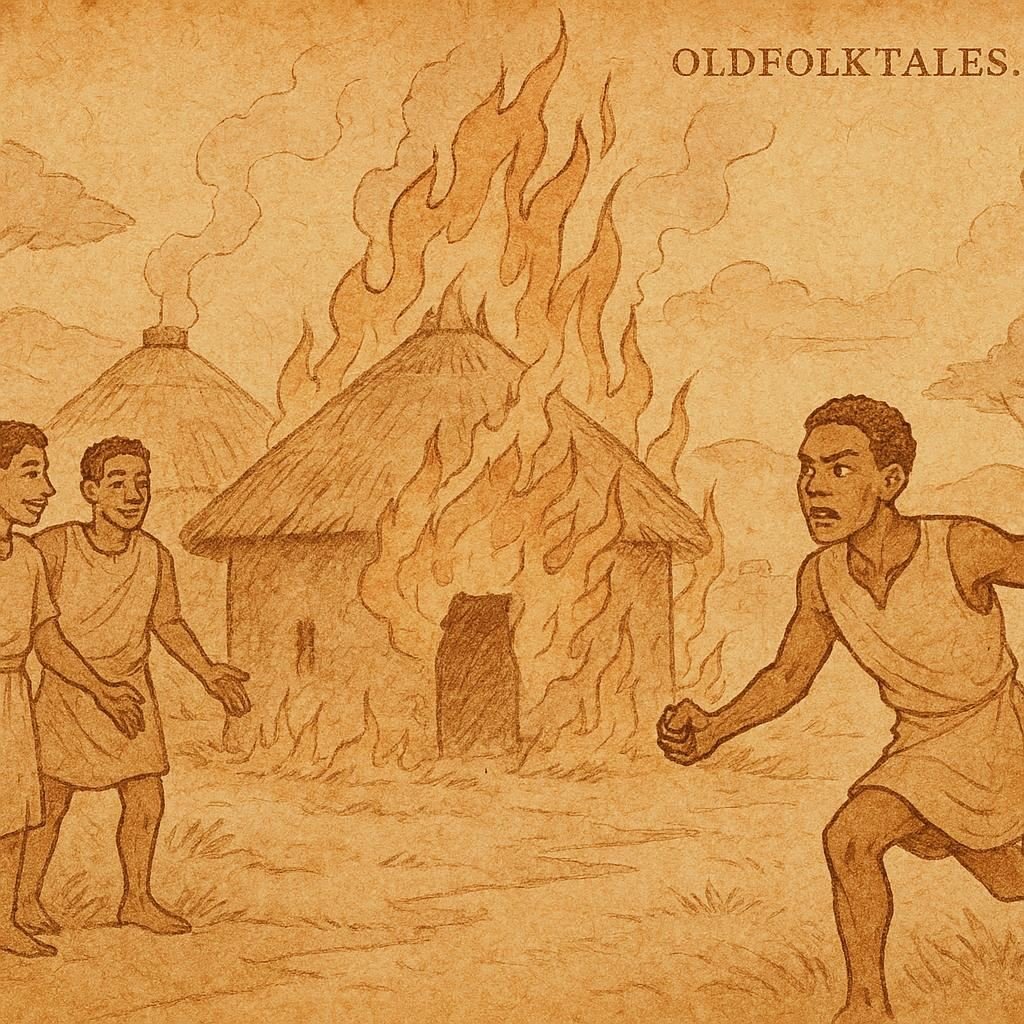
Then, one evening, smoke began to rise into the sky. The people sniffed the air.
“Fire!” they cried.
They ran to Obang’s compound, where flames devoured the huts, the food store, the clothes, and the tools. Everything was being reduced to ash. Obang’s wives and children wailed in despair.
“What will we do now?” they sobbed. “We have nothing left! Hunger will kill us.”
At that very moment, Obang’s son was sitting with his friends, drinking as usual. But when he heard the shouting, he rushed to the scene of the fire. His friends called after him, “Come back! Do not trouble yourself. Have another drink. There is nothing you can do.”
But the young man stood still, staring at the flames and then at the faces of his father’s wives and children. His heart tightened.
“No, no,” he said to his companions. “Goodbye. I can no longer sit idly. From today, I must work.”
True to his word, the son changed his ways. From dawn to dusk he labored on his father’s land. He rebuilt the huts with his own hands and worked the soil until the stores overflowed with food. His father’s wives ate their fill, and the children grew happy and strong once again.
Watching from afar, Obang’s faithful friend smiled.
“My old friend’s plan was wise,” he thought. “The son has learned to work, and in truth, I was his teacher.”
Moral Lesson
This story teaches that true love often requires hard decisions. Obang understood that wealth alone could not protect his family; only discipline, responsibility, and work could. By destroying his possessions, he ensured that his son would grow into the man the family needed.
It also reminds us that hardship can be a gift in disguise. Struggle shapes character, while ease can weaken it. Through trial, the young man found strength, purpose, and dignity.
Knowledge Check
1. Who was Obang, and what was his main concern before death?
Obang was an elder who worried about his family’s survival after his death.
2. Why did Obang distrust his son’s ability to care for the family?
Because his son was lazy, preferring to eat, drink, and play with friends instead of working.
3. What unusual request did Obang make to his friend?
He asked his friend to burn all his huts, food stores, clothes, and tools after his death.
4. What effect did the fire have on Obang’s son?
It forced him to abandon his laziness, begin working hard, and provide for the family.
5. How did the community react when they saw Obang’s possessions burning?
They cried out in despair, fearing that the family would starve without resources.
6. What is the main lesson of this folktale?
That hardship can be a powerful teacher, and responsibility is born from struggle.
Source: Anuak folktale, Ethiopia (Gambela region).