Listen, children of the earth. Listen to the wind that carries the old words. Listen to the story that your grandmothers’ grandmothers whispered when the stars were young…
In the time before time, when the world was soft and new like a springbok’s first steps, the people lived in darkness. Cold, cold darkness that bit their bones like the winter wind from the great dry lands. The sun would rise each day, yes, but when she walked her path back to her sleeping place, the people huddled together like meerkats in their holes, shivering, shivering.
No fire lived among the people then. No warm orange tongue to dance and sing in the night. No glowing heart to cook the meat or chase away the prowling shadows where the hyenas laughed their wicked laughs.
The fire lived only with the Sky People, the ancient ones who walk on the wind. Up, up, up above the clouds, they kept the sacred flames burning bright as the morning star. They guarded it jealously, these Sky People, for they remembered the old warnings: “Fire is power. Fire is life. Fire is danger. Give it to the earth-walkers, and see how they burn themselves and all the world.”
But there was one among the Sky People whose heartbeat with compassion. Her name was Xabbukattu, She Who Sees All Things. She watched the earth-people shivering in their shelters. She saw the mothers trying to warm their babies with breath and fur. She saw the old ones growing cold and still when the black nights stretched too long.
“This cannot be,” she whispered to her sister-spirits. “These earth-walkers are our children too. Did we not breathe the first life into them? Did we not teach them to hunt and gather? How can we let them suffer so?”
But the other Sky People turned away. “It is forbidden,” they said. “Fire belongs to us alone.”
Now, Xabbukattu was wise, wise as the old stories. She knew the laws of sky and earth. She could not steal fire and give it as a gift that would break the sacred balance. But there was another way, an older way, written in the patterns of storm and season.
She waited. Patient, patient as the desert waiting for rain. She watched the earth turn through many seasons, watched the people grow thin and weak from the cold nights. Then came the time of the great storms, when the Sky People danced their wildest dances and shook their spears of lightning.
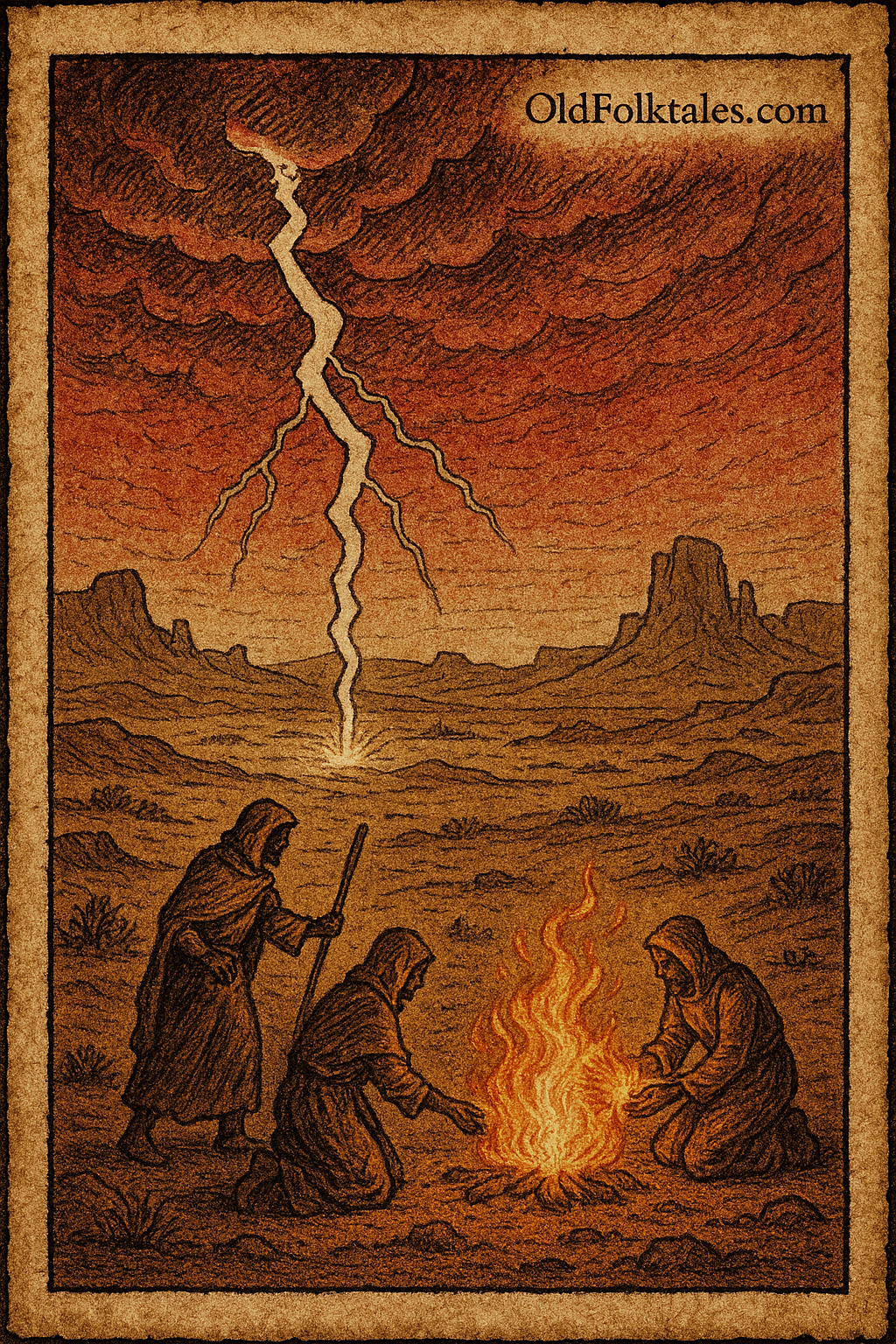
Xabbukattu joined the storm-dance, but she danced with purpose. She spun and whirled until she was dizzy as a dust devil. She sang the old, old songs until her voice became thunder. And when the moment was perfect when earth and sky breathed together like lovers she hurled herself down, down, down in a blazing streak of light.
CRACK! FLASH! BOOM!
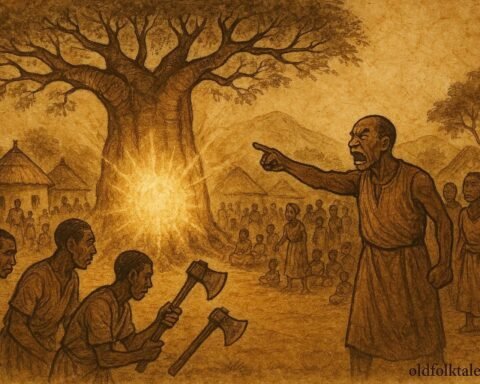
The lightning struck the great baobab tree that stood in the center of the earth-people’s land. The ancient tree split and smoked, and there oh, wonder! fire bloomed in its hollow heart like a red flower opening.
The earth-people came running, running from all directions. They had never seen such a thing bright flames dancing without the sun! They reached out trembling hands to feel the warmth, and their faces lit up with joy bright as the fire itself.
But Xabbukattu was not finished. Though her body had become lightning, her spirit remained. She appeared to the wisest of the earth-people, an old woman whose eyes held the depth of waterholes.
“Grandmother,” the spirit whispered, “I have brought you fire from the sky. But listen well this gift comes with great responsibility. Fire can warm your homes and cook your food. It can light your way in darkness and protect you from the night-hunters. But fire can also burn and destroy. It can eat the grasslands and turn the world to ash. You must guard it carefully, feed it wisely, and teach your children to respect its power.”
The old woman nodded, for she understood the weight of such gifts. “How shall we keep this fire alive, spirit-mother? How shall we honor your sacrifice?”
“When the rains come heavy and threaten to drown the flames, shelter them,” Xabbukattu replied. “When the dry season comes and the fire grows hungry, do not let it eat beyond its place. Pass the fire-knowledge from grandmother to granddaughter, from father to son. And remember, remember always that fire came not as conquest but as compassion, not as right but as responsibility.”
From that day forward, the earth-people tended their fire with careful hands. They learned to carry glowing coals from place to place, wrapped in clay and ash. They learned which woods burned clean and which made bitter smoke. They learned to bank the fires at night and wake them with the dawn.
And always, when the lightning danced in the sky, they remembered Xabbukattu’s gift and spoke her name with gratitude.
The fire spread from people to people, carried like seeds on the wind. Each tribe learned the sacred responsibility, each family kept the covenant with the Sky People. For they knew that fire was not just flame and heat, it was the bridge between earth and sky, the proof that the ancestors still watched over their children with love.
Even today, when the thunder rolls across the Kalahari and the lightning splits the dark sky, the old ones whisper: “There is Xabbukattu, dancing her storm-dance, reminding us that the greatest gifts come not from our own power, but from the compassion that bridges all worlds.”
This is the story as it was told to me, as it was told to my grandmother, as it will be told to the children not yet born. May you carry its wisdom like fire in your heart.
The Teaching of Fire: Balance Between Power and Responsibility
The folktale of Xabbukattu teaches us profound truths about the nature of power and our responsibility as its wielders. Fire represents transformative force in human society the technology and knowledge that can either elevate civilization or destroy it. The Sky People’s initial reluctance reflects the legitimate fear that accompanies the sharing of powerful tools, while Xabbukattu’s compassion demonstrates that withholding beneficial power can itself become a form of cruelty.
The story emphasizes that true power comes with inherent responsibility. Fire was not given freely without conditions, but came with explicit instructions for its proper use and safeguarding. This reflects the San understanding that humans must be stewards rather than masters of the forces they employ. The fire must be sheltered from floods but prevented from consuming beyond its boundaries, a perfect metaphor for the delicate balance required when wielding any significant power.
Furthermore, the tale highlights the importance of intergenerational knowledge transfer. The fire-wisdom must pass “from grandmother to granddaughter, from father to son,” ensuring that each generation understands both the benefits and dangers of their inherited power. This speaks to our modern responsibility to pass on not just our technologies and capabilities, but the wisdom and ethical frameworks necessary to use them responsibly.
The story reminds us that the greatest gifts often come through sacrifice and should be received with humility. Xabbukattu’s transformation into lightning represents the ultimate giving of self for others’ benefit. When we receive such gifts whether they be knowledge, resources, or opportunities we honor the sacrifice by using them not for selfish gain, but for the betterment of our communities and the continuation of wisdom.
Knowledge Check: Understanding San Fire Folklore
Q1: What is the significance of fire in traditional San culture and storytelling? A: Fire holds central importance in San culture as both a practical necessity for survival in the Kalahari Desert and a powerful spiritual symbol. In San storytelling, fire represents the connection between the earthly and divine realms, transformation, and the responsibility that comes with power. Traditional San communities relied on fire for warmth, cooking, protection from predators, and as a gathering point for storytelling and community bonding.
Q2: How do San folktales use natural elements like lightning and storms in their narratives? A: San folktales frequently incorporate natural phenomena as manifestations of spiritual activity and divine intervention. Lightning and storms are portrayed as the actions of ancestral spirits or Sky People, representing moments when the boundary between the physical and spiritual worlds becomes permeable. These elements serve both as plot devices and as ways to explain natural phenomena while teaching moral lessons about respect for nature’s power.
Q3: What role do ancestral spirits play in traditional San folklore and mythology? A: Ancestral spirits in San folklore act as intermediaries between the living and the divine, often intervening to help or guide their descendants. These spirits, like Xabbukattu in the fire tale, are portrayed as compassionate beings who maintain connection to their earthly children while possessing wisdom and power from the spiritual realm. They serve as moral exemplars and sources of cultural knowledge and traditions.
Q4: How does the oral storytelling tradition preserve San cultural values and wisdom? A: San oral storytelling serves as the primary method for transmitting cultural values, practical knowledge, and spiritual beliefs across generations. The rhythmic, repetitive style aids memorization, while the vivid imagery and moral teachings embedded in stories like “The Fire That Came from the Sky” ensure that essential cultural wisdom about responsibility, respect for nature, and community values are preserved and passed down intact.
Q5: What environmental and survival themes appear in traditional San folktales? A: San folktales frequently address themes of survival in harsh environments, the importance of cooperation, respect for natural resources, and sustainable living practices. Stories often feature lessons about water conservation, food sharing, fire management, and the delicate balance between human needs and environmental preservation reflecting the San people’s deep understanding of living sustainably in the challenging Kalahari environment.
Q6: How do San creation stories and origin myths reflect their worldview and relationship with nature? A: San creation stories and origin myths, like the fire folktale, reflect a worldview that sees humans as interconnected with all aspects of nature and the spiritual realm. These stories emphasize balance, reciprocity, and responsibility rather than dominance over nature. They portray the acquisition of important cultural elements (like fire) as gifts that come with obligations, reflecting the San understanding that humans are stewards rather than masters of the natural world.