Long ago, when the waters of Lake Victoria stretched endlessly beneath the African sun, there stood a magnificent palace on its very shores. Within those walls lived a powerful chief whose wealth was measured not only in cattle and land, but in the treasure he valued most his only daughter, Nyakana.
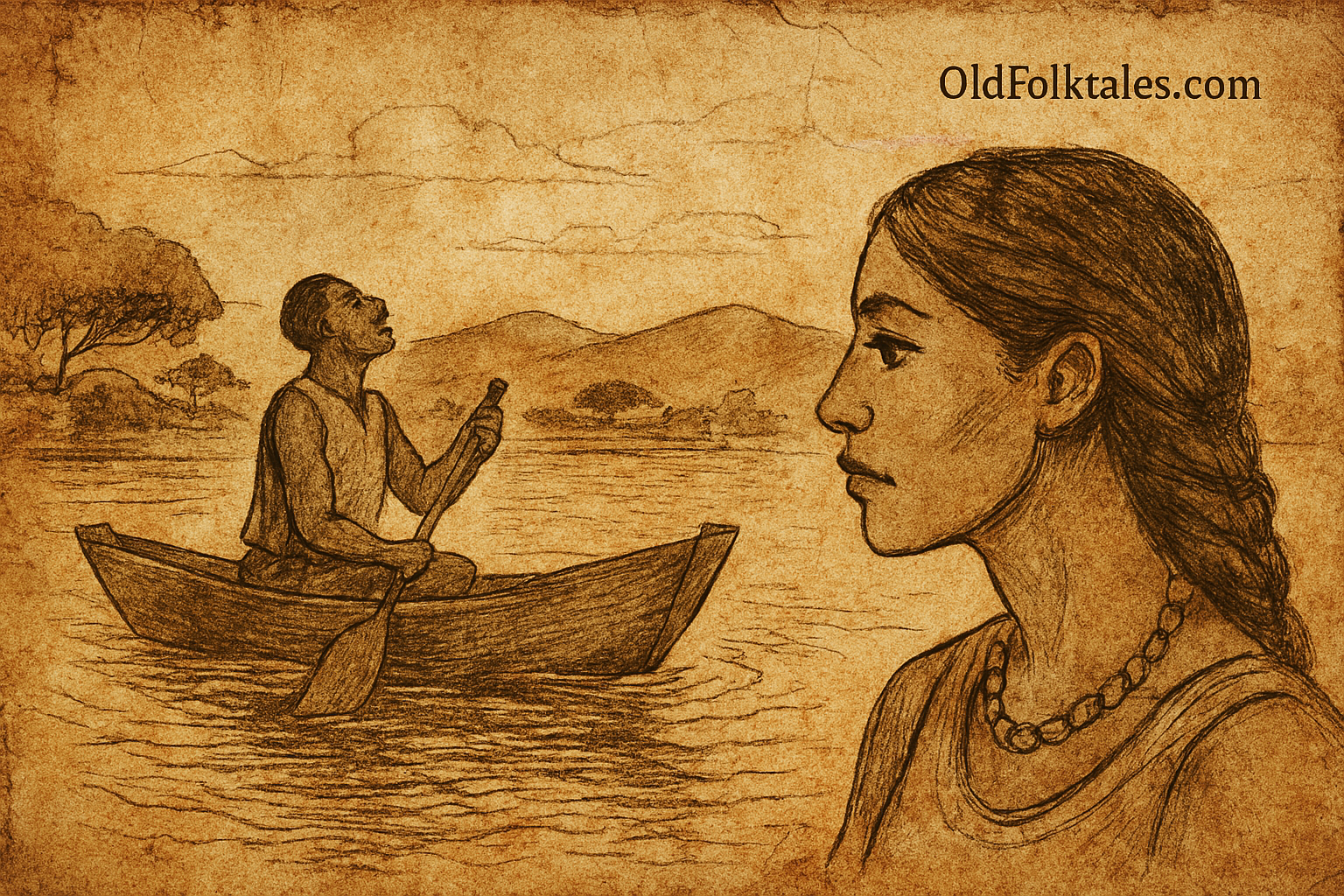
Nyakana was a maiden of exceptional beauty and grace, born into the highest ranks of her people. As was the custom for daughters of nobility, she was kept carefully sequestered from the common world, shielded from the gazes of ordinary men who might dare to desire her. Her days unfolded in quiet solitude within the tall tower of her father’s palace, where sunlight filtered through narrow windows and the breeze carried the scent of hibiscus flowers. There, she would embroider intricate patterns onto barkcloth, braid her long hair with practiced fingers, and gaze out across the shimmering expanse of Lake Victoria, watching fishermen’s canoes glide across waters that seemed to stretch into eternity.
One particular afternoon, as Nyakana sat by her window with her needlework forgotten in her lap, something extraordinary happened. A song drifted across the water, deep and resonant, sweet as honey, filled with a longing that seemed to speak directly to her soul. She rose quickly and pressed herself against the window frame, searching for the source of this enchanting melody.
Looking for more? Explore the magic of East African folktales here
There, upon the glittering lake, she saw a lone fisherman paddling his canoe with steady, practiced strokes. He cast his net with the rhythm of one who had performed this task a thousand times, yet his voice soared above the mundane work, singing words that made her heart quicken:
“My love is like the hibiscus in the breeze,
My love is like the moonlight on the lake.”
Nyakana’s breath caught in her throat. “Surely,” she whispered urgently to her maid who stood nearby, “such a voice could only belong to a noble man. Perhaps even the son of a great chief, disguised as a common fisherman for reasons of adventure or escape.”
From that day forward, Nyakana returned to her window every afternoon, waiting with desperate hope to hear that song again. But the fisherman did not return. Days stretched into weeks, and the silence where his music had been grew unbearable. Nyakana stopped eating. She pushed away her embroidery. Her eyes grew distant and her skin pale, as though the very life was draining from her body.
The chief, watching his beloved daughter waste away, summoned every healer in the land. Herbalists brought potions brewed from roots and leaves. Medicine men performed elaborate rituals. Diviners cast bones and read portents in smoke. But nothing could cure the mysterious ailment that consumed her.
Finally, Nyakana’s faithful maid could bear the secret no longer. She fell to her knees before the chief and confessed the truth: “My lord, your daughter is sick with love. Her heart yearns for the one who sang upon the lake. Find him, and she may yet be saved.”
The chief immediately dispatched messengers throughout the land. They traveled to every village, questioned every fisherman, searched every shoreline. At last, they found him, a humble man named Kaweesi, who lived in a simple hut and spent his days casting nets for fish to sell at the market.
When they brought Kaweesi to the palace, the chief could barely conceal his disappointment. This man was not young, nor was he handsome in the way noblemen were. His skin was weathered from years under the sun, his hands calloused and rough from rope and nets. The smell of fish and lake water clung to his worn clothing. The chief frowned deeply. “Surely this cannot be the man my daughter has lost her heart to.”
Nevertheless, Kaweesi was led through the palace corridors and told to stand outside Nyakana’s chamber and sing. His voice, trembling with nervousness and hope, rose through the heavy wooden door:
“My love is like the hibiscus in the breeze,
My love is like the moonlight on the lake.”
Inside her room, Nyakana leapt to her feet with sudden energy, her illness seemingly forgotten. “It is him!” she cried out joyfully. “That is the voice I have been longing for!” She called for her finest barkcloth garments, adorned herself with strings of colorful beads, arranged her hair beautifully, and stood ready to meet the man whose song had captured her heart.
The door swung open. Nyakana stepped forward, her eyes bright with anticipation, and then she stopped. Before her stood not the noble prince of her imagination, but Kaweesi the fisherman, with his ragged clothes and rough, weathered face.
Her expression changed in an instant. First came confusion, then disbelief, and finally something cruel, laughter. She laughed at her own foolishness, at the gap between fantasy and reality. “A chief’s son?” she said mockingly. “No, you are nothing but a common fisherman! Close the door at once. Remove him from my sight.”
The heavy door slammed shut between them. Kaweesi stood frozen in the corridor, her laughter echoing in his ears like the cries of lake birds. That sound, filled with contempt and rejection, cut deeper into his heart than any spear ever could.
He returned to his humble hut by the lake, refusing all food and water. He would not sleep, would not fish, would not speak to his concerned neighbors. He simply sat staring out at the waters where he had once sung so hopefully, until at last his broken heart could bear no more, and he died.
When his neighbors came to prepare his body for burial, they discovered something extraordinary. Where his heart should have been, there was no longer flesh and blood, but a clear crystal that shone like water reflecting moonlight, perfectly transparent, perfectly hard.
“This is his heart,” said the village elder, holding the crystal up to the light with reverence. “It has been hardened by the weight of his sorrow and the cruelty of rejection.”
According to custom, they placed the crystal heart in Kaweesi’s canoe along with his fishing net and pushed it out onto Lake Victoria, expecting the current to carry it toward the wide, open waters. But the canoe did not drift away. Instead, as if guided by an invisible hand, it floated steadily back toward the chief’s palace, coming to rest against the shore where the palace walls met the lake.
The chief himself, taking his evening walk along the waterfront, discovered the canoe and the remarkable crystal within it. “What a rare treasure!” he exclaimed, holding it up to examine it in the fading light. He had never seen anything so beautiful, so perfectly formed. He immediately summoned the finest craftsmen in the land and ordered them to carve the crystal into a drinking cup worthy of his daughter.
The artisans worked for many days, shaping and polishing the crystal until it became a cup of extraordinary beauty. When it was finished, the chief presented it to Nyakana, who accepted it with delight, never knowing its true origin.
One warm night, when the moon hung full and bright over Lake Victoria, Nyakana prepared tea in her chamber and poured it into her beautiful crystal cup. She carried it to her window, where she loved to sit and watch the moonlight dance upon the water’s surface. But as she lifted the cup to her lips, preparing to drink, she suddenly gasped.
There, in the tea’s dark, rippling reflection, was a face. Kaweesi’s face. His eyes gazed up at her with an expression of such profound, sorrowful love that her breath caught in her throat. And then his voice rose from the cup, soft and haunting, singing new words to the old melody:
“Nyakana is like the hibiscus in the breeze,
Nyakana is like the moonlight on the lake.”
Tears sprang immediately to Nyakana’s eyes and began streaming down her cheeks. “Forgive me,” she whispered desperately to the face in the cup. “Please forgive me. I was cruel and foolish. I judged you by your appearance and not by the beauty of your soul. I did not understand what I was destroying. I am so, so sorry.”
A single tear fell from her face into the tea. The moment it touched the liquid, the crystal began to dissolve, melting away like morning mist. Kaweesi’s spirit, trapped for so long in that hardened heart, was finally released. His song drifted one last time across Lake Victoria, growing fainter and fainter until it faded completely into the night:
“Nyakana is like the hibiscus in the breeze,
Nyakana is like the moonlight on the lake…”
Not long after this strange and sorrowful event, arrangements were made for Nyakana’s marriage. Her father betrothed her to the son of another powerful chief, a young man who possessed all the qualities she had once dreamed of. He was handsome and strong, well-spoken and noble, exactly the kind of husband a chief’s daughter should desire.
The wedding was celebrated with great ceremony, and Nyakana became the wife she had been raised to be. Yet something had changed within her. On quiet evenings, when she stood alone by the shores of Lake Victoria and watched the moonlight paint silver paths across the dark water, she would often hear it, faint but unmistakable, the echo of Kaweesi’s song, carried on the breeze, living forever in the chambers of her heart.
The Moral Lesson
This poignant tale teaches us that true worth cannot be measured by outward appearances, social status, or material wealth. Nyakana’s cruel rejection of Kaweesi, based solely on his humble station rather than the beauty of his soul and the sincerity of his love, brought irreversible tragedy and lifelong regret. The story reminds us to look beyond the surface, to honor the feelings of others, and to recognize that pride and prejudice can destroy something precious that can never be recovered. Sometimes we don’t realize the true value of what we have until it’s gone forever, and some opportunities for love and connection, once lost, can never be reclaimed.
Knowledge Check
Q1: Who is Nyakana in this Ugandan folktale?
A: Nyakana is the only daughter of a powerful chief who lives in a palace on the shores of Lake Victoria. As a maiden of high birth, she is kept secluded in a tower where she becomes enchanted by a fisherman’s beautiful song, leading to the story’s tragic events.
Q2: What is the significance of the crystal heart in the story?
A: The crystal heart symbolizes how Kaweesi’s heart was hardened by the profound sorrow of rejection and humiliation. When he dies of heartbreak, his physical heart transforms into a clear crystal, representing both the purity of his love and the permanent damage caused by Nyakana’s cruelty. It becomes the vessel through which his spirit later reveals the truth to her.
Q3: Why does Nyakana reject Kaweesi after falling in love with his song?
A: Nyakana rejects Kaweesi because of his humble social status and rough appearance. She had imagined the singer to be a nobleman or disguised prince, not a common fisherman. Her pride and prejudice based on social class prevent her from seeing the beauty of his soul, leading her to laugh cruelly at him despite his genuine love.
Q4: What lesson does the fisherman’s song teach about judging others?
A: The story teaches that we should not judge people by their outward appearance, occupation, or social status. True worth lies in the character, sincerity, and soul of a person. Nyakana’s superficial judgment destroyed a genuine love and brought her lifelong regret, demonstrating how pride and prejudice can have irreversible consequences.
Q5: What is the cultural significance of Lake Victoria in this folktale?
A: Lake Victoria serves as both the physical setting and a symbolic element in this Ugandan tale. It represents the boundary between different social worlds, the source of livelihood for common people like Kaweesi, and a witness to both love and tragedy. The lake’s moonlit waters become a recurring motif for beauty, longing, and memory throughout the story.
Q6: Why does Kaweesi’s canoe return to the palace instead of drifting away?
A: The canoe’s supernatural return to the palace represents the unfinished nature of Kaweesi’s story and the inescapable consequences of Nyakana’s actions. It suggests that his spirit and the truth of what happened cannot simply disappear or be forgotten, they must eventually be confronted, bringing the crystal heart directly back to the one who caused his death.
Source: Ugandan folktale from the Lake Victoria region, East Africa