Once upon a time, when rivers still spoke and spirits walked among men, there lived a fisherman in Osogbo named Adekunle. Every morning, he would take his net and paddle his small canoe into the golden waters of the Oshun River. The river fed his family, and for many seasons he prospered. But over time, Adekunle became greedy. Instead of offering thanks to the goddess of the river, Oshun, he boasted that his skill alone brought him success.
The elders often warned him. “Adekunle, remember Oshun is the mother of this river. Without her blessing, no fish would swim to your net.” But Adekunle laughed and said, “My hands are strong, my net is wide, and my canoe is swift. What need have I for offerings?”
One hot afternoon, Adekunle set out on the river, his heart heavy with pride. He cast his net again and again, yet not a single fish appeared. The once bountiful waters had turned silent. Angered, he struck the river with his paddle and shouted, “If Oshun is truly here, let her show herself!”
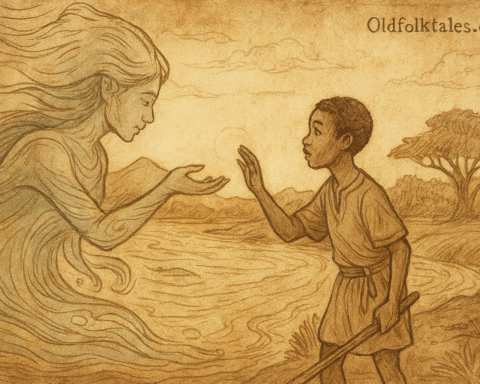
The waters rippled and began to glow. From the golden current rose Oshun, radiant in flowing garments, her crown shimmering like sunlight on water. Her beauty filled the air with fragrance, and her eyes carried both gentleness and power.
“Adekunle,” Oshun said, her voice like the song of running streams, “you have eaten from my river yet refused to honor me. You take without giving. Do you think the river belongs to you?”
The fisherman trembled, but his pride still clung to him. “I have worked hard, Great Mother. My net and strength bring the fish. Why should I bow to you?”
Oshun lifted her hand. At once, the river swelled, and Adekunle’s canoe rocked fiercely. From the depths, fish leapt and splashed, but none entered his net. “Your pride blinds you,” Oshun said. “The river is sacred. Without respect, you will find only emptiness.”
Humbled by fear, Adekunle fell to his knees in the canoe. “Forgive me, Oshun. I did not know the weight of my words. Teach me how to honor you.”
Oshun’s eyes softened. “It is not offerings alone that I seek, but respect. Pour libation before the river. Speak my name with gratitude. Share your catch with the hungry, for the river nourishes all.”
Adekunle returned to the village that evening with an empty basket, but his heart was full of new wisdom. The next morning, he rose before dawn. At the riverbank, he poured palm wine onto the waters and said, “Mother Oshun, I thank you for the gift of life and the food you provide.”
When he cast his net that day, fish swam freely into it until it overflowed. The villagers saw and marveled, but Adekunle no longer boasted. Instead, he gave part of his catch to the poor and reminded others, “This is Oshun’s blessing, not mine.”
From that day, the fisherman lived in harmony with the river. His children and grandchildren learned that no man owns the waters. They belong to the goddess, and only through respect can they bring abundance.
Moral Lesson of The Fisherman and the River Goddess Oshun
The story teaches that pride leads to downfall, but respect for the sacred brings blessings. Oshun reminds us that nature is not to be taken for granted. We must honor the rivers, forests, and spirits that sustain life. To dishonor them is to invite emptiness, but to walk humbly with gratitude is to receive abundance.
Knowledge Check: The Fisherman and the River Goddess Oshun
Why did Adekunle lose his fish at the river?
Adekunle lost his fish because he disrespected Oshun and claimed his success came only from his own strength.What lesson did Oshun teach the fisherman?
Oshun taught him that respect and gratitude must be given to the sacred river and that blessings flow only through humility.How did Oshun appear to Adekunle?
She rose from the golden waters, radiant in flowing garments with a crown shining like sunlight on water.What actions did Adekunle take after his encounter with Oshun?
He poured libation, offered thanks, shared his catch with the poor, and reminded others that the river’s abundance came from Oshun.What is the central moral of The Fisherman and the River Goddess Oshun?
The central moral is that honoring the sacred and respecting nature leads to blessings, while pride brings emptiness.How does the story reflect Yoruba cultural beliefs?
It reflects the Yoruba belief that rivers, especially Oshun’s, are sacred and that harmony between humans and spirits is essential for prosperity.
Cultural Origin: Yoruba folktale from Osogbo, Nigeria, where the Oshun River and her sacred grove are central to Yoruba spirituality and traditions.