In the highlands of northern Tunisia, where the mountains of El Kef touch the clouds, the people once lived under the rule of a cruel governor. His palace was built on the slope of the mountain, and from his balcony, he could see every field and village below. He taxed the farmers for their olives, the shepherds for their milk, and even the children for playing in the fields. The villagers called him the Wolf of El Kef, because he devoured everything in his path.
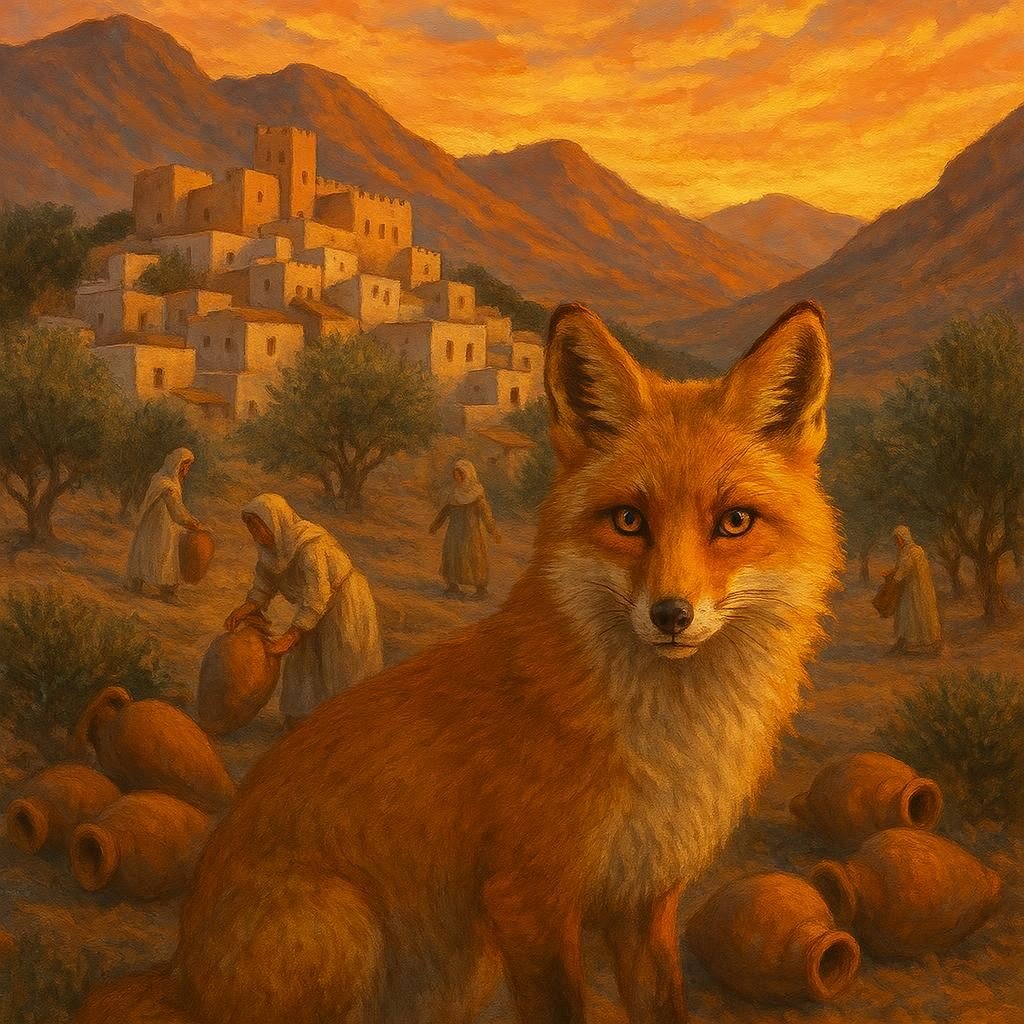
Yet in the forest just beyond the mountain lived another creature, smaller but far wiser the Fox of El Kef Mountain. His fur was the colour of sand after rain, and his eyes sparkled like amber in the sun. He was known among the villagers as cunning and kind, a trickster who used his wits to defend the weak.
One morning, the governor’s soldiers marched into the valley demanding a new tax: every villager had to pay one basket of olives per week or lose their land. The people cried out in despair. “We cannot feed our families if we give him all our olives!” they said. The Fox, hearing their complaints, flicked his tail and whispered, “Perhaps it’s time someone teaches the Wolf a lesson.”
That night, under the silver moonlight, the Fox crept up to the governor’s palace. He saw guards snoring by the gate and torches flickering low. Near the storehouse, rows of baskets overflowed with stolen olives. The Fox sniffed the air and smiled. “Greed has a scent,” he murmured.
He leapt through a window, landing silently beside the governor’s bed. The man snored loudly, dreaming of gold. The Fox climbed onto his chest and whispered into his ear, “Great governor, awake! I am the spirit of El Kef Mountain. You have angered the land.”
The governor stirred, trembling in fear. “Who speaks to me?”
“I am the guardian of these hills,” the Fox said in a deep voice. “Because of your greed, the mountain will crumble, and your wealth will vanish. Only an offering can save you.”
“What offering?” the frightened man asked.
“You must fill one hundred jars with olive oil before sunrise and leave them by the sacred well. If you obey, you will be spared. If not, the mountain will swallow your palace.”
Without question, the governor rang his bell and summoned his servants. “Fill one hundred jars with oil!” he shouted. “Quickly, before the earth devours us!”
The servants worked through the night, hauling olive oil from the storehouse. Meanwhile, the Fox ran down to the village and told the people, “Prepare your carts and come quietly to the sacred well.” When the governor’s men finished, they rolled the full jars to the well and left them there as instructed. As soon as the guards disappeared, the villagers appeared from the shadows, guided by the Fox’s shining eyes.
“Take back what belongs to you,” said the Fox. “Your oil, your labour, your dignity.”
They whispered prayers of thanks as they filled their own jars again. When dawn came, the Fox returned to the palace and jumped once more upon the sleeping governor’s bed. “Wake, greedy man,” he said, “for your test is not complete.”
The governor groaned. “What more must I do?”
“You must visit the sacred well and see the offering with your own eyes,” said the Fox. “But do not look too closely, or the spirit will curse you.”
Terrified, the governor wrapped himself in his robe and hurried down the mountain. When he reached the well, he saw the empty jars lying on their sides. “The spirit has accepted my offering!” he cried in relief. But as he leaned over the edge of the well to thank the mountain, the loose earth gave way beneath his feet. With a great splash, he tumbled into the cold water below.
From the bushes, the Fox watched and chuckled. “Now you have what you wished for oil and water together!”
The soldiers ran to pull the governor out, soaked and humiliated. Word of his foolishness spread across El Kef. The people laughed for days, and the governor, too ashamed to face them, fled the mountain forever.
From that day, the villagers lived in peace. They rebuilt their groves, shared their olives fairly, and honoured the clever Fox who had saved them. Some said he was not an ordinary fox at all but a spirit sent by the mountain itself. Others believed he was simply a friend of the people, too wise to be caught and too free to be ruled.
In time, songs were sung about him the Fox of El Kef Mountain, who turned the greed of a man into laughter and gave justice back to the poor.
Years later, travellers passing through El Kef would sometimes see a small fox sitting on the rocks at sunset, watching the valley below. They said he smiled whenever he heard laughter rising from the village. And whenever a ruler grew greedy again, the wind would carry a whisper through the olive groves: “Beware, for the Fox still watches.”
Moral Lesson:
The Fox of El Kef Mountain teaches that intelligence and courage can overcome greed and injustice. True strength lies not in power or wealth but in wisdom used for the good of all. Those who exploit others eventually fall by their own greed, while those who act with fairness and wit restore balance to the world.
Knowledge Check
Where does The Fox of El Kef Mountain take place?
The story takes place in the northern Tunisian mountains of El Kef.What kind of ruler was the governor of El Kef?
He was greedy and cruel, taxing the villagers unfairly and hoarding their goods.How did the Fox trick the governor?
The Fox pretended to be the spirit of the mountain and convinced the governor to fill one hundred jars with oil.What did the villagers do with the oil?
They took back the oil that rightfully belonged to them, restoring fairness and peace.How did the governor meet his downfall?
When he leaned over the sacred well, he fell in, humiliated and frightened, and eventually fled the land.What message does this Tunisian folktale teach?
The tale shows that wisdom and justice can defeat greed and oppression, no matter how powerful the oppressor appears.
Source: Northern Tunisian animal folktale from El Kef. Recorded by Georges Durand in Contes Populaires Tunisiens(1930).