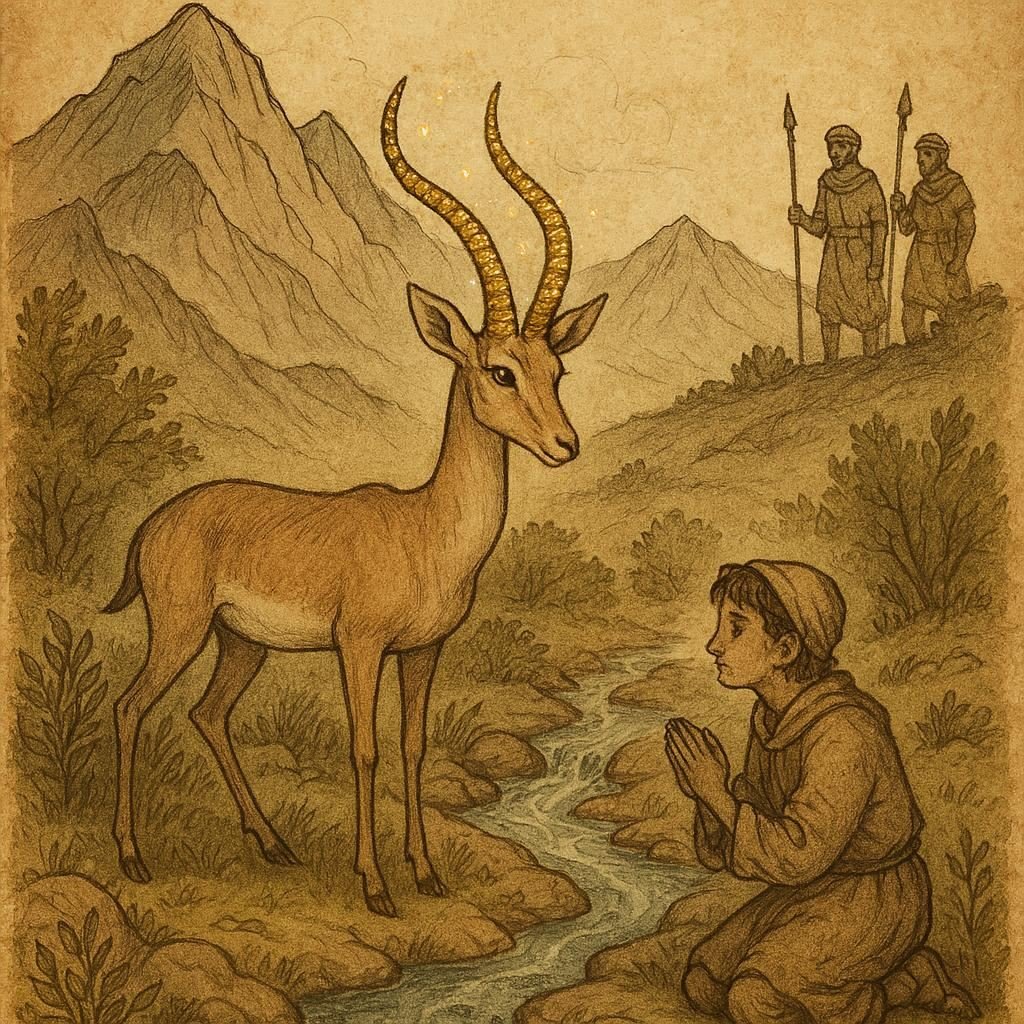
In the high valleys of the Atlas Mountains, where the peaks touched the sky and the winds carried whispers of old legends, there lived a gazelle unlike any other. Her coat shimmered in the sunlight, sleek and graceful, but what set her apart were her horns. They were not ordinary horns of bone but glittering, golden horns that shone like fire at dawn. Hunters, shepherds, and wanderers alike spoke of her beauty in hushed tones. Some saw her as a blessing from the spirits of the mountains, while others saw only the wealth her horns could bring.
One summer morning, when the mountain air was thin and the earth dry, a group of hunters spotted the gazelle grazing near a spring. Her golden horns caught the light and dazzled their eyes. “Brothers,” one hunter whispered greedily, “if we catch her, we will be rich beyond measure. Her horns alone could buy us fields of grain, her hide could be sold for gold, and her name will be ours to boast of.” They strung their bows and prepared their spears, their hearts beating with hunger not for food but for treasure.
Want to dive deeper? Read more North African folktales today
The gazelle lifted her head, her eyes clear and full of knowing. She saw the hunters approach and leapt with unmatched grace, bounding over rocks and streams. The men chased her for hours, their feet blistered and their throats dry, but the gazelle remained always a step beyond their reach. Her golden horns flashed between the trees like a ray of sunlight, luring them deeper into the mountains.
Exhausted, the hunters paused. Their greed burned hotter than their weariness, and one cried out in anger, “She mocks us! She dares to escape while we starve. We must catch her or die trying.” Yet as they spoke, the gazelle stopped at the crest of a hill and turned back to look at them. She lowered her head, not in fear but in warning, and then vanished like mist into the hidden paths of the mountains. The hunters returned empty-handed, their hearts heavy with rage and shame.
But not all who crossed paths with the gazelle sought to harm her. Days later, a poor shepherd boy found her drinking from a small spring. His flock grazed nearby, thin and weary from the dry season. The boy saw the golden horns and gasped, but instead of reaching for a stone or a snare, he stood quietly, afraid to startle such a wondrous creature. The gazelle looked at him, her eyes deep and calm. She stepped forward, dipped her horns into the spring, and as she lifted them, the water flowed stronger and clearer than before. The boy’s sheep drank and grew strong again. He knelt on the earth and whispered, “Bless you, gentle spirit. May you wander free forever.”
The gazelle bowed her head, as if in answer, and bounded away. When the boy returned home, he found that his hut, once worn and broken, now stood repaired. His jars were full of grain, and his flock multiplied. His kindness had been rewarded not with gold but with blessings that would sustain him for life.
The tale spread across the mountains, and more men sought the golden-horned gazelle. Some came with nets, others with poison, and still others with traps hidden along the mountain paths. Yet none succeeded. The greedy found themselves lost in thorny valleys or bitten by their own snares, while those who approached her with quiet hearts found their lives strangely blessed. A sick woman who once left bread for the gazelle at the edge of her field soon recovered her strength. A farmer who gave her water in secret found his barren land rich with crops.
Generations passed, and the golden-horned gazelle remained a mystery. Some said she was a spirit sent to test the hearts of humankind. Others believed she was a guardian of the mountains, ensuring that compassion remained stronger than greed. Whatever the truth, the people of the High Atlas knew this much: those who chased her with selfish desires always failed, but those who met her with respect and compassion carried blessings in their lives.
Moral Lesson
The story of the gazelle with golden horns teaches that true blessings come not from greed but from compassion and respect. Wealth gained through selfishness fades quickly, but kindness brings rewards that last through generations.
Knowledge Check
Who was the main character in the story of the gazelle with golden horns?
Answer: The main character was a magical gazelle with glittering golden horns.What did the hunters want from the gazelle?
Answer: They wanted to capture her for her horns and the riches they believed she would bring.How did the gazelle escape from the greedy hunters?
Answer: She used her speed and grace to stay always a step ahead, leading them deeper into the mountains until they failed.What did the shepherd boy do when he saw the gazelle?
Answer: He showed respect and kindness, letting her drink and blessing her instead of trying to harm her.How was the shepherd boy rewarded for his compassion?
Answer: His hut was repaired, his jars filled with grain, and his flock grew strong and multiplied.What lesson does the Amazigh folktale of the gazelle with golden horns teach?
Answer: It teaches that compassion brings true blessings, while greed leads to loss and shame.
Source: Amazigh legend, High Atlas. Hans Stumme, Märchen der Berbern (1895).