
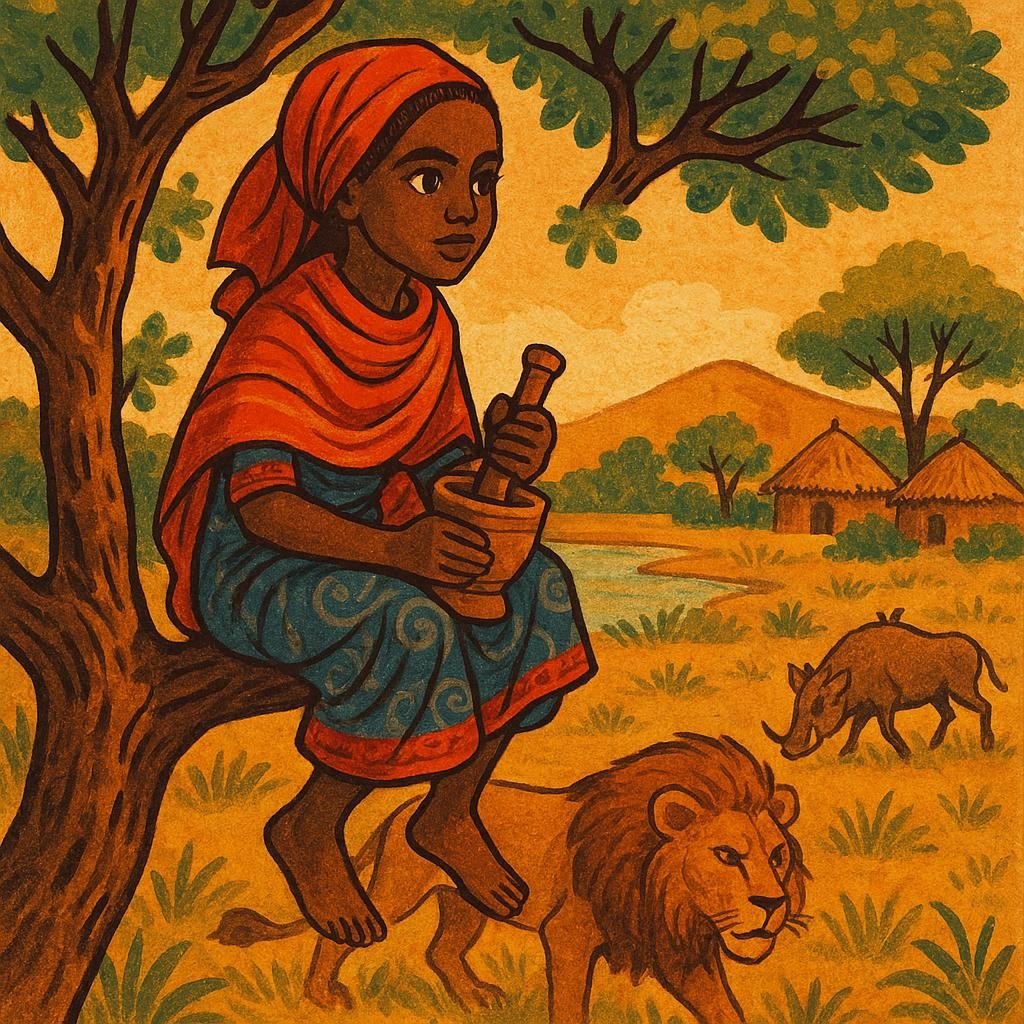
Once upon a time, in a village by the vast Somali plains, there lived a young girl named Fatima. She was engaged to a man, and her family awaited the day the dowry would be delivered. One morning, her fiancé set off with the dowry cows and oxen, traveling through the open fields. Suddenly, one of the cows was seized by a lion.
“What caught my cow?” the man shouted.
“A real man caught it,” the lion answered.
The man could not believe his ears. “A man? You dare take my cow? I will not let you get away with this!”
READ THIS: How Mohammed Hassan Learned Not to Be Too Shy
They fought fiercely. The man had the upper hand. But the lion, cunning and strong, suggested, “Your right hand gives you advantage. Cut it, and we will fight again.”
The man obeyed and cut his right hand, yet he remained victorious. Then the lion said, “Your left hand gives you advantage too. Cut it as well.”
The man, determined, obeyed again. But this time, weakened and vulnerable, he fell, and the lion devoured him.
The lion then dressed in the man’s clothes and carried the dowry to the village. Fatima’s family, expecting their future son-in-law, welcomed the figure and served him food. They presented him with cooked meat, but he refused it.
“This is not for me,” the lion said. “Give me uncooked meat.”
The family, shy and fearful, obeyed.
Later, when it was time to sleep, the lion insisted on changing the bed to sticks. That night, he revealed his fur, and Fatima realized the truth. “Father, you have given me to a wild animal! This is not a man!” she cried in song.
Her father grew angry but devised a plan to test him. The next morning, he ordered the village to move in search of grass and water. The lion, overhearing, called out, “Why is the village not moving? The time has come!”
Hearing this, the father knew his daughter had told the truth. The lion was indeed a wild creature.
The lion decided to take Fatima to a distant place. On the journey, he insisted on riding the camel, but he repeatedly bit the camel’s hump. Each time, Fatima removed her scarf, bracelets, and even her dress, hoping to calm the animal. They reached a desolate place, and Fatima put up a Somali nomadic house. The lion left to check on his relatives, leaving her alone.
Fearing for her life, Fatima cut off her little finger, placed it in a mortar, and escaped. When the lion returned with wild animals, snakes, and hyenas, they found only her finger. Furious, the lion searched for her, but she had vanished.
A small bird with only one wing came to Fatima, asking for a date in exchange for a message to her family. Fatima agreed. The bird flew to her village, carrying the message, warning her parents that she was trapped in a tree on the lake.
Her family rushed to the lake and found her. Yet, she refused to come down, still angry at her father for giving her to a wild animal. The youngest brother prayed to Allah, asking for protection. Miraculously, the tree fell, leaving Fatima with only the loss of her little finger. She forgave her family, and they returned to the village.
Later, while churning butter on the roof, a strong wind lifted Fatima and the churn into the sky. Her parents shouted for the wind to leave her, and she fell into the bush, transforming into two carved sticks. A young boy discovered the sticks and tried to use them on his camel. Each stick entered the camel, causing it to lose milk and leaving the boy’s family in shock.
Through courage, cleverness, and divine protection, Fatima survived the lion and other dangers. She remained wise and strong, teaching her village the importance of bravery and vigilance.
Moral Lesson
“The Girl and the Lion” teaches that courage, cleverness, and careful observation can protect us from danger. Even in the face of deception or overwhelming power, intelligence and patience allow us to survive. The story also shows the value of family, prayer, and relying on wisdom to overcome life-threatening challenges.
Knowledge Check
Who was Fatima engaged to before the lion appeared?
Fatima was engaged to a man who was bringing the dowry to her family.Why did the lion disguise himself in the man’s clothes?
The lion wanted to deceive the family and take the dowry while appearing human.How did Fatima realize her husband was a lion?
She saw his fur while they slept and understood he was not human.What strategy did Fatima use to escape the lion?
She cut off her little finger and hid, later using clever tactics to evade the wild animals.How did Fatima’s family find her in the tree?
A one-winged bird carried her message to her family, revealing her location.What is the moral of “The Girl and the Lion”?
Bravery, intelligence, and vigilance protect us from danger, and prayer and wisdom help overcome challenges.
Cultural Origin: Somalia (Eastern African Folktale)


