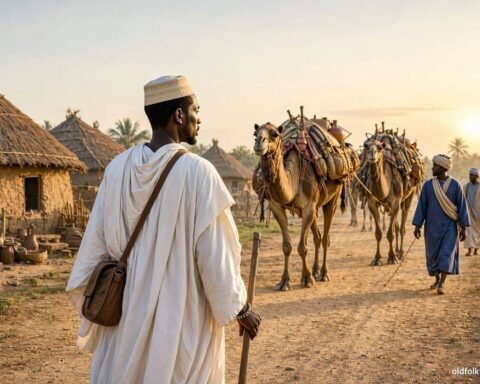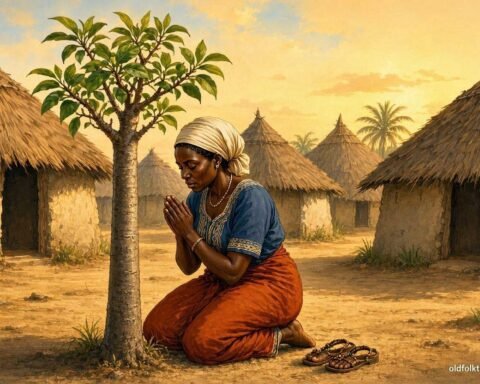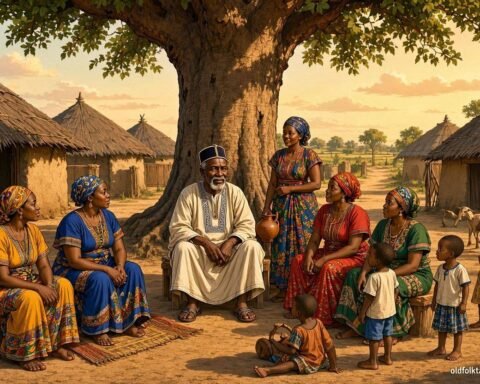
In the fertile hills of Burundi, where once green fields stretched across the land like woven cloth and rivers moved steadily through valleys, there came a time when the earth began to change.
The rains stopped.
Click here to discover more legendary tales from West Africa
At first, the villagers believed it was a delay. Seasons sometimes shifted, and patience was part of life. But as days turned into weeks, and weeks into months, the truth became impossible to ignore.
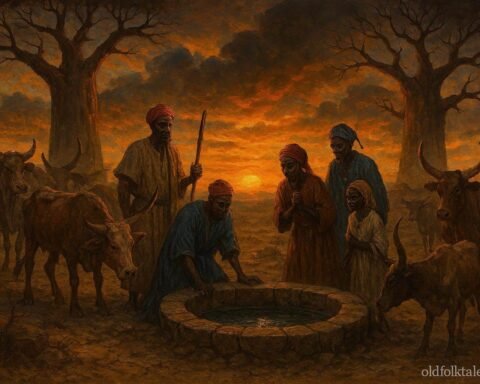
The soil hardened. Crops withered. Rivers shrank into thin, uncertain streams. The sun hung heavy in the sky, unchallenged by clouds. The land began to suffer.
And with it, the people suffered too.
The villagers prayed.
They gathered at sacred places, offering songs and words to the sky. Elders spoke ancient invocations, calling upon the forces believed to govern rain and growth. But the skies remained silent.
No thunder answered.
No clouds gathered.
Only heat and emptiness.
Among the village was a young girl known for her courage.
She was not the strongest, nor the wealthiest, but she was steady in heart. While others worried and despaired, she continued to help her family gather what little remained—fetching water from distant sources, tending dry fields, and caring for those weakened by hardship.
But as the drought deepened, even her strength began to waver.
One evening, as she returned from a long journey to find water, she stopped at the edge of the village.
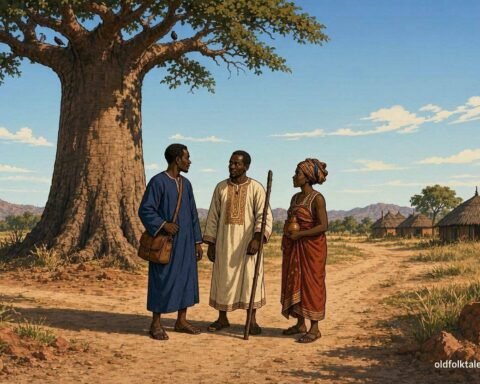
There, standing alone beneath the fading light of dusk, was a stranger.
He was not like anyone she had seen before.
His presence was calm, yet unusual, like the air before a storm that has not yet arrived. His clothes did not seem bound by dust or travel. His eyes reflected something distant, as though he carried the sky within them.
The girl watched him carefully.
“You look for water,” he said gently.
It was not a question.
It was an understanding.
She nodded.
“We all do,” she replied.
The stranger was silent for a moment.
Then he spoke again.
“I can bring it back.”
The girl did not answer immediately.
In times of drought, many promises were spoken. Some false. Some desperate. Some born of hope.
She studied him.
“And what do you ask in return?” she asked.
The stranger’s gaze remained steady.
“A marriage,” he said simply.
The words hung in the air.
The girl felt her breath pause.
A marriage was no small thing. It meant leaving one life and entering another. It meant responsibility, belonging, and permanence.
But the land around her reminded her of something heavier still.
The suffering of her people.
That night, she did not sleep.
She thought of her family. Of the village. Of the cracked earth that stretched farther each day. She thought of children growing weaker, of elders who no longer spoke as often, of silence replacing laughter.
And she thought of the stranger.
He had not demanded riches.
He had not demanded power.
Only commitment.
At dawn, she made her decision.
She returned to the place where she had met him.
“I will marry you,” she said.
The stranger nodded once, as though he had already known her answer.
“Then come,” he said.
He led her away from the village, not toward any known path, but toward the open land where earth met sky.
As they walked, the air began to change.
The heat softened.
The wind grew cooler.
And somewhere far above, clouds began to form, slowly at first, like memory returning to the sky.
The girl noticed but said nothing.
They reached a place where the land seemed to rise toward the horizon.
There, the stranger stopped.
He turned to her.
“You have chosen,” he said.
She nodded.
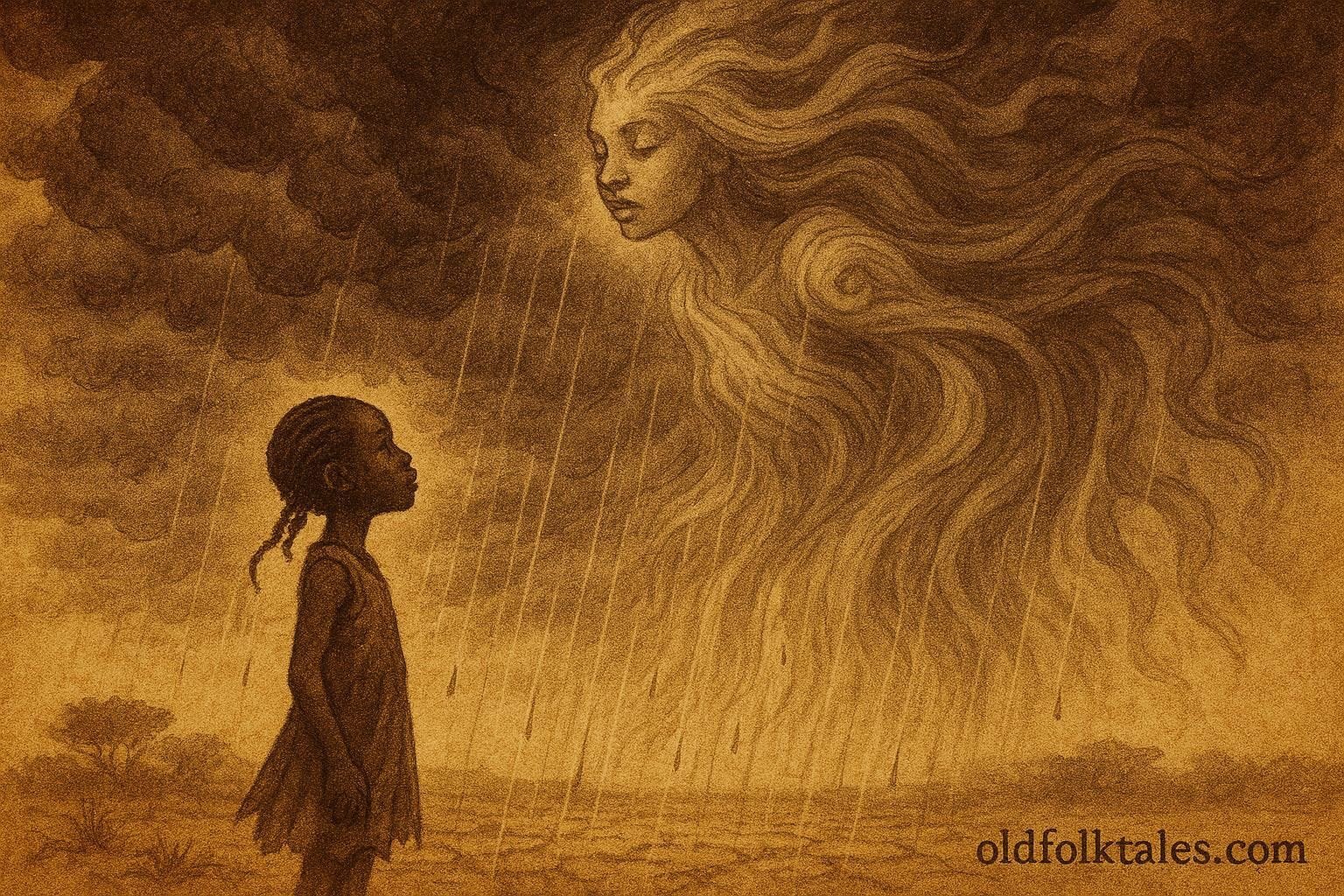
Then, before her eyes, something remarkable happened.
The stranger’s form shifted.
Not into something frightening, but something vast.
His presence expanded, not in size alone, but in essence.
The wind responded.
The clouds gathered more quickly now.
And she understood.
He was not merely a man.
He was something older.
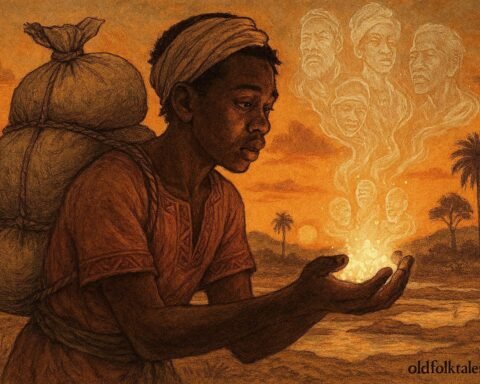
A spirit of the rain.
The sky darkened gently above them.
For the first time in many months, thunder rolled in the distance, not loud or violent, but deep and steady.
The girl stood still.
Rain began to fall.
Slow at first.
Then steady.
Then full and alive.
The land, long thirsty, received it like breath returning to a body.
But as the rain surrounded her, she felt something else.
A shift in herself.
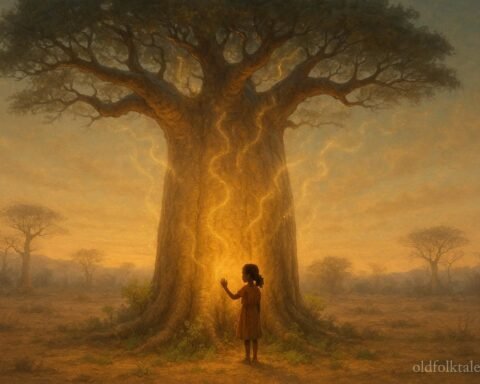
A connection forming, not just between her and the rain, but between her and something greater.
The spirit looked at her.
“You are now bound to this cycle,” he said.
“The rain will listen to you. And you will listen to it.”
The girl understood, though not fully.
“What does that mean?” she asked.
The spirit did not answer directly.
Instead, he said:
“You may return once the first rains restore your people. Or you may remain, and become part of what brings life to them.”
The rain continued for days.
The village below changed rapidly.
Fields softened. Rivers returned. Life slowly reawakened.
When the girl finally returned, she was greeted with joy.
Her people had not expected her survival. They believed she had been lost.
But she was not the same as before.
Something about her felt distant, as though part of her still belonged elsewhere.
The villagers asked questions.
Where had she been?
Who was the stranger?
How had the rain returned?
But she answered only what she could.
“I was given a choice,” she said.
Nothing more.
That night, as she lay in silence, she felt it.
A pull—not of force, but of calling.
Outside, the sky began to shift again.
Clouds gathered, not in threat, but in recognition.
The rain spirit had not left her entirely.
She understood then what her role truly was.
She had not simply married a stranger.
She had entered a bond between earth and sky.
A responsibility.
A bridge.
A guardian of balance.
Some days, she stayed among her people.
Other days, she walked alone toward the open land where clouds gathered more easily.
And when drought threatened again, the rain came sooner than expected.
Not because it was commanded.
But because she listened.
And so did the sky.
The villagers never fully understood what she had become.
Some said she was blessed.
Others said she had been changed by forces beyond human life.
But all agreed on one thing:
When she was present, the rains remembered the earth.
Continue your journey: Read more East African folktales
Moral Lesson
Sacrifice often carries unseen responsibilities. True balance between humans and nature is built on understanding, duty, and the willingness to serve something greater than oneself.
Knowledge Check
- What is the main lesson of “The Girl Who Married the Rain”?
The story teaches that sacrifice for the greater good can create lasting responsibility and connection with nature. - Why did the girl agree to marry the stranger?
She agreed to save her drought-stricken village by accepting his promise to bring rain. - What was the stranger’s true identity?
He was a rain spirit who controlled and embodied the cycles of rainfall. - What responsibility did the girl gain after the marriage?
She became a guardian of the connection between the rain spirit and her people. - How did the rain return to the village?
The rain returned through the spiritual bond formed between the girl and the rain spirit. - What cultural themes are reflected in this Burundian folktale?
Themes include sacrifice, spiritual bonds with nature, drought survival, and duty versus personal desire.
Source: Central African oral narratives recorded in African Myths of Nature and the Cosmos by regional ethnographers (1965)
Cultural Origin: Burundian agrarian societies where rainfall is deeply tied to survival and spiritual beliefs