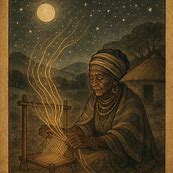
In the quiet hills of Venda, where mist clings to the trees at dawn and the nights are alive with the hum of crickets, there once lived a young girl named Tavona. She was small and quiet, her eyes always searching the stars, her heart heavy with loneliness. Her parents had passed away when she was very young, and though her aunt cared for her, Tavona often felt invisible, like a shadow in her own home.
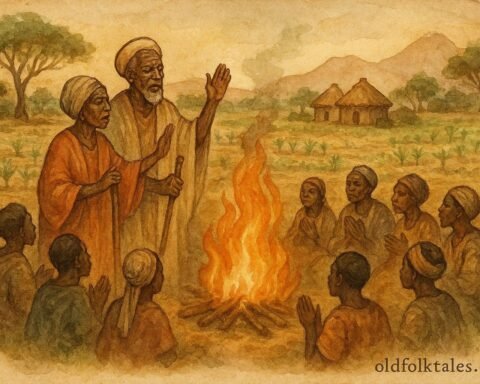
The village where she lived had known better days. Once, it was full of laughter, song, and light, but fear had settled over it like a long shadow. Strange droughts came and went, crops withered before harvest, and wild animals grew bolder, creeping near the huts at night. The elders said the spirits had turned away, and no one dared to go beyond the river after dark, where they said restless souls wandered.
Love this story? Discover our full Southern African folktales collection
But Tavona was not afraid of the dark. Every night, she would sit outside her small hut, watching the flickering lights of fireflies rise above the grass like tiny stars come down to rest. They danced and shimmered, whispering in soft glows of gold and green. She often whispered back, telling them her dreams and her sorrows, for there was no one else who would listen.
One night, as the moon hung low and round, Tavona saw something different. The fireflies gathered more thickly than ever, swirling around her in patterns like woven cloth. Their light pulsed in rhythm, and a voice, soft and melodic, drifted through the air.
“Tavona,” it said, though no lips moved. “Do not fear the night. The night is where light is born.”
She gasped and looked around, but no one was there. The fireflies continued to hum and glow, their tiny bodies flickering like hearts that spoke without words.
“Who are you?” she whispered.
“We are the voices of the hills,” the lights answered. “We carry the courage of those who walk in darkness and the hope of those who believe in dawn.”
That night, Tavona followed them. They led her through the tall grass, past the river that her people feared, and into a clearing filled with old trees whose roots shone faintly beneath the earth. In the centre was a single pool of clear water, glowing faintly blue beneath the moon.
The fireflies circled above the pool, forming the shape of a human face gentle, radiant, and ancient. “Tavona,” it said again, “your people have forgotten that courage shines brightest when the world grows dim. The light they seek is not lost; it lives inside the brave.”
Tavona knelt beside the pool. “But what can I do? I am just a child. I have no power.”
The lights danced faster. “Power is not in strength or wealth. It is in those who listen to the whispers of truth. Take our light, and remind your people that even the smallest glow can chase away great darkness.”
When Tavona awoke the next morning, she thought it had all been a dream until she looked down at her hands. Her palms glowed faintly, as if holding a piece of the night sky.
That evening, she returned to the village square. People watched curiously as she lifted her hands, and the same golden-green firefly light spilled out, swirling into the air. The villagers gasped. Children clapped their hands in awe.
Tavona spoke softly but clearly. “The fireflies say that light never dies. It only hides when hearts grow cold. We must not fear the night, we must fill it with our own glow.”
That night, for the first time in many seasons, the villagers gathered together. They sang old songs by the fireside, told stories of their ancestors, and shared food and laughter. The fear that had gripped them began to loosen. The rains came soon after gentle at first, then steady and strong and the fields greened again.
From that day on, the people of Tavona’s village called her Mhani wa Tanda, the Mother of Light. When children were frightened, their mothers would tell them, “Remember Tavona, she spoke to the fireflies and brought light back to our nights.”
And when Tavona grew older, she still visited the clearing beyond the river. The fireflies would come to greet her, dancing like old friends, whispering in their glowing language. Though she could never quite understand all their words, she knew their meaning in her heart: courage, kindness, and light.
The fireflies’ glow never faded from her palms, and some say that even after she passed on, her spirit still walked the hills at night, surrounded by golden fireflies guiding lost souls home.
Moral Lesson
True courage shines brightest when times are darkest. Even the smallest act of hope and kindness can bring light to others and heal a fearful heart.
Knowledge Check
Who was the main character in The Girl Who Spoke to Fireflies?
Answer: Tavona, a lonely Venda girl who learned courage from the fireflies.Why was the village living in fear?
Answer: The people believed the spirits had abandoned them after droughts and strange events.What message did the fireflies give Tavona?
Answer: They told her that light lives inside the brave and that courage brings hope.How did Tavona help her people?
Answer: She reminded them not to fear the night and inspired them to find courage and unity again.What happened after the villagers listened to Tavona’s message?
Answer: They regained hope, came together in harmony, and the rains returned.What lesson does this Venda folktale teach?
Answer: It teaches that even small lights like hope, kindness, or courage can overcome great darkness.
Source: Venda folktale, South Africa. Recorded by Phyllis N. Kabini in Stories from the Spirit Hills (1982).