Listen, children of the mountains, gather close as the evening mist settles upon the shoulders of Maluti. Let your hearts be still as the highland streams, for I shall tell you a tale that flows from the ancient springs of our people, a story that dances like firelight upon the faces of stone.
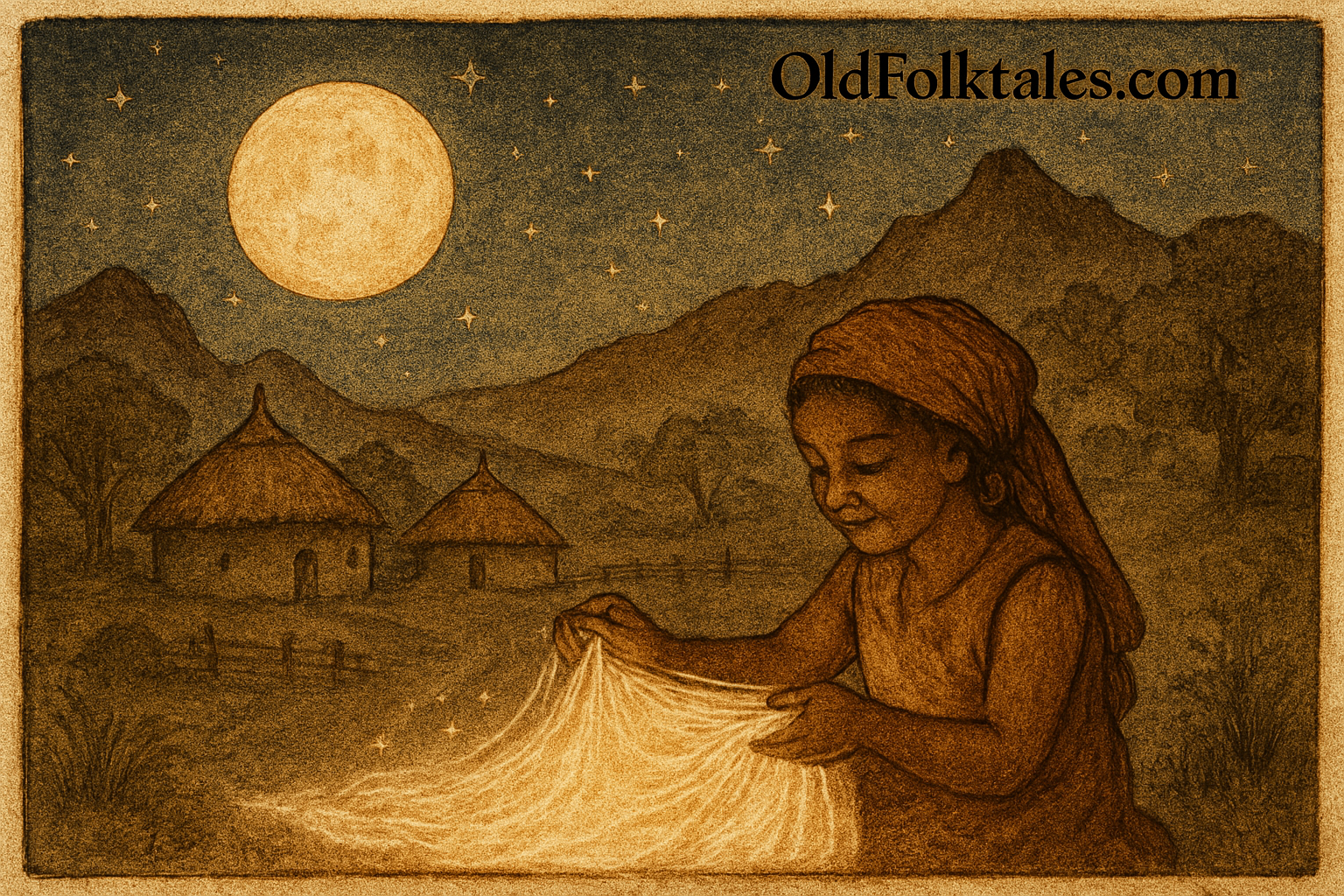
In the time when the world was younger and the mountains sang more clearly to those who listened, there lived a girl named Palesa in a village nestled between two great peaks. Like the morning star that kisses the mountain’s brow, Palesa possessed a gift that made the ancestors smile in their eternal rest. Her fingers, blessed by Modimo himself, could weave moonlight into cloth as surely as other girls could weave grass into baskets.
Each night, when Khongolose the grandmother moon climbed the star-scattered sky, Palesa would climb to the highest terrace of her hut. There, with a loom carved from the sacred mohlaka tree, she would catch the silver threads that fell like gentle rain from the moon’s generous face. Under her patient hands, these threads of light became cloth more beautiful than the dawn itself cloth that shimmered with the wisdom of night and held the soft music of ancestral songs.
The people of the village would gather when Palesa worked, their faces upturned like flowers seeking the sun. The children would whisper in wonder, the mothers would nod with knowing smiles, and the grandfathers would stroke their beards and speak of old magic returning to the world. For Palesa’s moon-cloth could heal the sick when wrapped gently around weary shoulders, could bring peaceful dreams to troubled sleepers, and could protect travelers from the dangers that prowl in darkness.
But as the eagle soars above the valleys, so does envy rise in certain hearts. In the same village lived Mmabatho, a girl whose fingers flew swiftly at the loom but whose heart grew heavy with jealousy. Like a storm cloud gathering strength in the mountain passes, her bitterness darkened with each passing moon.
“Why should Palesa alone possess such gifts?” Mmabatho muttered to herself as she watched her neighbor’s silver threads dance in the moonlight. “Are my hands not as skilled? Is my heart not as devoted? Surely the ancestors favor her without cause, and fortune smiles where it should not.”
Night after night, Mmabatho’s envy grew like a thorn tree in her chest, until she could bear it no longer. When the moon was fat and full, casting strong shadows across the village, she climbed secretly to Palesa’s terrace. There, with quick and greedy hands, she tried to steal the falling moonbeams for herself.
But moonlight, children, is not wool to be grasped by angry fists. As Mmabatho reached for the silver threads, they scattered like startled birds, dissolving into mist that swirled and danced away from her grasping fingers. The moon herself, seeing this act of envy and theft, withdrew her light behind thick clouds, leaving Mmabatho alone in darkness.
The next morning, the village elders, those wise ones whose hair was white as morning frost and whose eyes held the knowledge of many seasons, discovered Mmabatho weeping on the empty terrace. They found Palesa’s loom shattered, its sacred wood splintered like a broken heart.
“Grandmother,” Mmabatho wept to the eldest woman, Mmamotse, whose wisdom was deep as the mountain springs, “I have done a terrible thing. My jealousy has destroyed what was beautiful, and now the moonlight will never return.”
Old Mmamotse, bent with age but straight with wisdom, placed a gentle hand upon the girl’s shoulder. Her voice, soft as wind through the mountain grass, carried the weight of ancestral knowledge: “Child of my heart, the moon’s light is not lost forever. Like the grass that grows again after fire, like the streams that flow again after drought, forgiveness can restore what envy has destroyed. But first, you must plant new seeds in the garden of your heart.”
The elders, in their great wisdom, called both girls before them when the sun stood highest in the sky. There, surrounded by the entire village, they spoke words that rang clear as bells across the valley:
“Palesa, daughter of light,” they said, “your gift came not because you were chosen above others, but because your heart was open as the morning sky. You shared your blessing freely, asking nothing in return, caring for your people as the mountains care for our villages,steadily, faithfully, without counting the cost.”
Then they turned to Mmabatho, their eyes holding both sorrow and hope: “And you, daughter of storms, have learned that gifts stolen in darkness cannot shine in the light of day. But see your tears water the ground where new understanding can grow. If you plant humility where envy once grew, if you water kindness where bitterness took root, you too may find gifts you never knew you possessed.”
That very night, as if the ancestors themselves had whispered to her sleeping spirit, Mmabatho began to change. She approached Palesa with a heart humbled like clay in the potter’s hands, asking not for moonlight to weave, but for wisdom to serve her people in her own way. Together, the two girls worked to build a new loom, stronger than before, from wood blessed by the village elders and watered with tears of true repentance.
When the moon rose full again, she smiled upon the village with renewed brightness. Palesa’s fingers found their magic once more, and the silver threads flowed like streams of starlight into her patient hands. But now, beside her worked Mmabatho, who discovered that her gift lay not in catching moonbeams, but in weaving stories beautiful tales that helped preserve the wisdom of their people and taught the children the sacred ways of their ancestors.
From that day forward, whenever the moon climbed the sky above the Maluti Mountains, two girls would work side by side on the highest terrace. One would weave with moonlight, creating cloth to heal and protect, while the other would weave with words, creating stories to guide and inspire. The village prospered as never before, for they had learned that the greatest magic comes not from the gifts we possess, but from how we choose to share them.
The Wisdom of the Ancestors
Thus speaks the ancient wisdom passed down through generations of our people: True beauty and blessing flow not from what we can grasp for ourselves, but from what we freely give to others. Like the mountains that share their strength with the valleys, like the streams that share their water with all who thirst, our greatest gifts multiply when offered with open hands and generous hearts.
Envy is the winter that freezes the soul, but humility is the spring that allows new growth to flourish. When we celebrate others’ gifts instead of coveting them, when we seek to serve rather than to possess, we discover that the ancestors have prepared blessings for us that we never imagined—blessings that suit our own spirits as perfectly as the mountain suits the sky.
The girl who tried to steal moonlight learned that the greatest treasures cannot be taken by force but must be received with gratitude and shared with love. In the end, she found a gift more precious than silver threads—the gift of wisdom, the gift of friendship, and the gift of a heart at peace with itself and the world.
Knowledge Check
What is the central gift possessed by Palesa in the Sotho folktale?
Palesa possesses the magical ability to weave moonlight into cloth using silver threads that fall from the moon. This moon-cloth has healing properties and can bring peaceful dreams and protection to those who use it.
How does the setting of the Maluti Mountains influence the story?
The mountainous setting is integral to Sotho storytelling tradition, representing spiritual connection and ancestral wisdom. The elevated terraces where Palesa weaves symbolize being closer to the heavens and the ancestors, while the mountains themselves serve as witnesses to the moral lessons unfolding.
What motivates Mmabatho’s jealousy toward Palesa?
Mmabatho becomes envious because she believes her own weaving skills are equal to Palesa’s, yet she lacks the magical gift of weaving moonlight. Her jealousy stems from feeling that the ancestors unfairly favor Palesa over her.
What role do the village elders play in resolving the conflict?
The elders serve as the moral compass of the story, representing ancestral wisdom and traditional Sotho values. They guide both girls toward understanding, teaching Palesa about the responsibility that comes with gifts and helping Mmabatho discover her own unique talents.
Moral lesson
The folktale teaches that true gifts cannot be stolen through envy or force but must be shared freely. It emphasizes the importance of humility, kindness, and discovering one’s own unique talents rather than coveting others’ abilities.
How does this folktale reflect traditional Sotho storytelling elements?
The story incorporates classic Sotho elements including mountain imagery, references to ancestors and traditional beliefs, moral instruction through narrative, lyrical language patterns, and the emphasis on community harmony and wisdom passed between generations.