Deep in the heart of the African wilderness, where ancient baobab trees cast their shadows across sun-baked earth and the calls of exotic birds echoed through dense forests, there lived a hunter whose skills were known throughout his village. His name was spoken with both admiration and concern, for while his abilities with bow and spear were unmatched, his heart had grown cold toward his fellow people.
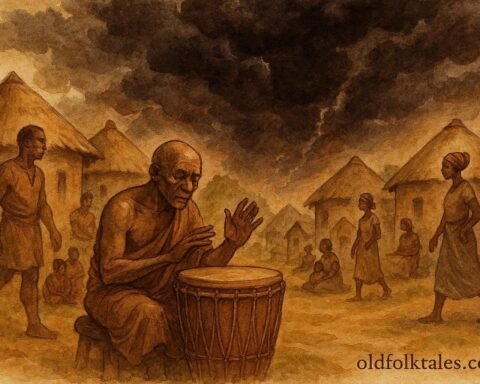
The village where he lived was a close-knit community of mud-brick houses with thatched roofs, surrounded by fields of millet and cassava that the people tended with care. Children played between the houses while their mothers ground grain and prepared meals over wood fires that sent fragrant smoke curling into the clear blue sky. It was a place where sharing was not just a custom but a sacred duty, where the fortune of one was considered the blessing of all.
Yet this hunter had forgotten these ancient ways. He was a man of impressive stature, with muscles hardened by years of tracking through thorny bushes and climbing rocky hills in pursuit of game. His eyes, sharp as a hawk’s, could spot the slightest movement in the undergrowth, and his hands were steady enough to bring down a running antelope with a single arrow. The leather pouch at his side held charms and amulets passed down from his ancestors, and his spear was carved with symbols of power that gleamed in the sunlight.
Also read: Why the Sun and Moon Live in the Sky
For months, the hunter had struggled with poor fortune. His carefully crafted snares remained empty, his arrows missed their marks, and the animals seemed to vanish like spirits whenever he approached. The forest, which had once provided abundant game, now seemed to mock his efforts. His family’s food stores dwindled, and the hollow ache of hunger became a constant companion.
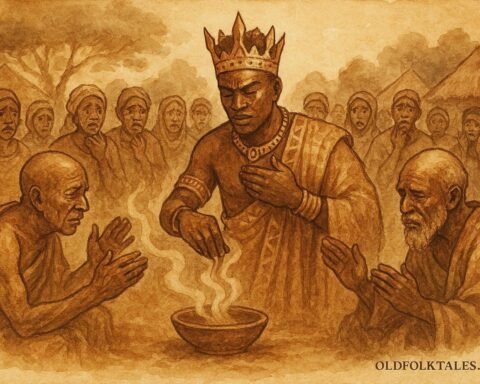
Desperate and humbled by his failures, the hunter finally turned to the spirits of his ancestors for help. In the sacred grove just beyond the village, where massive trees formed a natural cathedral and ancient stones marked holy ground, he knelt beneath the stars and raised his voice in fervent prayer.
“Oh great spirits of the forest and sky,” he called out, his voice carrying across the still night air, “I beseech you to hear my plea. My traps are empty, my arrows find no target, and my family grows thin with hunger. Grant me success in the hunt, and I will honor you with grateful offerings.”
The night wind rustled through the leaves above him, and somewhere in the darkness, an owl called out as if in response. The hunter felt a shiver of recognition, sensing that his prayers had been heard by forces beyond the mortal world.
The very next morning, as the first rays of sunlight painted the eastern horizon gold and orange, the hunter ventured into the forest with renewed hope. To his amazement and joy, his first trap held a fat bush pig, its meat enough to feed his family for days. His second snare contained a large antelope, and by midday, his arrows had brought down three more animals.
Day after day, this incredible fortune continued. The forest seemed to offer up its treasures willingly. Rabbits practically leaped into his snares, birds fell at the whisper of his arrows, and even the most cunning of forest creatures seemed drawn to his traps like iron to a magnet. His hunting sack grew heavy with game, and his steps became light with satisfaction.
The spirits had indeed answered his prayers beyond his wildest dreams. Never before had any hunter in living memory experienced such abundant success. The meat from his daily hunts could have fed not just his own family, but several families in the village. The blessing was so generous that it seemed the very essence of prosperity had chosen to rest upon his shoulders.
But as the hunter’s success grew, so did a darkness in his heart. Instead of remembering the hungry faces of his neighbors and the tradition of sharing that had sustained his people for generations, he began to hoard his good fortune. The sight of his overflowing meat storage filled him with a selfish pride that clouded his judgment and hardened his compassion.
When elderly neighbors came to his door, their ribs showing through threadbare clothes and their eyes hollow with need, the hunter would hide his abundant catch and claim he had caught nothing. “The forest has been cruel to me,” he would lie, even as fresh meat hung drying just steps away from where they stood.
Children from families struggling with hunger would approach him with hopeful expressions, their small hands extended in the universal gesture of need. But the hunter would turn away, clutching his hunting pouch possessively and muttering excuses about his own family’s supposed wants.
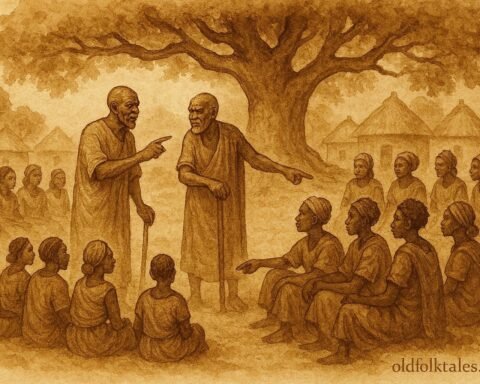
Even when village elders approached him during community gatherings, speaking diplomatically about the traditions of sharing and mutual support that had kept their people strong through countless seasons of feast and famine, the hunter remained deaf to their wisdom. His heart had become as hard as the stones in the riverbed, impervious to the flow of compassion that should have moved him to generosity.
The man who had once been merely struggling was now wealthy beyond measure, yet he acted as though he possessed nothing. His storage huts overflowed with dried meat, his family ate until they could eat no more, and still he continued to accumulate more than any one household could possibly consume. The abundance that should have been a blessing to the entire community became a source of division and hidden resentment.
But the spirits who had blessed the hunter were watching, and they saw how their generous gift was being twisted into something ugly and selfish. The same supernatural forces that had filled his traps with game and guided his arrows to their targets began to stir with righteous anger.
In the sacred grove where the hunter had first made his desperate plea, the ancient spirits gathered in council. The wind through the trees carried their whispered displeasure, and the very stones seemed to hum with supernatural indignation. They had blessed this man not so he could become a miser, but so he could become a blessing to others in turn.
One morning, when the hunter rose before dawn to check his traps as had become his custom, he found them all mysteriously empty. “Perhaps the animals were simply elsewhere last night,” he told himself, refusing to acknowledge the growing unease in his stomach.
But the next day brought the same result, and the day after that. His arrows, which had flown true for so many weeks, now seemed to have lost their power. They would veer away from their targets at the last moment, as if pushed aside by invisible hands. Animals that had once practically offered themselves to his snares now seemed to detect his presence from impossible distances, fleeing long before he could even aim.
Week after week, his hunting fortunes declined. The supernatural success that had made him the envy of every hunter in the region evaporated as suddenly as morning mist in the blazing sun. His traps remained as empty as his heart had become, and his arrows found only trees and stones.
As his stored meat was consumed and not replaced, the hunter began to understand the magnitude of his situation. The same gnawing hunger that had once driven him to prayer returned with vengeance, made all the more bitter by the memory of recent abundance.
His family, grown accustomed to plenty, now looked at him with confusion and growing concern. His neighbors, who had once sought his help, now passed by his door without stopping, remembering his coldness during their own times of need. The hunter found himself isolated not just from success, but from the very community that might have offered support in his renewed time of struggle.
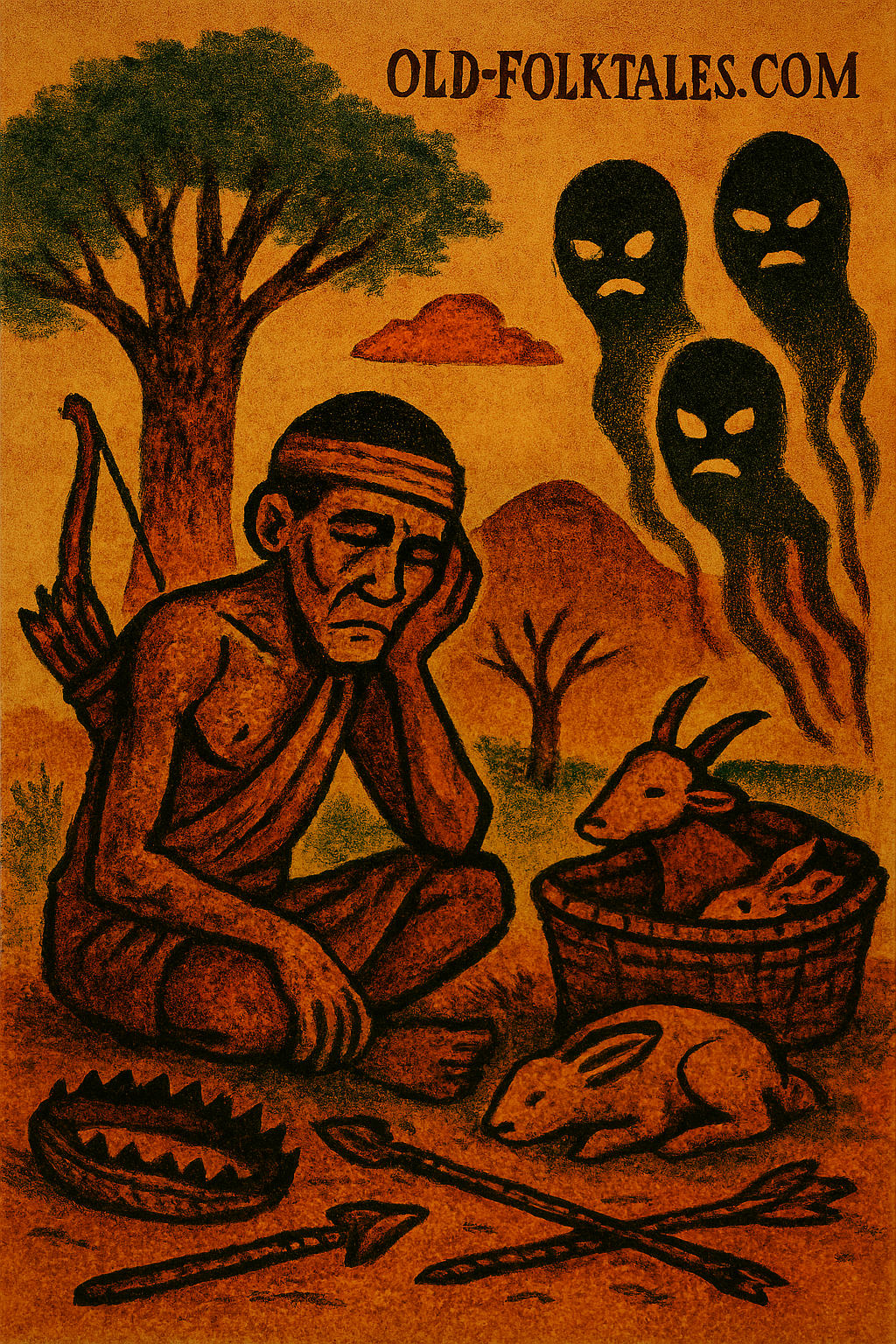
Days turned into weeks, and the hunter’s condition grew desperate. His proud bearing gave way to the hunched posture of defeat, and his confident stride became the shuffling walk of a man weakened by hunger and remorse. The leather of his hunting gear, once supple and well-maintained, began to crack and fray, mirroring the deterioration of his fortunes.
Finally, as he sat in his empty storage hut surrounded by the lingering scents of the meat he had hoarded and wasted, the terrible truth became clear to him. The spirits had not simply withdrawn their blessing, they had actively cursed him for his ingratitude and selfishness.
The hunter who had been blessed beyond measure had lost everything because he had forgotten the most fundamental truth of his people: that abundance shared multiplies, while abundance hoarded withers and dies. In his greed, he had transformed a divine gift into a curse, and now he faced the consequences of his choices with the bitter knowledge that his suffering was entirely of his own making.
As hunger weakened his body and regret consumed his thoughts, the hunter finally understood that true prosperity comes not from what we keep for ourselves, but from what we give to others. But for him, this wisdom came too late, and he faced his fate knowing that he had squandered not just material blessings, but the trust and goodwill of his entire community.
Moral Lesson
This African folktale teaches that blessings are meant to be shared, not hoarded. When we receive abundance, whether material or spiritual, we have a responsibility to use it for the benefit of our community. Selfishness and greed transform gifts into curses, while generosity multiplies blessings. The story reminds us that true prosperity comes from understanding our interconnectedness with others and honoring the reciprocal relationships that sustain communities.
Knowledge Check
Q1: What drove the hunter to pray to the spirits in this African folktale? A1: The hunter was desperate because he had been experiencing poor hunting fortune for months his snares were empty, his arrows missed their targets, and his family was growing hungry due to his failures.
Q2: How did the spirits initially respond to the hunter’s prayers for success? A2: The spirits blessed him with extraordinary hunting success, filling his traps with abundant game and guiding his arrows to hit every target, providing more meat than he had ever caught before.
Q3: What selfish behavior led to the hunter’s downfall in this African moral tale? A3: Instead of sharing his abundant catch with hungry neighbors and following traditional community values, the hunter hoarded all the meat for himself and lied about his success to avoid helping others.
Q4: How did the spirits punish the greedy hunter for his selfishness? A4: The spirits cursed him by making his traps empty, causing his arrows to miss their targets, and driving away all game, effectively reversing their earlier blessing and leaving him to starve.
Q5: What does the hunter’s punishment represent in terms of African community values? A5: The punishment reflects the traditional African belief that individual success is meaningless without community welfare, and that those who violate the sacred duty of sharing will face spiritual consequences.
Q6: What lesson about reciprocity does this African folktale teach? A6: The story teaches that spiritual blessings come with responsibilities when we receive abundance, we must share it with others, as selfishness transforms divine gifts into curses while generosity multiplies blessings.