Long ago, in the green forests of Gabon where the trees rise tall and the drums of the village echo through the evening air, there lived a restless creature named Shulo the Hare. Clever yet impatient, Shulo was always the first to chase after new ideas, whether wise or foolish.
Not far from his burrow lived Jongwe the Rooster. Jongwe was famous in the village not only for his shining feathers and his loud crow at dawn, but also for his sly tricks and clever tongue. Where Shulo rushed without thinking, Jongwe thrived by weaving half-truths and laughter into mischief.
The Hare Sees a Wonder
One hot afternoon, Shulo wandered into Jongwe’s yard. The kraal was quiet except for chickens scratching in the dust. Then Shulo froze in shock.
There was Jongwe the Rooster, standing tall on one leg, the other hidden, and his head seemed to have vanished completely!
Shulo rubbed his eyes, blinked, and trembled. “Is this witchcraft?” he thought. Without a word, he fled back to his hut, nearly colliding with his wife at the doorway.
READ THIS: The Quest for Heavenly Fire: Gabonese Folktale
“Wife!” he cried, gasping. “You will not believe what I saw. Jongwe was standing in the yard without his head, and with only one leg! It is a wonder, a true mystery of the forest!”
His wife frowned, doubtful, but Shulo was too excited to rest. That night he tossed and turned, unable to stop thinking about the strange sight.
Jongwe Explains His “Dream”
At sunrise, Shulo returned to the kraal. This time Jongwe perched high on a tree branch, both legs firm beneath him, his bright head shining as he crowed.
The Hare’s mouth fell open. “Jongwe! Yesterday your head was gone and one leg missing. Now they are back again! Tell me, how can this be?”
The Rooster flapped his wings proudly and said, “Ah, Shulo, that is nothing at all. Sometimes, when I am tired, I ask my wife to cut off my head and one leg. They go to another village to feast, to dance, to drink palm wine. When they finish, they return, good as new. That is the gift of dreams.”
Shulo’s eyes widened with wonder. “If Jongwe can do this, why should I not also?”
The Hare’s Fatal Request
He rushed home, shouting, “Wife! I want you to cut off my head and one leg. They will go visiting like Jongwe’s, and then they will return to me.”
His wife trembled. “Husband, if I cut off your head, you will surely die. No creature lives without a head.”
But Shulo stamped his foot. “You know nothing! I saw it myself. Do as I command.”
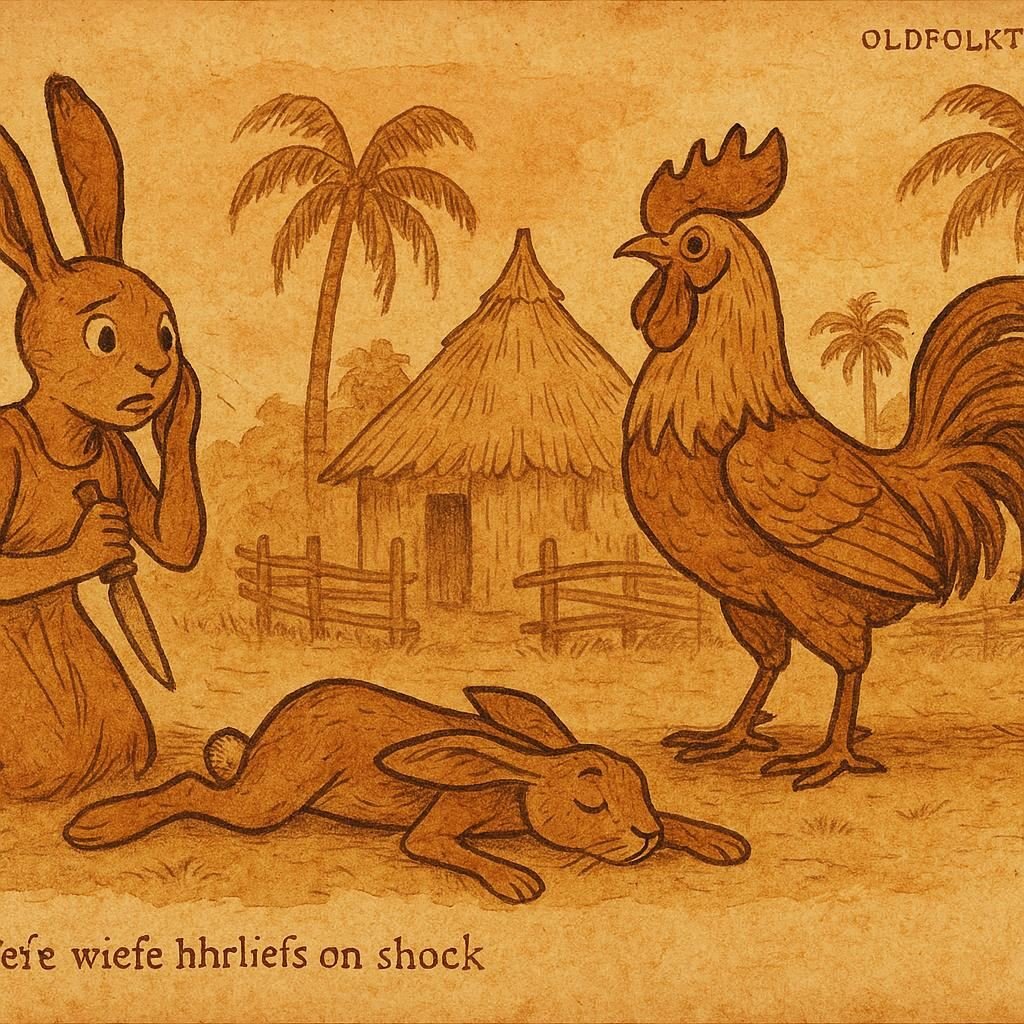
With tears streaming down her face, the poor woman obeyed. She cut off his leg. Then, with shaking hands, she cut off his head. She waited for them to rise and fly away.
But nothing happened. The head lay still. The leg did not move. Shulo’s body was lifeless on the ground.
Jongwe’s Trick Revealed
Desperate, the wife ran to Jongwe. “Rooster! Help me! My husband is dead. His head and leg did not go visiting as you said. What must I do to bring him back?”
Jongwe only laughed, beating his wings. “Oh foolish Hare! I never lost my head. It was tucked beneath my wing while I slept. I never lost my leg. It was folded under me as I rested. The feasting, the dancing, the palm wine, those were nothing but dreams.”
And so Shulo the Hare perished, undone by his own gullibility.
Moral Lesson
This Gabonese folktale teaches that wisdom is the child of patience. What appears magical may only be a trick of the eye. Shulo the Hare trusted appearances without questioning, and his haste brought death. Jongwe the Rooster understood the power of illusion, but used it to mock the gullible. The lesson is clear: in the forest of life, those who fail to think will fall into traps of their own making.
Knowledge Check
1. Who are the main characters in this Gabonese folktale?
The main characters are Shulo the Hare, Jongwe the Rooster, and the Hare’s wife, each playing a role in the lesson on wisdom and folly.
2. What strange sight did Shulo the Hare believe he witnessed?
He thought Jongwe the Rooster had lost his head and one leg, not realizing it was only an illusion created by the Rooster’s posture.
3. How did Jongwe trick Shulo with his explanation?
Jongwe claimed that his head and leg left to another village to feast and dance, returning later — a clever but false tale.
4. Why did Shulo ask his wife to cut off his head and leg?
He believed Jongwe’s story and thought his own head and leg would also “go visiting” and return, proving his gullibility.
5. What moral lesson does this Gabonese folktale teach about wisdom and appearances?
The tale shows that appearances can deceive, and wisdom comes from questioning, patience, and resisting blind trust in others’ words.
6. How does this story reflect Gabonese oral storytelling traditions?
It reflects Gabonese traditions by using animal characters, trickster humor, and moral teaching woven into a vivid, entertaining folktale.
Source: Gabonese Folktale