
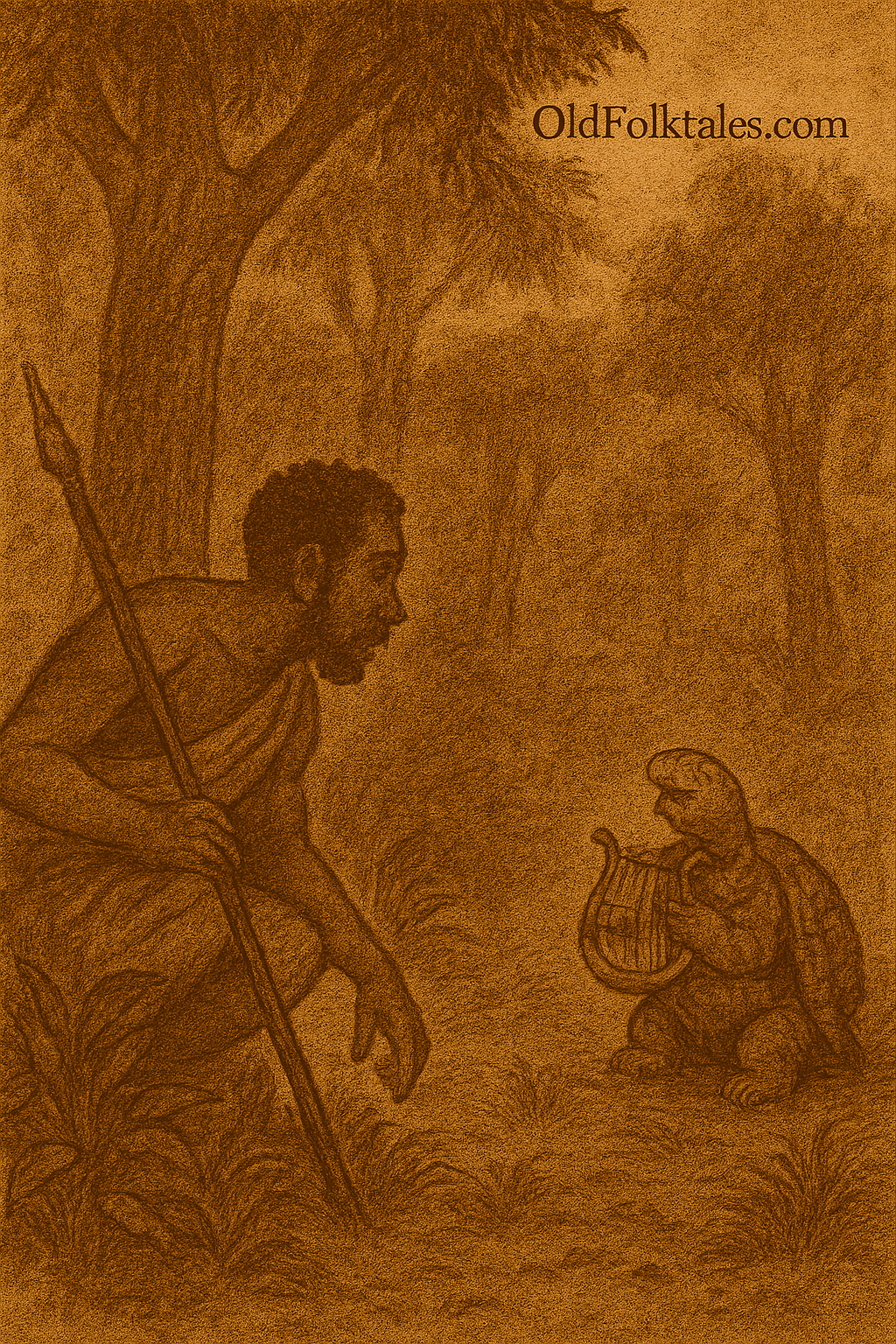
In the heart of ancient Africa, where the forest stretched endlessly in all directions and wildlife flourished in abundance, there lived a village hunter whose skill with bow and arrow was renowned throughout his community. This hunter possessed the keen eyes of an eagle and the silent step of a leopard, qualities that served him well in providing meat for his family and neighbors.
One fateful day, driven by the promise of greater game, this experienced hunter ventured deeper into the wilderness than he had ever traveled before. The familiar paths gave way to unknown trails, and the sounds of his home village faded into distant memory. As he moved through this uncharted territory, the canopy above grew thicker, filtering the sunlight into dappled patterns on the forest floor.
Suddenly, the hunter froze in his tracks. Through the symphony of natural forest sounds the chirping of birds, the rustling of leaves, the distant calls of monkeys came something entirely unexpected and extraordinary. A voice was singing, clear and melodious, accompanied by the gentle strumming of what sounded like a musical instrument.
The hunter held his breath and listened intently to the enchanting song that drifted through the trees:
“It is man who forces himself on things, Not things which force themselves on him.”
The melody was hauntingly beautiful, accompanied by music so sweet and pure that it seemed to speak directly to the hunter’s soul. Never in all his years wandering the forest had he encountered anything so magical and captivating. The song stirred emotions within him that he had never experienced before—a deep sense of wonder and an inexplicable longing.
When the final notes faded into the forest silence, curiosity overcame the hunter’s caution. Moving as quietly as only an experienced tracker could, he crept closer to the source of the mysterious music. Carefully parting the dense foliage with his hands, he peered through the branches, expecting to find perhaps a lost maiden or a traveling musician.
What he discovered defied all logic and expectation. There, sitting peacefully in a small clearing dappled with filtered sunlight, was a tortoise unlike any creature he had ever seen. The tortoise was not large, but she carried herself with an dignity that commanded respect. Most remarkable of all, slung gracefully across her shell was a tiny harp, perfectly proportioned for her size, its strings gleaming in the forest light.
The hunter rubbed his eyes, certain that the long day and unfamiliar surroundings were playing tricks on his vision. But there was no mistaking what he saw: a tortoise who could sing with the voice of an angel and play music that touched the very depths of his being.
Day after day, the hunter found himself returning to this hidden grove, drawn by an irresistible desire to hear the tortoise’s enchanting performances. Each time, he arrived to find her singing the same profound song, her tiny claws moving expertly across the harp strings. The music became an obsession, a daily necessity that filled a void in his life he hadn’t known existed.
Over time, the hunter’s visits became so regular that the tortoise grew accustomed to his presence. Eventually, he gathered the courage to approach her directly, speaking in gentle tones and offering tokens of friendship. The tortoise, perhaps sensing his genuine appreciation for her art, began to acknowledge his presence with nods and eventually with conversation.
“Your music brings such joy to my heart,” the hunter confessed one day. “I find myself thinking of nothing else from dawn until dusk. Would you consider coming to my village, to my humble hut, so that I might enjoy your singing in comfort every day?”
The tortoise considered this request carefully, her ancient eyes studying the hunter’s face for signs of his true intentions. Finally, she agreed to accompany him, but only under one absolute condition: “I will sing only for you,” she said firmly. “My music is a gift meant for those who truly appreciate its meaning, not for those who would turn it into spectacle or entertainment. Promise me that my performances will remain our secret.”
The hunter eagerly agreed to these terms, his heart racing with excitement at the prospect of having this magical creature as a daily companion. He carefully carried the tortoise and her precious harp back to his village, where he created a comfortable space for her in his hut.
For a time, this arrangement brought the hunter immense happiness. Each evening, after returning from his hunting expeditions, he would sit quietly and listen as the tortoise filled his humble dwelling with her ethereal music. The profound words of her song seemed to gain deeper meaning with each performance, speaking to truths about the relationship between humanity and the natural world.
However, as days turned to weeks, a different kind of hunger began to grow within the hunter’s heart. The private joy he experienced began to feel insufficient. He found himself imagining how impressed his neighbors would be if they could witness this miracle. He envisioned the respect and admiration he would receive as the man who had discovered such an extraordinary wonder.
The temptation proved too powerful to resist. Despite his solemn promise to the tortoise, the hunter began to whisper hints about his secret to his closest friends. “You wouldn’t believe the marvels I have witnessed in the deep forest,” he would say with a mysterious smile. These tantalizing hints only increased his listeners’ curiosity, encouraging him to reveal more.
Gradually, the secret spread like ripples in a pond. One friend told another, who shared the tale with his family, who mentioned it to their neighbors. Each telling added embellishments and wonder, until the story reached the ears of the village chief himself.
The chief, intrigued by these fantastic claims, summoned the hunter to appear before the Village Assembly—the formal gathering where important matters were discussed and disputes resolved. Standing before the assembled community, the hunter found himself the center of attention as he had always dreamed. With growing confidence, he described his discovery in elaborate detail: the singing tortoise with her tiny harp, the beautiful music, the profound wisdom of her song.
But instead of the awe and admiration he had expected, the hunter was met with skeptical laughter and open scorn. The villagers whispered among themselves, shaking their heads in disbelief. Some called him a fool, others accused him of seeking attention through ridiculous fabrications.
Stung by their mockery and desperate to vindicate himself, the hunter made a fateful declaration: “If I do not speak the truth, I give you permission to take my life. Tomorrow, I will bring the tortoise to this very place, and you may all hear her sing with your own ears. If she cannot perform as I have claimed, I am willing to die for my lies.”
The villagers, equally committed to their position, accepted his challenge. “Very well,” they replied, “and if this tortoise can indeed do as you claim, we grant you the right to punish us in whatever manner you choose.”
The agreement sealed, the hunter returned home with his heart pounding with both excitement and anxiety. He had complete confidence in the tortoise’s abilities, yet something in her manner seemed different when he excitedly told her about the next day’s performance. Her ancient eyes held a sadness that he was too caught up in his own anticipation to fully recognize.
When morning arrived, the hunter carefully carried the tortoise and her harp to the Village Assembly Place, where the entire community had gathered. A special table had been prepared at the center of the clearing, and every villager had found a seat with a clear view of the proceedings. The atmosphere buzzed with curiosity and skepticism.
The hunter placed the tortoise gently on the table, positioning her harp within easy reach. Then he stepped back with a confident smile, certain that within moments the entire village would be spellbound by the magical music that had so captured his heart.
But silence stretched across the gathering. Minutes passed, then an hour, then another. The tortoise sat motionless on her table, her harp untouched, offering not even the smallest sound. The hunter tried everything he could think of—gentle coaxing, desperate pleas, even attempts to manually position her claws on the harp strings. Nothing worked.
As the day wore on, the villagers’ patience began to wear thin. Whispers of “charlatan” and “fool” grew louder. Some began to leave, shaking their heads in disgust at what they saw as an elaborate waste of their time. The hunter’s confidence crumbled into panic, then desperation, and finally resignation as he realized that his life was forfeit.
When the sun began its descent toward the horizon, painting the sky in shades of orange and red, the chief solemnly pronounced the sentence. As the final ray of sunlight disappeared behind the trees, the hunter was executed for his perceived deception.
The instant the hunter’s life ended, a clear, melodious voice rang out across the stunned assembly. The tortoise began to sing, her tiny claws moving gracefully across her harp strings, filling the evening air with the same haunting melody the hunter had described:
“It is man who forces himself on things, Not things which force themselves on him.”
The villagers stared at one another in shock and growing horror as the reality of their mistake became clear. “Our brother spoke the truth,” they whispered, “and we have killed an innocent man.”
But the tortoise continued, her voice carrying both sorrow and wisdom as she explained the tragic sequence of events: “He brought this fate upon himself, though his death grieves me deeply. I lived contentedly in the forest depths, sharing my simple song with the wind and trees. He was not satisfied merely to listen and appreciate this gift. Instead, he chose to betray my trust and reveal secrets that were not his to share. He sought to transform something sacred and private into public spectacle for his own glory. Had he respected the boundary between appreciation and exploitation, this tragedy would never have occurred.”
And with those final words of explanation, she sang once more her eternal song of wisdom, a reminder that some gifts are meant to be cherished quietly, and that true magic dies when it is forced into service for human ambition.
Moral Lesson
This profound African folktale teaches us about the destructive power of greed for recognition and the importance of respecting the boundaries that come with special gifts. The hunter’s tragedy illustrates how the desire for public acclaim can lead us to betray trust and destroy the very treasures we seek to celebrate. The story reminds us that some experiences are meant to remain private and sacred, and that forcing magical or special things into the spotlight often causes them to lose their power entirely.
Knowledge Check
Q1: What does the hunter represent in this African wisdom folktale? A: The hunter represents human greed for recognition and the tendency to exploit special gifts for personal glory. His character demonstrates how the desire for public acclaim can lead someone to betray trust and ultimately destroy what they most treasure.
Q2: What role does the singing tortoise play in this African moral tale? A: The tortoise represents the sacred wisdom of nature and the importance of respecting boundaries. As a creature who shares her gift freely but conditionally, she embodies the principle that some treasures are meant to remain private and that magical things lose their power when exploited.
Q3: What is the significance of the tortoise’s song in African storytelling traditions? A: The song “It is man who forces himself on things, not things which force themselves on him” serves as the central wisdom of the tale, teaching that humans often create their own problems by trying to control or exploit natural gifts rather than simply appreciating them as they are.
Q4: How does this folktale explain the relationship between humans and nature? A: The story illustrates that nature offers its gifts freely to those who approach with respect and humility, but withdraws them when humans try to exploit or commercialize what should remain sacred. It emphasizes the importance of maintaining proper boundaries with the natural world.
Q5: What cultural values does this African folktale promote? A: The tale promotes values of humility, respect for privacy, keeping one’s word, and appreciating gifts without seeking to exploit them. It reflects African wisdom about living in harmony with nature and understanding that some experiences are meant to remain personal and sacred.
Q6: Why does the tortoise only sing after the hunter’s death in this moral tale? A: The tortoise’s post-death performance serves as both vindication of the hunter’s claims and a final lesson about consequences. By singing only after his death, she demonstrates that her silence was a conscious choice to honor their broken agreement, showing that trust, once betrayed, cannot be easily restored.

