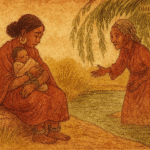
In the days when the trees still whispered secrets to those who dared to listen, there lived a man named Garba. He was a hunter, strong of arm and sharp of eye. His fame stretched across the savannah and deep into the forest villages. People said he could strike a flying bird from the sky without missing a step.
But Garba was not just skilled—he was proud. Too proud. Where others walked in gratitude, Garba walked in boasting. He would say, “I do not need luck. I command the forest. The animals flee because they know I am near.”
The elders warned him gently, “The forest is alive, Garba. It listens. Speak with respect.”
But Garba would wave a hand and laugh. “I speak only the truth.”
One season, a long drought swept the land. The rivers shrank to dusty trails, and animals vanished into the heart of the forest. The drums of hunger began to beat in the bellies of the villagers.
“Garba,” the chief said, his voice heavy, “you must go beyond the hills. You must find food, or we will not see the next moon.”
Garba’s eyes gleamed. A new challenge. “I will return with a beast so large it will feed ten families.”
He set out at dawn with his bow, a quiver full of arrows, and a knife tied to his hip. The forest greeted him with silence—no rustling, no birdsong, no footprints in the soil. The deeper he went, the stranger it became. Trees stood taller, older, their roots like twisted arms. The sky faded behind a thick green roof.
On the third day, hungry and alone, Garba stumbled upon a clearing. In its center stood a massive tree—twice the size of any baobab he had seen. Its bark was dark and smooth like woven cloth, and its branches stretched wide, shimmering with silvery leaves though no wind blew.
Garba stepped forward, then froze.
“Hunter,” came a voice—deep and calm like the earth itself. “Why do you carry pride where patience should be?”
Garba turned in circles, gripping his bow. “Who speaks?”
“I do,” said the tree. “I have watched your feet stomp the forest, your words insult the wind. Sit, Garba. You have much to unlearn.”
A tree that talks? Garba’s instincts told him to run. But curiosity rooted him in place and he sat.
The tree’s voice rumbled on. “You boast of conquest, but you do not understand the forest. You walk through it, but you do not see. Do you know why the antelope runs before you step? Do you know how the wind hides the leopard?”
Garba said nothing.
“If you listen, I will teach. But first, leave your pride at my roots.”
Slowly, Garba untied the feather from his bow—a symbol of his boast—and placed it at the base of the tree.
The tree taught him how to watch for the way leaves curl before animals pass. How to taste the air and know what hour the rain will fall. How to step without stirring the soil. And more than anything, how to wait.
For three days and nights, Garba sat, listened, and learned. The forest, once silent, became a song of signs.
When he rose, the Talking Tree said, “You seek meat. But today, I give you something greater.”
From a fold in its roots, the tree revealed seeds—strange, dark, and firm.
“Plant these. They feed not one, but generations.”
Garba returned to the village with no animal, no horns or hide. Only seeds.
Murmurs followed him.
“He failed.”
“He returned empty.”
But Garba stood tall—not with pride, but with calm.
“These seeds,” he said, “come from wisdom. They will grow food when the hunt is bare. We must not always take. We must learn to grow.”
The chief listened. The elders nodded.
And so, Garba planted.
Seasons passed. The seeds grew into strong plants—ones no one had seen before, rich with fruit even in dry times. Slowly, animals returned, sensing peace.
Garba never again boasted. He returned often to the forest, not to hunt—but to sit beneath the Talking Tree.
Some say the tree still stands. And if you walk softly and listen humbly, it may speak to you too.
✧ Commentary
This story beautifully weaves themes of humility, growth, and the sacred bond between humanity and nature. Garba represents the modern person who relies too heavily on skill and ego, forgetting that wisdom often comes from listening—not doing. The Talking Tree, like many sacred trees in West African folklore, symbolizes the spirit of nature, ancestral knowledge, and harmony. The transformation of Garba—from a proud hunter to a humble cultivator—reflects a deeper truth: those who listen to nature find not just survival, but lasting prosperity.
✧ Moral
Nature rewards those who approach it with respect. Pride blinds us, but humility reveals wisdom. Sometimes, what we truly need is not what we set out to find.
✧ Questions & Answers
1. Q: Who was Garba, and what was he known for? A: Garba was a skilled hunter, known for his pride and confidence in the forest.
2. Q: What caused the village to send Garba into the forest? A: A drought had made food scarce, and the villagers trusted Garba to find animals.
3. Q: What was unusual about the tree Garba found? A: It could speak and offered wisdom instead of game.
4. Q: How did the Talking Tree help Garba and the village? A: It taught Garba humility and gave him seeds that could grow food for generations.
5. Q: What is the main lesson of the story? A: Humility and wisdom lead to greater rewards than pride and conquest.