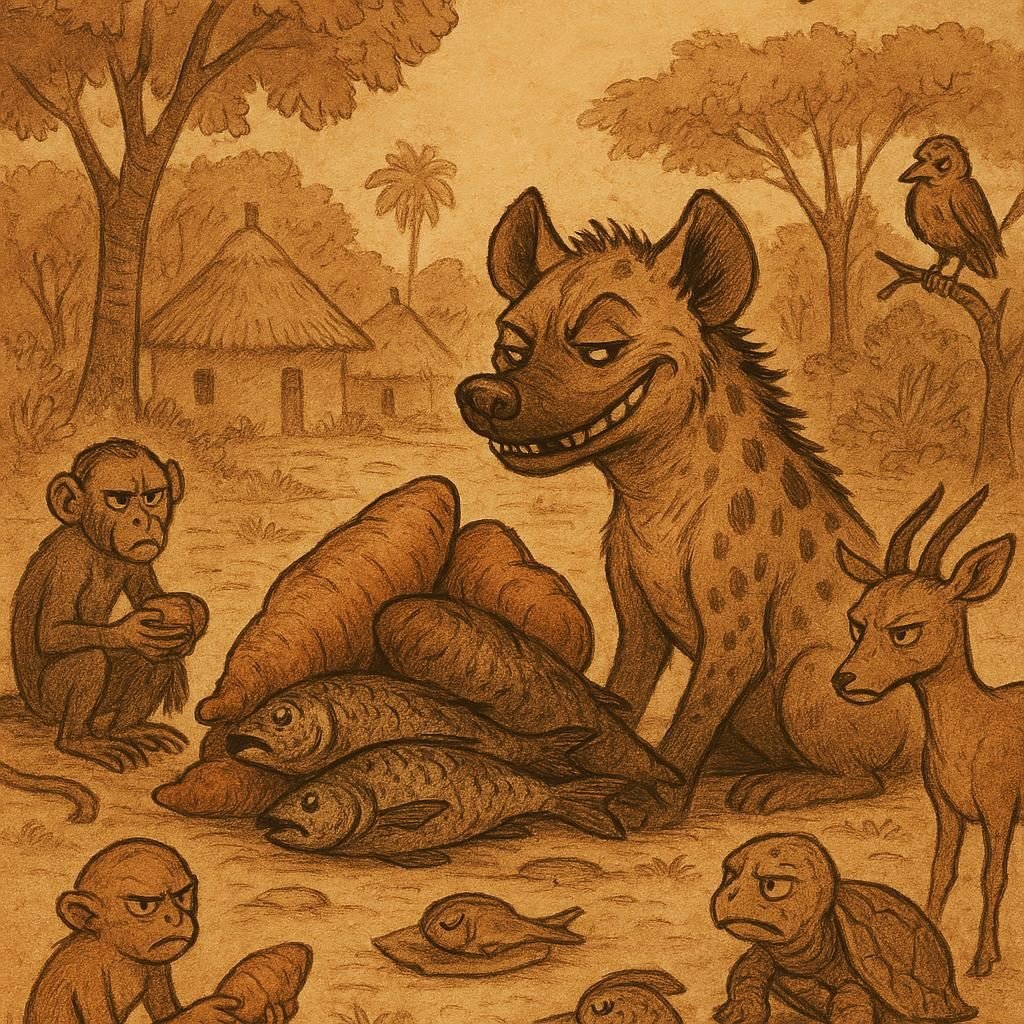
In the forests of Gabon, where the tall trees spread wide branches and the earth smelled of fresh rain, the animals often gathered together to share food. They hunted, fished, and foraged as a community, each taking turns so no one would go hungry. It was a way of living that kept peace among them, for the forest gave plenty when shared fairly.
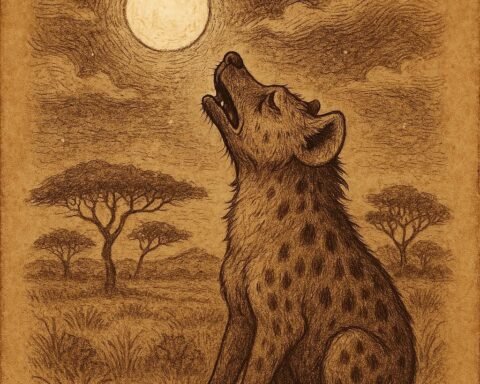
Yet among them lived Hyena, who had a sly heart. He wore a crooked smile and spoke with smooth words, but his mind always plotted ways to take more than his share. He thought himself clever, believing no one could see through his tricks.
One evening, when the moon shone like silver on the river, the animals caught fish and roasted yams to enjoy together. Hyena offered to divide the food. “Let me share it for all of us,” he said sweetly. “I am fair and wise, and I will see that everyone receives what is due.”
READ THIS: The Greedy Hunter
The animals, trusting his words, agreed. They placed the food before him in a large basket. Hyena’s eyes gleamed as he saw the fat fish and golden yams. With quick hands, he began to divide. To Monkey, he gave a small yam. To Antelope, he gave a thin fish. To the birds, he offered crumbs and scraps. But for himself, Hyena slipped the fattest fish and the largest yams into his own pile.
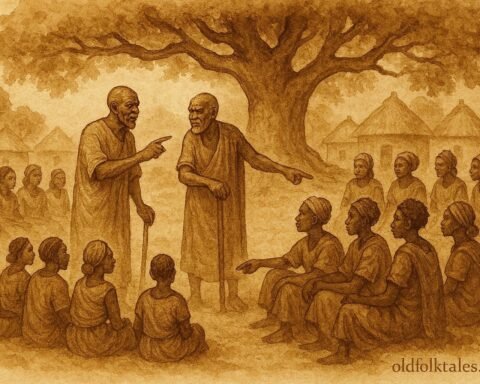
At first, the animals did not notice. Hyena chuckled softly, licking his lips as he ate. But Monkey’s sharp eyes soon caught the trick. He whispered to Antelope, “Look at Hyena’s portion. It is twice as large as ours.” Antelope nodded, and soon the others began to murmur among themselves.
Tortoise, though slow, was always wise. He raised his voice and said, “Hyena, are we to believe this is fairness? Why is your pile greater than all the rest combined?”
Hyena laughed nervously. “Oh, my friends, you mistake me. My pile only looks large because I am large. Surely you do not want me to starve.”
But the animals had grown suspicious. Monkey leapt forward and pulled one of Hyena’s fish. “This belongs to all of us!” he cried. The others joined, tugging at the yams and fish that Hyena had stolen. In the struggle, Hyena’s trick was revealed for all to see.
The animals grew angry. “You deceived us,” said Antelope. “You claimed to be fair, but you were greedy.”
Ashamed but still stubborn, Hyena tried to laugh it away. “It was only a small trick. Why do you take it so seriously?”
But the animals would not forgive him. From that day, they agreed never to let Hyena divide food again. When they gathered to eat, he was pushed aside, and no one trusted his words. Hungry and alone, Hyena wandered the forest, his belly empty though food was plenty.
And so it is said in Gabon that Hyena still roams with his sly smile, forever searching for a chance to trick others, yet never trusted, never welcomed, and often left to hunger.
Moral Lesson
The story of the Hyena’s trick reminds us that deception may bring short gains but always leads to long losses. Hyena thought himself clever, but his greed cost him the trust and friendship of his community. True wealth lies not in taking more but in sharing fairly. Without trust, even the cleverest trickster will find himself alone and empty-handed.
Knowledge Check
What role did Hyena volunteer to take during the feast?
Hyena offered to divide the food among the animals.How did Hyena trick the other animals?
He secretly kept the fattest fish and the largest yams for himself while giving smaller portions to the others.Who first noticed Hyena’s unfairness?
Monkey noticed that Hyena’s portion was larger than everyone else’s.How did the animals react when Hyena’s trick was revealed?
They grew angry, refused to trust him again, and took away the food he had stolen.What was Hyena’s fate after his deception was discovered?
He was left hungry and excluded, as the other animals no longer allowed him to share in their meals.What is the central lesson of this Gabonese folktale?
The tale teaches that dishonesty and greed destroy trust and community, leaving the deceiver isolated.
Cultural Origin: Gabonese folktale (Mpongwe Tribe), recorded by Robert H. Nassau in Where Animals Talk: West African Folklore Tales (1914).