In the wide, open lands of South Africa, near the colony’s borders, lived a sly creature known to all as Jackal. He was sharp-eyed, quick-thinking, and always searching for ways to fill his belly without too much effort. Jackal relied not on strength but on wit, and wherever he went, his cleverness often left others in awe or in misery.
One moonlit evening, Jackal prowled along a road leading inland from the sea. His keen eyes caught sight of a heavy wagon making its slow way home. The wagon was creaking under the weight of its load, for it was piled high with freshly caught fish. Jackal’s stomach growled with hunger, and at once his mind began to work.
He first tried to leap into the wagon from behind, but the load was too tall, and he slid back to the ground. Still, he did not give up. Crafty as ever, he ran ahead of the oxen and threw himself across the dusty road, lying flat and still as though he were dead. His tongue lolled from his mouth, his legs sprawled lifelessly, and he made a convincing picture of a fallen animal.
When the wagon reached him, the man leading the oxen stopped. “Look here!” he called to the driver. “What luck a fine kaross for your wife!” A kaross, made from animal skin, was considered a useful blanket and garment.
The driver peered at the still body and said, “Throw it into the wagon.” Without hesitation, the man lifted Jackal and tossed him on top of the pile of fish.
The wagon rolled on beneath the moon, the wheels groaning and the oxen plodding steadily forward. Jackal, though, was far from dead. As the wagon rocked, he reached down with careful paws and began to toss the fish, one by one, into the road. They landed with soft thuds on the earth, glimmering faintly in the moonlight. By the time the wagon was halfway home, Jackal had built himself a trail of fish fit for a feast.
When he felt satisfied, Jackal leapt lightly out of the wagon and returned to gather his prize. His jaws worked busily, and his belly grew round as he devoured the stolen catch. For Jackal, the night had been a success.
But his good fortune did not remain his alone. Soon afterward, Wolf often called Hyena in these tales stumbled across the pile of fish. Wolf was a foolish creature, greedy and slow-witted. He pounced on the catch without thought, gobbling down more than his fair share. Jackal, who returned to find his feast nearly gone, grew angry. Still, he hid his fury behind a smile.
“Ah, my friend,” Jackal said smoothly, “you need not envy me. You, too, can have as many fish as your belly can hold. All you must do is what I did. Lie very still in the road when the wagon comes, and no matter what happens, do not move. Soon you will be carried into riches.”
Wolf’s eyes gleamed with hunger. “So,” he muttered, “that is how you did it.”
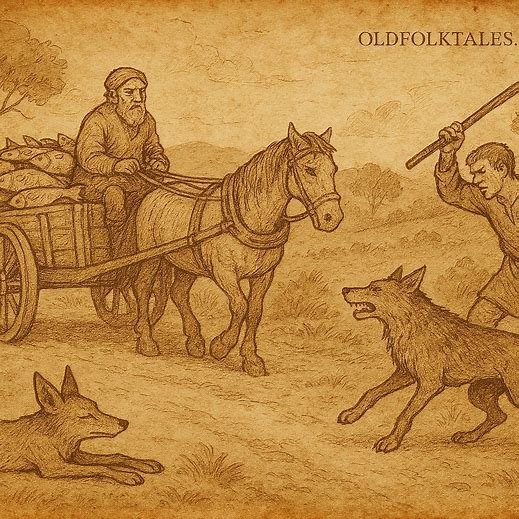
The very next day, another wagon full of fish came creaking up from the coast. Eager for his reward, Wolf stretched himself across the road, stiff and awkward, pretending to be dead. His fur bristled unevenly, his body looked rough and unconvincing, and unlike Jackal, he lacked the charm of disguise.
When the man leading the wagon saw him, he wrinkled his nose in disgust. “What ugly beast is this, lying in the way?” he cried. Instead of lifting Wolf into the wagon, he kicked him hard in the side. Wolf, following Jackal’s advice, clenched his teeth and lay still.
But the driver grew suspicious. He took up a heavy stick and began to beat the “dead” animal. The blows rained down mercilessly, each one sharper than the last. Wolf bore the pain as long as he could, but at last his courage failed. With a cry, he scrambled to his feet and hobbled off, battered and bruised.
When he reached Jackal, his sides aching and his back stinging, he moaned about his misfortune. Jackal, hiding his delight at the success of his trick, pretended to console him. “Ah, what a pity,” Jackal sighed, shaking his head. “Perhaps it is because you do not have such a handsome skin as I do. The men must have thought you worthless.”
Wolf groaned miserably, realizing too late that he had been tricked. Jackal’s revenge was complete.
Moral
The story of Jackal and Wolf teaches that greed and blind imitation often bring misfortune. Jackal succeeded because of wit, not because of chance, while Wolf’s envy led him into pain. The lesson is clear: do not follow another blindly, for what benefits one may ruin another.
Knowledge Check
1: What clever trick did Jackal use to get fish?
He pretended to be dead so he would be thrown into a wagon, then tossed fish onto the road.
2: Why did Jackal decide to trick Wolf?
Wolf had greedily eaten more than his share of Jackal’s stolen fish, which angered Jackal.
3: How did Wolf imitate Jackal’s trick?
He lay in the road pretending to be dead, hoping to be thrown into a wagon like Jackal.
4: What happened to Wolf instead of being rewarded?
The wagon leader found him ugly, kicked him, and beat him badly with a stick.
5: What does the story symbolize about envy?
It shows that envy leads to blind imitation, which often results in harm and failure.
6: What is the cultural origin of this tale?
It is a South African folktale, part of the region’s tradition of trickster stories.
Source: South African folktale