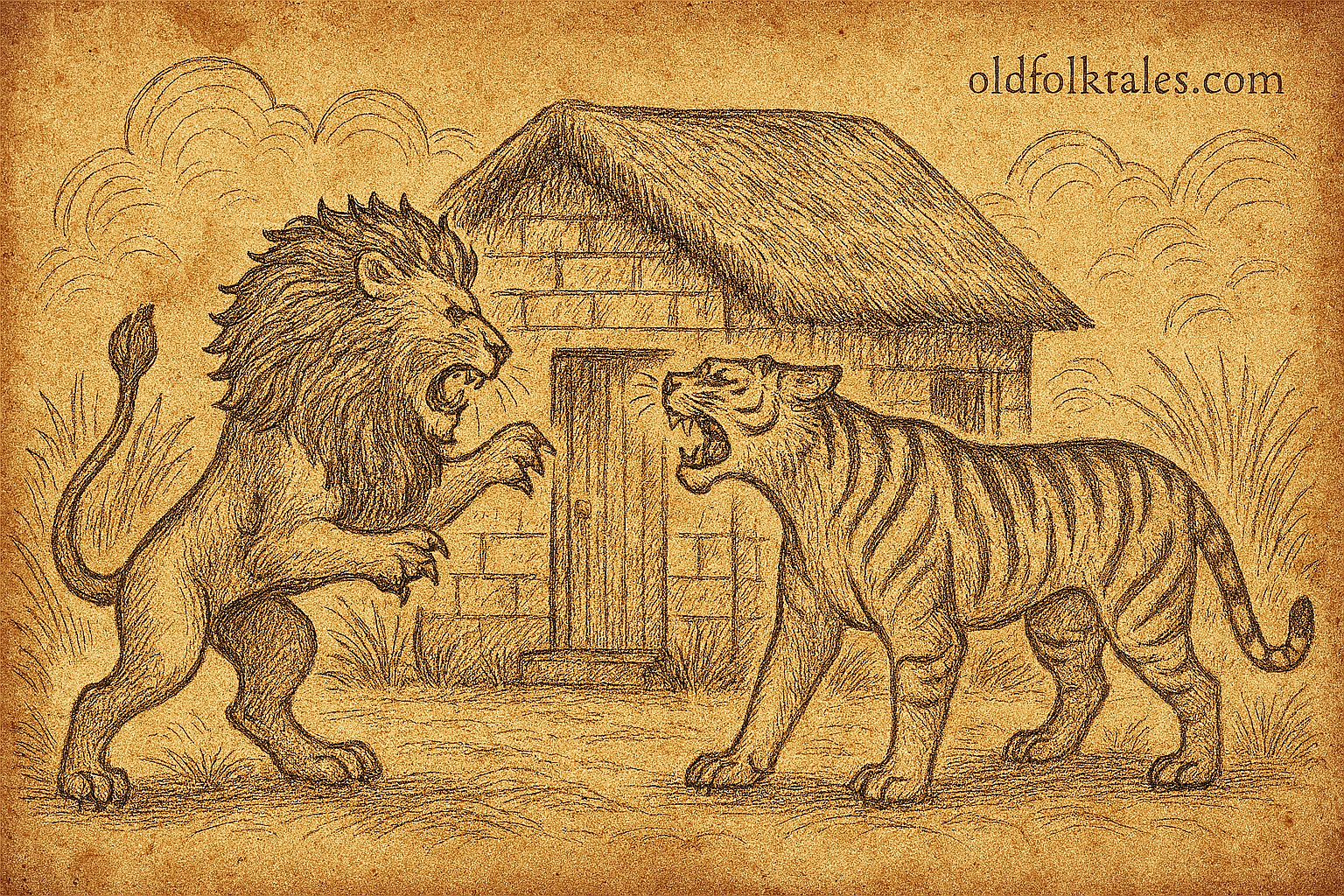
Deep in the heart of the jungle, where ancient trees stretched their limbs toward the sky and the calls of wild creatures echoed through dense foliage, a mighty lion roamed in search of the perfect place to settle his family. His golden mane rippled in the dappled sunlight as he padded through the undergrowth, his keen eyes surveying every clearing, every patch of level ground. He was not just any lion, he was a king in his own right, responsible for the safety and comfort of his pride.
After hours of searching, the lion discovered a beautiful spot that met all his requirements. The ground was firm and level, surrounded by tall grasses that would provide privacy and protection. A gentle breeze rustled through nearby acacia trees, and the location offered clear sightlines in all directions perfect for watching over his territory.
Standing in the center of this ideal plot, the lion nodded with satisfaction and declared, “Inch’allah, tomorrow I will plant the first pole for the foundation.” Content with his discovery, he settled into the soft grass nearby with his family, their bodies forming a protective circle as they rested under the star-filled sky.
Looking for more? Explore the magic of East African folktales here
That very same evening, as darkness deepened across the jungle, a tigress prowled through the same forest on her own urgent mission. Unlike the lion, she traveled alone, her sleek form moving silently through the shadows. Behind her trailed her young cubs, mewing softly as they struggled to keep pace with their mother. The tigress’s situation was desperate she needed shelter immediately, a safe nest where her vulnerable babies could rest while she hunted for their survival.
By remarkable chance, or perhaps by fate’s mischievous hand, the tigress arrived at the exact same clearing the lion had claimed just hours earlier. Her amber eyes swept across the space, and she too recognized its perfection. But unlike the lion, the tigress could not afford to wait. Her cubs were exhausted and exposed.
Without hesitation, she drove the first foundation pole deep into the earth with powerful strikes of her paw. “I will continue tomorrow, Inch’allah,” she murmured, then disappeared into the night to hunt fresh meat for her hungry young ones.
When dawn broke and painted the jungle in shades of gold and green, the lion returned to begin his construction. But as he approached his chosen plot, he stopped abruptly. There, standing exactly where he had planned to begin, was a sturdy pole already planted in the ground.
The lion’s eyes widened with wonder and gratitude. He lowered himself reverently, raising his massive paws toward heaven, and began to pray with deep sincerity. “Oh, my God! I thank you for the strong hand you lent me to build my house more quickly! My family and I will be forever grateful to you. My mane, my courage, my health all belong to you. Amen!”
Filled with renewed energy and divine blessing, the lion planted a second pole beside the first and departed, his heart light with joy.
Later that day, the tigress returned to continue her work. When she saw the second pole standing beside her own, she too believed that heaven had answered her prayers. She offered her own thanks to God for this miraculous assistance, added another pole to the growing structure, and hurried back to feed her waiting cubs.
And so it continued, day after day. The lion would arrive, find new poles, praise God’s generosity, and add his own contribution. The tigress would do the same, each believing they were receiving divine help with their construction. Neither ever crossed paths with the other. The house rose steadily walls took shape, a roof was assembled, rooms were divided, and finally, the structure stood complete.
On moving day, both families arrived simultaneously, each carrying their belongings, each certain of their rightful ownership. They came face to face at the entrance, and the shock was immediate and absolute.
The lion’s roar shook the trees. The tigress’s snarl cut through the air like a blade. Both families, feeling betrayed and offended, quickly pushed their young ones inside to safety. Then they turned back to face each other, claws unsheathed and gleaming, whiskers bristling, teeth bared in fierce displays of dominance. Their growls rumbled like thunder through the jungle.
But as the tigress sized up her opponent, cold reality struck her heart. Before her stood not just the lion, but his entire family a mated pair of powerful predators. She was alone, outnumbered. Raw strength would not win this battle.
With remarkable composure, the tigress retracted her claws. She relaxed her snarling face and softened her posture. Speaking with unexpected diplomacy, she acknowledged that despite the misunderstanding, they had indeed built this house together, brick by brick, pole by pole.
The Lion King, secure in his power but generous in spirit, considered the situation and made his royal decree: “Each family shall have one room. The lounge and garden will belong to everyone. This is my decision, and it is final.”
The tigress bowed her head in apparent acceptance. But behind her submissive exterior, her cunning mind was already weaving a darker plan. She had no intention of sharing this house permanently. Beyond the issue of territory, there was a more pressing problem survival itself. When she went hunting to feed her cubs, they would be left alone and vulnerable, with lion parents always nearby. She could not trust them. She needed the entire house for herself and her young.
Several nights later, when midnight cloaked the jungle in absolute darkness, the tigress initiated her scheme. She deliberately woke her sleeping cubs by scratching them sharply with her claws—hard enough to make them cry out in genuine pain and distress. Their pitiful mewing echoed through the house, piercing the peaceful night.
“Be quiet! Silence!” the tigress shouted at them loudly, ensuring her voice carried to the neighboring room.
The lion family stirred from their slumber. The male lion yawned, his great jaws opening wide, before addressing their neighbor through the thin wall. “Madam Tigress, forgive my intrusion, but are you certain you fed your cubs properly today?”
The tigress responded in her sweetest, most innocent voice. “Oh yes, Sir Lion, I assure you! I brought them fresh game as always. I never give them the same carcass twice only the finest meat.”
She paused deliberately, then added with chilling casualness, “But you see, they have grown so accustomed to the tender flesh of doe and the rich meat of stag that they now refuse such ordinary fare. Tonight, they are crying because they demand something more… specific. They are insisting on lion’s liver.”
The words hung in the darkness like a death sentence.
The lion family’s ears shot up in alarm, their eyes wide with sudden fear. Lion’s liver. The cubs wanted lion’s liver.
The next night, at precisely the same midnight hour, the tigress repeated her performance scratching her cubs until they wailed, shouting at them to be quiet, ensuring the lions heard every disturbing moment.
By the third night, the lion family had reached their breaking point. The terrible thought consumed them: What if the tigress, driven by maternal instinct to satisfy her children’s demands, decided to extract their livers while they slept? After all, everyone knows that a mother whether human or beast is capable of anything, absolutely anything, to fulfill her children’s desires.
Under the cover of darkness, moving as silently as their massive forms allowed, the lion family gathered their belongings and crept away from the house. They abandoned their claim, their room, their shared construction driven out not by force, but by fear and psychological manipulation.
By morning, the tigress and her cubs had the entire house to themselves. She had won through cunning what she could never have taken through strength.
The Moral Lesson
This tale teaches us that intelligence and strategy can triumph where physical power fails. When facing stronger opponents, direct confrontation may lead to defeat or destruction. The tigress understood her limitations and used psychological warfare exploiting the lion family’s fears rather than challenging their strength. The story reminds us that wit, cunning, and understanding of human (or animal) nature can be more effective tools than brute force. However, it also raises questions about the ethics of manipulation and whether victory gained through deception carries its own costs to one’s character and honor.
Knowledge Check
Q1: What is the central conflict in this African folktale between the lion and tigress?
A1: The central conflict arises when a lion and tigress unknowingly build the same house together, each believing God is helping them with construction. When they discover the truth on moving day, they must resolve who has rightful ownership a conflict complicated by the tigress being alone while the lion has family support.
Q2: What does “Inch’allah” mean and why is it significant in the story?
A2: “Inch’allah” (also spelled “Insha’Allah”) means “God willing” or “if God wills it” in Arabic, reflecting Islamic influence in African oral traditions. Its use by both the lion and tigress shows their faith and reliance on divine providence, which ironically leads them to attribute each other’s work to God’s miraculous intervention.
Q3: How does the tigress use psychological manipulation to win the house?
A3: The tigress deliberately scratches her cubs at midnight to make them cry, then tells the lion family that her cubs are demanding lion’s liver for dinner. This creates fear in the lions that she might kill them in their sleep to satisfy her children’s demands, causing them to flee the house rather than risk being murdered.
Q4: What does the lion’s initial generosity reveal about his character in this folktale?
A4: The lion’s decision to share the house equally giving each family a room while sharing common spaces demonstrates royal generosity, fairness, and confidence in his power. As the “King,” he believes he can afford to be magnanimous, not realizing that his opponent will use cunning rather than accept this arrangement.
Q5: What survival challenge makes the tigress’s situation more desperate than the lion’s?
A5: The tigress is a single mother who must leave her vulnerable cubs unattended when she goes hunting, while the lion family has two parents who can take turns guarding their young. This imbalance not only makes her weaker in direct confrontation but also motivates her scheme to secure the entire house for her cubs’ safety.
Q6: What cultural wisdom does this African legend convey about conflict resolution?
A6: This folktale teaches that when facing more powerful enemies, one must rely on intelligence, strategy, and psychological understanding rather than direct confrontation. It reflects a survival philosophy common in African oral traditions: the clever and resourceful can overcome the strong through wit, though it also invites reflection on the morality of deception.
Source: Somali folktale