Long ago, when kingdoms were still young and stories traveled on the breath of griots, there lived a mighty king whose wealth and power stretched far across the land. But his greatest treasure was not his crown, nor his warriors, nor even his gold. It was a tree.
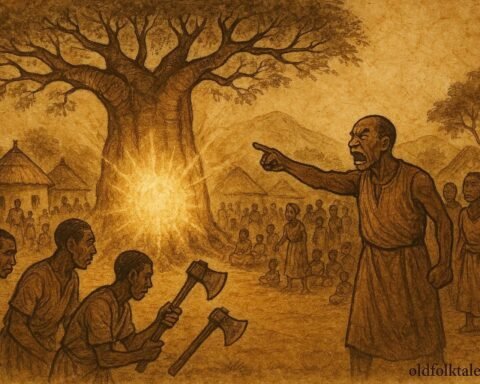
At the very heart of his town stood a majestic juju tree, a tree unlike any other in all the world. Its trunk was broad, its roots deep, and its branches stretched out like a roof over the king’s courtyard. Every day, without fail, the king would leave his palace, walk to the shade of the tree, and sit beneath its boughs.
There, the tree gave him whatever he desired. If he longed for food, steaming plates appeared at his side: roasted meats dripping with fat, bowls of yam and cassava, piles of ripe fruit still warm from the sun. If he thirsted, gourds of palm wine and crystal-clear water emerged as though the tree’s roots reached into hidden rivers. The king needed nothing more, his every want was fulfilled beneath that tree.
The King’s Growing Pride
For many years, the king lived in peace and luxury. His people admired his fortune, though some whispered that the juju tree was a gift too powerful for any man. Still, the king ruled well enough, and his kingdom prospered. Travelers came from far lands to see the wonder of the tree that obeyed the will of their ruler.
But as the seasons passed, pride began to take root in the king’s heart. The daily gifts of the tree no longer seemed like blessings but like proof of his own greatness. He forgot the humility that once guided him.
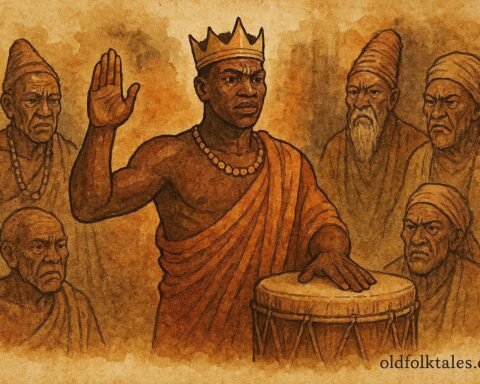
One morning, as he sat beneath the juju tree, surrounded by abundance, the king rose to his feet and addressed his people. His voice was proud and booming:
“Look at me, your king! What man is greater than I? Even God Himself cannot compare to me, for this tree gives me all that I desire. Food, drink, comfort, everything I need flows from it. I am greater than God.”
A stunned silence fell upon the crowd. The elders, wise with age, shook their heads gravely. They knew such words were dangerous, for arrogance against God never goes unanswered. Some villagers dropped their heads in shame; others whispered in fear. But the king, drunk on pride, ignored them all.
God’s Wrath Awakens
The words of the king did not vanish into the air. They reached the heavens, where God heard them. And God’s anger was fierce.
That evening, as the town settled into quiet, the skies darkened. A heavy stillness fell, the kind that makes even animals restless. Then, without warning, a fierce wind howled through the land. Trees bent, roofs shook, and dust filled the air. It was no ordinary wind, it was a whirlwind sent by God Himself.
The storm roared like an angry lion. Its twisting funnel tore through the market, scattering baskets of grain, toppling huts, and driving people to the ground. Mothers clutched their children, men shouted warnings, and elders cried out prayers.
But the whirlwind was not aimless. It raced directly toward the king and the juju tree.
The King’s Fall
The king, still standing proudly beneath his tree, tried to resist. He clung to the trunk, shouting, “I am greater than God! I will not fall!”
But the whirlwind’s fury was unstoppable. It wrapped around the tree like a giant hand, lifting its roots from the earth, twisting its branches until they cracked. The king, caught in its grip, was pulled into the churning winds.
The people watched in terror as both the king and the juju tree rose into the sky, spinning higher and higher, until they vanished into the storm clouds. The winds raged a little longer, then just as suddenly as it had come, the storm was gone.
Silence settled over the land. The king was gone. The juju tree was gone. And neither was ever seen again.
Aftermath
When the skies cleared, the townspeople emerged from hiding. They gathered at the empty patch of ground where the tree once stood. Nothing remained—no roots, no branches, not even a shadow of what had been.
The people mourned, but they also understood. Their king had let pride consume him, and in declaring himself greater than God, he had sealed his fate. Parents retold the story to their children so they would never forget: blessings are not given to elevate pride, but to inspire gratitude.
From that day forward, the kingdom remembered not the king’s wealth, nor the magical power of the juju tree, but the downfall that came from arrogance.
Moral Lesson
Pride blinds the heart. No matter how high one rises, to place oneself above God leads only to destruction.
Knowledge Check
Q1: What was special about the king’s juju tree?
A1: The juju tree was magical, providing the king with endless food and drink.
Q2: Why did the king grow proud?
A2: Because the tree supplied his every desire, he believed he was greater than God.
Q3: How did God punish the king?
A3: God sent a whirlwind that carried away both the king and the juju tree.
Q4: What did the townspeople learn from this event?
A4: They learned that pride leads to ruin and that no one is greater than God.
Q5: What does the juju tree symbolize in the folktale?
A5: The tree represents abundance, but also the danger of letting blessings lead to arrogance.
Q6: What is the origin of this folktale?
A6: It is an African folktale passed down through oral tradition, teaching humility and respect for God.
Source: Nigerian Folktale