There was a time when a king’s authority was not secured by wealth, armies, or the praise of his people alone, but by something far greater and more enduring. In those days, the power to rule came from a sacred connection between the living, the ancestors, and the unseen forces that watched over the land.
At the center of this connection stood a drum.
It was not an ordinary drum such as those played in celebration or used to call people together. This drum was sacred. It was believed to carry the voice of the ancestors, to hold the memory of past rulers, and to bear witness to truth and falsehood alike.
The people regarded it with deep respect. It was kept in a place set apart, guarded and only brought forth during moments of great importance.
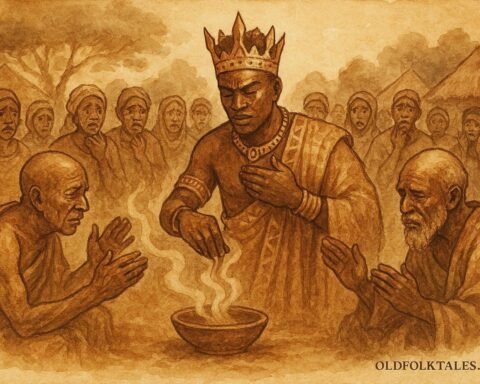
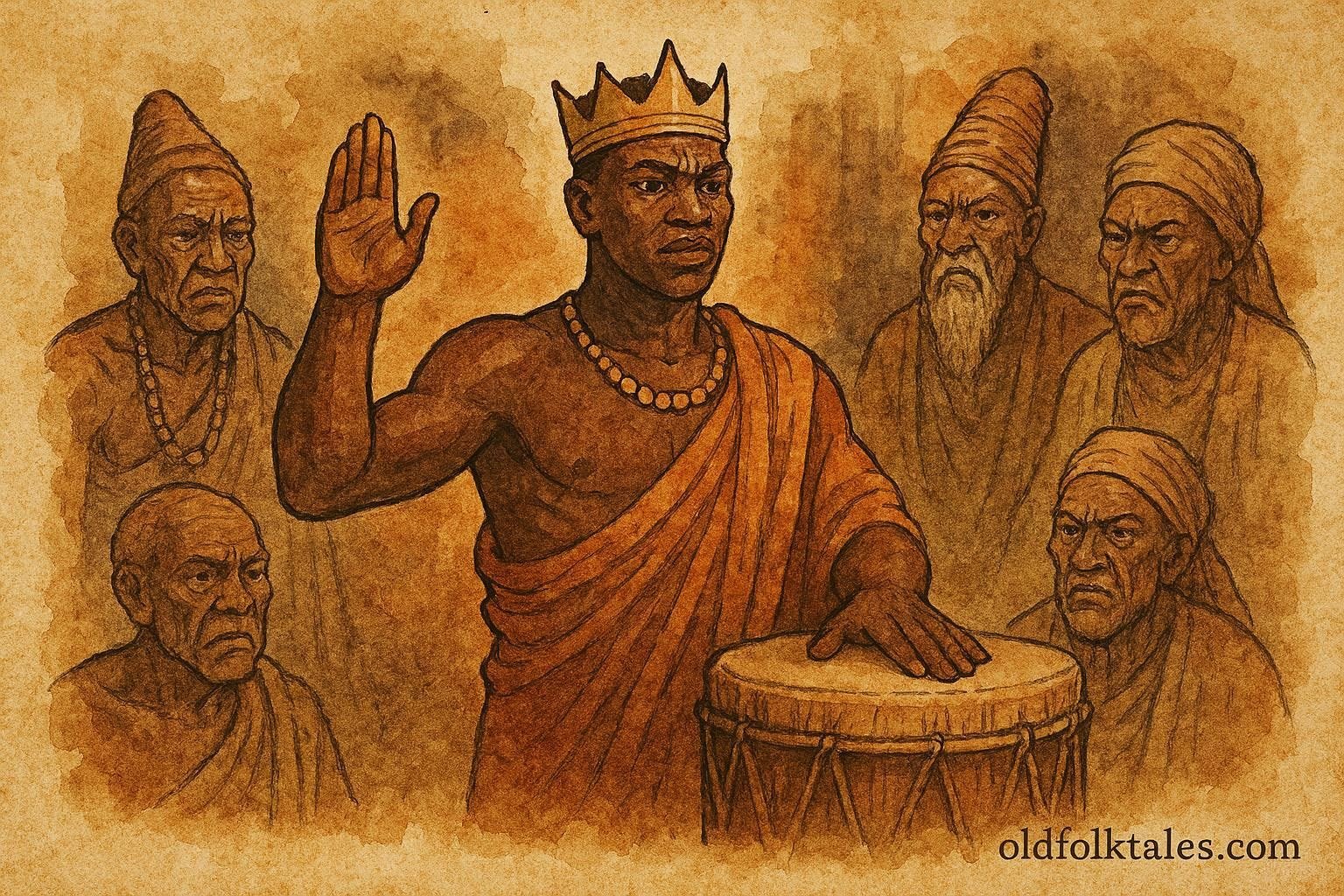
When a new king was chosen, his right to rule was not immediately accepted. Before he could fully take his place, he had to stand before the sacred drum and take an oath.
This oath was not simply spoken. It was tested.
If you enjoyed this story, explore our full West African folktales collection
The elders would gather, and the drum would be brought out with great care. The king would stand before it, surrounded by those who preserved the traditions of the land. In that moment, he was not above anyone. He was simply a man whose truth would be weighed.
The oath required the king to declare his intentions openly.
He would speak of how he intended to rule, how he would protect the people, and how he would honor the traditions that bound the kingdom together. He would promise to uphold justice, to respect the ancestors, and to act not for himself, but for the good of all.
As he spoke, the drum remained silent.
But it was believed that the drum listened.
If the king spoke truthfully, if his heart was aligned with his words, the drum would respond. Its sound would be clear and steady, a sign that the ancestors accepted him.
But if there was falsehood in his words, if he intended to misuse his power or place himself above the laws that governed the land, the drum would reveal it. Its sound would falter, or it would refuse to speak at all.
This was the test that no king could escape.
There came a time when a new ruler was to be tested.
He was a man of strong presence, admired for his confidence and ability to command attention. Many believed he would be a powerful king.
But among the elders, there was quiet concern.
They had observed him closely and wondered whether his ambition might be greater than his sense of duty. Still, the traditions required that he be given the chance to prove himself.
The day of the oath arrived.
The people gathered in silence, aware of the importance of what they were about to witness. The sacred drum was brought forward, its presence commanding respect.
The man who would be king stepped forward.
He stood before the drum and began to speak.
His voice was strong as he declared his intentions. He spoke of leadership, of strength, of his desire to bring greatness to the kingdom. He promised to protect the land and to lead the people with wisdom.
His words were impressive, and many who listened were moved by them.
But as he spoke, the elders watched closely.
They were not listening only to his words, but to what lay beneath them.
When he finished, all eyes turned to the drum.
There was a moment of silence, heavy and expectant.
Then the drum sounded.
But its sound was not as it should have been.
It was uneven, uncertain, as though something within it resisted the voice that had just spoken. The rhythm did not carry the strength and clarity that signaled acceptance. Instead, it faltered.
A murmur passed through the crowd.
The elders stepped forward.
“The drum has spoken,” they said. “There is something within your words that does not stand in truth.”
The man was taken aback. He had expected to be accepted without question.
“What do you mean?” he asked. “I have spoken my intentions clearly.”
But the elders shook their heads.
“It is not enough to speak well,” they said. “Your heart must be aligned with your words. The drum does not listen only to what is said. It listens to what is meant.”
The man stood in silence, confronted with a truth he could not deny.
For a moment, he struggled within himself. He could choose to deny what had happened, to challenge the elders, or to walk away.
But he knew that the drum could not be deceived.
Slowly, his posture changed.
He stepped forward again, this time with a different voice.
He spoke not of greatness, but of responsibility. He admitted that he had been driven by ambition, that he had desired power for its own sake. He acknowledged that he had not fully understood the weight of what it meant to rule.
“I see now,” he said, “that to lead is not to command, but to serve. If I am to be king, it must be with humility, not pride.”
Once again, the people waited.
The drum was still.
Then, slowly, it began to sound.
This time, its rhythm was steady and clear. It carried a sense of balance and strength that could not be mistaken.
The elders nodded.
“The drum has accepted your oath,” they said.
The man was now king.
But he was not the same as he had been before.
The test had changed him. It had shown him that leadership was not about power, but about truth, responsibility, and alignment with the values that sustained the kingdom.
From that day onward, he ruled with a different understanding.
He listened more carefully. He sought the counsel of the elders. He respected the traditions that had once seemed restrictive.
The sacred drum remained a reminder of the moment when his truth had been tested and revealed.
The story of the drum oath was told across generations, not only as a tale of kingship, but as a lesson for all.
It taught that authority must be grounded in truth, that words alone are not enough, and that the deepest judgments come not from people, but from the unseen forces that uphold balance in the world.
Don’t stop yet! See our complete East African folktales collection
Moral Lesson
True leadership is built on honesty, humility, and responsibility. Power without truth cannot stand.
Knowledge Check
- What role did the sacred drum play in the story?
It tested the truth and legitimacy of the king’s oath. - Why did the drum reject the king at first?
Because his words were not fully sincere and were driven by ambition. - What changed during the second oath?
The king spoke with honesty and humility. - What does the drum symbolize?
Ancestral authority and the truth beyond spoken words. - What lesson did the king learn?
That leadership requires responsibility and truth, not pride. - What is the main message of the story?
True authority comes from integrity and alignment with tradition.
Source
Burundian oral tradition. Recorded by Jan Vansina in Antecedents to Modern Rwanda: The Nyiginya Kingdom (2004).