
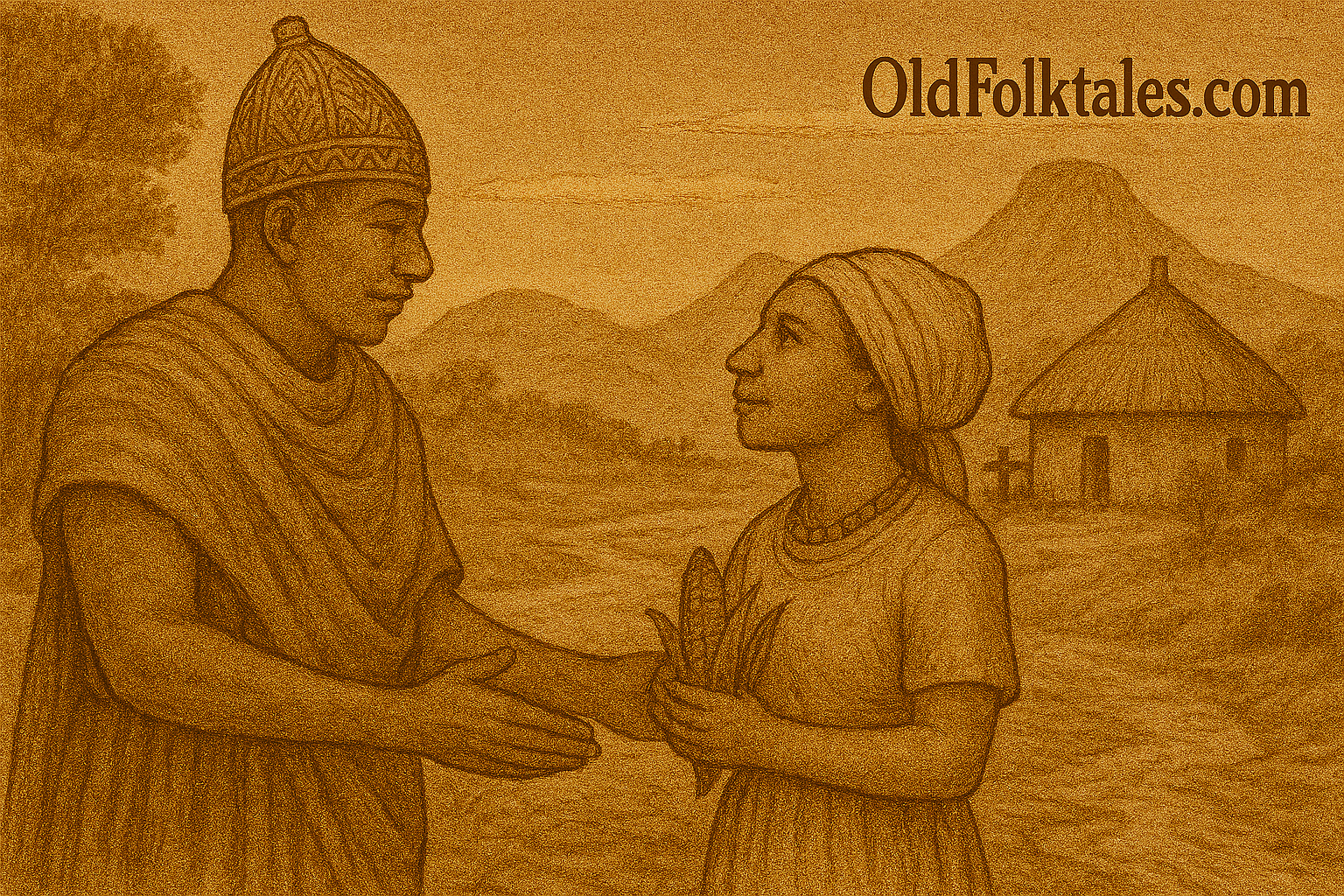
In the bustling kingdom of Duke Town, Calabar, there once ruled a king whose appetite for beautiful women knew no bounds. King Effiom was a man of immense wealth; his coffers filled with riches earned from the profitable slave trade that flourished along the coastal waters of his domain. With gold flowing like river water through his palace, he could afford any bride price demanded by eager fathers, and his royal compound housed an astounding two hundred and fifty wives.
Yet for all his accumulated beauty, King Effiom remained perpetually unsatisfied. His eyes constantly searched the horizon for lovelier faces, his heart yearning for the next enchanting maiden who might capture his restless attention. The king’s friends, ever eager to curry favor with their wealthy ruler, scoured the land like hunters seeking the most prized game, reporting back whenever they discovered a woman of exceptional beauty.
One fateful day, these loyal companions brought news that would forever alter the course of the kingdom. They spoke in hushed, reverent tones of a maiden whose beauty surpassed all others, a girl so stunning that she made the king’s current wives seem pale as morning mist by comparison. This extraordinary creature was none other than the daughter of the Cock, a humble bird who lived modestly among the common folk.
King Effiom’s interest blazed like wildfire upon hearing this description. Without hesitation, he summoned the Cock to appear before his royal throne, his voice booming with the authority of absolute power as he declared his intention to claim the bird’s daughter as his newest bride.
The poor Cock, trembling before the magnificent king in his golden robes and glittering crown, knew he possessed no power to refuse such a royal command. With a heavy heart, he brought forth his beloved daughter Adiaunen, whose beauty indeed proved to exceed every glowing description. Her grace captivated King Effiom instantly, her gentle movements and radiant smile igniting a passion within him more intense than any he had previously experienced.
As King Effiom counted out six precious puncheons of palm oil as the bride price, the Cock felt compelled to offer a gentle warning to his future son in law. “Great King,” he said with nervous respect, “my daughter carries within her the natural instincts of her heritage. If you take Adiaunen as your wife, you must remember that she cannot resist the call of scattered corn. When she sees grain upon the ground, her true nature will compel her to peck at it, just as any hen would do. Please do not hold this against her, for it is simply who she is.”
King Effiom, drunk with desire and blinded by Adiaunen’s beauty, waved away these concerns with careless confidence. “I care nothing for what she eats or how she behaves,” he declared boldly. “So long as she belongs to me, nothing else matters.”
From the moment Adiaunen entered the royal palace as Queen, King Effiom’s world transformed completely. She possessed an enchanting spirit that delighted him beyond measure, playing games that made him laugh like a child, entertaining him with songs and dances that filled his days with joy. Her presence became as essential to him as breathing itself. The king abandoned all his other wives entirely, refusing even to acknowledge their existence when he encountered them in the palace corridors.
This dramatic shift in the king’s affections created a powder keg of resentment among the neglected wives. While they had always competed fiercely among themselves for royal favor, they now found themselves united by a common hatred more powerful than their individual rivalries. In the past, though the king certainly had his preferences, he had rotated his attentions among various favorites. Now, however, they found themselves completely cast aside, invisible to the man who had once cherished them.
The fury of these scorned women grew like a storm gathering strength. They held secret meetings in shadowed corners of the palace, whispering plots and schemes. Finally, the wife who had been the king’s most recent favorite before Adiaunen’s arrival, a woman whose heart burned with the special bitterness of the recently displaced, proposed a cruel plan.
“This girl who has stolen everything from us,” she hissed to her conspirators, “is nothing more than a bird’s daughter. Her father himself warned the king of her weakness. We can use her own nature to destroy her in his eyes.”
The vengeful wives scattered corn throughout the palace courtyard, creating an irresistible carpet of golden grain. When unsuspecting Adiaunen walked through the area, her inherited instincts proved stronger than her human restraint. Unable to control herself, she began pecking at the scattered corn, her movements unmistakably those of a hen rather than a queen.
The wives immediately summoned King Effiom to witness this humiliating display. When the king saw his beloved Adiaunen pecking at grain like a common bird, his face darkened with shame and disgust. The romantic illusion that had captivated him shattered like fragile glass, replaced by embarrassment at having elevated such a creature to queenly status.
In his wounded pride, King Effiom commanded that Adiaunen be stripped of all her royal garments and jewelry, then sent back to her father’s humble dwelling in disgrace. The frightened girl was escorted from the palace with nothing but the simple clothes on her back, her brief reign as the king’s most cherished wife ending in heartbreak and humiliation.
That very evening, however, the king’s third wife, who had remained loyal to Adiaunen throughout the conspiracy, requested a private audience with her husband. With gentle but firm words, she revealed the entire plot, explaining how the jealous wives had deliberately engineered Adiaunen’s downfall through calculated manipulation of her natural instincts.
King Effiom’s rage upon learning of this deception burned hotter than the midday sun. In his fury, he commanded that the mastermind of the plot be cast out from the palace immediately, stripped of all her possessions and royal privileges. When the disgraced woman arrived at her father’s house seeking shelter, her own family turned her away in horror, unwilling to risk losing the benefits they had enjoyed through her royal connection. Cast into the streets with nowhere to turn, she wandered as a beggar until death claimed her broken spirit.
But the damage to King Effiom’s heart proved irreparable. Despite knowing the truth behind Adiaunen’s disgrace, his pride prevented him from bringing her back to the palace. Day by day, his grief consumed him like a slow poison. The vibrant, passionate king who had once delighted in life’s pleasures became a shadow of his former self, haunted by memories of the joy he had cast away. Within a year of losing his beloved Adiaunen, King Effiom’s broken heart finally ceased to beat.
When the people of Calabar witnessed their mighty king’s death from pure heartbreak, they recognized the tragic lesson contained within his story. In solemn council, they passed a law declaring that never again would any citizen of their kingdom marry a bird or animal, understanding that such unions, no matter how beautiful they might appear, could only lead to sorrow and destruction.
Moral Lesson: This tale teaches us that true love requires accepting others completely as they are, while warning against the destructive power of jealousy and the dangers of relationships built on superficial attraction rather than genuine understanding and acceptance of one’s partner’s true nature.
Knowledge Check
Q1: Who was King Effiom and what made him wealthy in this Nigerian folktale? A1: King Effiom was the ruler of Duke Town, Calabar, who became extremely wealthy through the slave trade. His riches allowed him to afford dowries for 250 wives, constantly seeking the most beautiful women in his kingdom.
Q2: What warning did the Cock give King Effiom about marrying his daughter Adiaunen? A2: The Cock warned King Effiom that his daughter Adiaunen retained the natural instincts of a hen and would not be able to resist pecking at corn when she saw it scattered on the ground, asking the king not to blame her for this inherited behavior.
Q3: How did the jealous wives plot against Adiaunen in this Calabar folktale? A3: The neglected wives, led by the king’s former favorite, deliberately scattered corn in the palace courtyard knowing Adiaunen could not resist her natural instincts. They then called the king to witness her pecking at the grain like a hen, causing her disgrace.
Q4: What was the ultimate consequence of the conspiracy against the Cock’s daughter? A4: The conspiracy led to Adiaunen’s banishment from the palace, the death of the plotting wife who was cast out by her own family, and ultimately King Effiom’s death from a broken heart within a year of losing his beloved wife.
Q5: What law did the people of Calabar create after King Effiom’s tragic death? A5: After witnessing their king die of heartbreak from losing his animal bride, the people of Calabar passed a law forbidding anyone in the kingdom from marrying birds or animals, recognizing the tragic consequences such unions could bring.
Q6: What cultural themes about marriage and acceptance does this Nigerian folktale explore? A6: This folktale explores themes of accepting one’s partner’s true nature, the destructive power of jealousy among co wives, the dangers of relationships based solely on physical beauty, and the importance of understanding cultural differences in marriage relationships.
Moral Lesson
This teaches that genuine love requires complete acceptance of one’s partner, including their inherent nature and limitations. King Effiom’s initial dismissal of Adiaunen’s warning about her natural instincts, followed by his rejection of her when those instincts manifested, reveals the shallow foundation of relationships built purely on physical attraction. The story warns against the destructive power of jealousy among rivals and demonstrates how pride can prevent us from correcting our mistakes. Most importantly, it illustrates that attempting to change someone’s fundamental nature rather than embracing it leads to tragedy, and that true compatibility in relationships comes from understanding and accepting each other’s authentic selves, not from trying to suppress or deny them.

