Long ago, in a time when kings ruled with absolute authority and cities prospered through trade, there lived a very rich and powerful king who governed a magnificent city. This prosperous settlement was a jewel of the region, its markets overflowing with spices, silks, and precious goods from distant lands. The king’s palace stood at the heart of the city, its towers reaching toward the heavens, its gardens fragrant with flowers and fruit trees.
The king had one treasure he valued above all his wealth and power, his daughter. She was not only blessed with extraordinary beauty that made visitors stop and stare in wonder, but she also possessed a brilliant mind. Her intelligence was sharp as a blade, her wisdom beyond her years. Merchants, scholars, and nobles all spoke of the princess with admiration, for she could solve problems that baffled the wisest counselors in the kingdom.
Looking for more? Explore the magic of East African folktales here
Three roads led into this prosperous city, each one vital for the traders, travelers, and pilgrims who journeyed there. The first road wound through rocky terrain and sparse vegetation. The second road crossed through dense bushland where visibility was poor. The third road stretched across open plains where dust devils danced in the afternoon heat. Each road should have been safe for travelers, but each had become plagued by a terrible danger.
On the first road lurked a ferocious lion, a massive beast with a golden mane and teeth like daggers. This mean-spirited creature attacked everything that moved along the path, devouring travelers, their animals, and their goods. The road was littered with bones and the remnants of merchant caravans. Fear kept most travelers away.
The second road had fallen under the control of a violent gang of men, ruthless killers who showed no mercy. They would ambush travelers without warning, murdering them for sport as much as for profit. Blood stained the dust of this road, and mothers warned their children never to venture near it.
The third road was plagued by a cunning group of thieves who worked in coordinated teams. They would surround travelers, strip them of all their food and belongings, and leave them stranded and desperate in the wilderness. These bandits had grown bold and wealthy from their crimes.
As the princess grew into womanhood, suitors came from far and wide to seek her hand in marriage. Wealthy merchants arrived with caravans loaded with gifts. Warriors came bearing tales of their battles and victories. Scholars presented poems praising her beauty and wisdom. The king’s palace was constantly filled with hopeful men seeking to win his daughter’s favor.
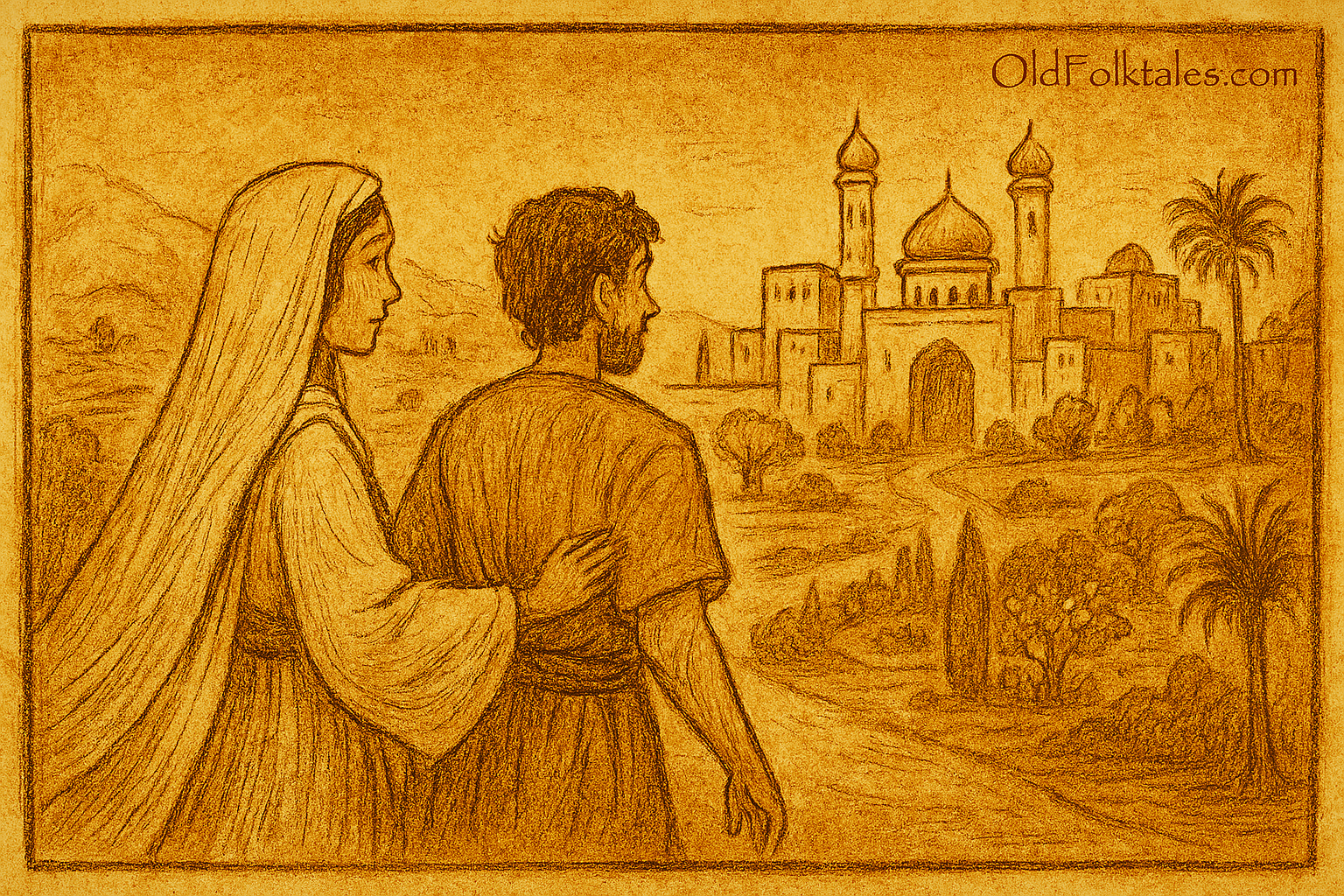
But the princess’s heart belonged to another, a young man from the city whom she had known and loved for years. He was neither the richest nor the most powerful of her suitors, but he was honest, brave, and kind. Their love was genuine and deep, built on mutual respect and understanding. When the princess told her father she wished to marry this man, the king’s face darkened with displeasure.
“No,” he declared firmly. “You are a princess, and you deserve a husband who can prove himself worthy of you.”
Determined to prevent their union, the king made a public announcement that echoed through every corner of the city: “My daughter will marry only the man who can rid our city of the three dangers on our roads. Whoever can make all three roads safe for travelers shall have her hand in marriage and my blessing.”
The challenge seemed impossible. Men throughout the city began competing frantically, each one believing he could succeed where others failed. Strong warriors took spears and swords to confront the lion, but the beast was too clever and too powerful. They either returned wounded or didn’t return at all. Groups of armed men tried to fight the murderous gang on the second road, but the criminals knew the terrain too well and always escaped or overpowered their attackers. Soldiers attempted to capture the thieves on the third road, but the bandits scattered like sand in the wind, only to regroup later. One by one, every challenger failed.
The princess watched these failures with growing concern. Her beloved came to her secretly one evening, his face troubled and anxious. “My love,” he said, taking her hands in his, “you are the smartest person I know. How can we solve these problems so that we can be married?”
The princess’s eyes sparkled with thought. She paced her chamber, her mind working through the challenges like a master strategist planning a campaign. Finally, she turned to him with a confident smile.
“Let’s take care of the lion first,” she said. “But you must not use a spear or carry any weapons. Instead, we’ll set a trap for him, one that uses his own hunger and arrogance against him.”
Following her precise instructions, the young man constructed an ingenious trap along the first road. He baited it cleverly and waited. When the mighty lion approached, driven by hunger and confidence, it walked straight into the trap. The great beast was captured without a single weapon being drawn, without a drop of blood being shed.
The young man immediately summoned the king and all the people of the city to witness his accomplishment. “Here is the lion I caught without any weapon!” he announced proudly. The crowd erupted in amazement, clapping and cheering. Even the king raised his eyebrows in surprise. How could this be done? It seemed like magic!
But the challenge was far from over. That night, the young man returned secretly to his beloved and asked anxiously, “How can we defeat the gang of murderers on the second road?”
The princess thought carefully, then smiled with satisfaction. “We will prepare the most delicious food, meat seasoned with the finest spices, bread baked until golden, dates and honey. But we’ll mix poison into everything. Then we’ll load the food onto donkeys and send them along the second road, as if they’re merchant animals that have strayed from a caravan.”
The plan worked perfectly. When the gang of criminals saw the donkeys laden with aromatic food, their greed overwhelmed their caution. They robbed the animals of all the provisions and, unable to resist, devoured the food quickly, fighting over the best portions. Within hours, every member of the gang had died from the poison, their reign of terror ended forever.
Two roads were now safe, but one challenge remained. The young man came again to the princess, his confidence growing but still needing her wisdom. “How do we rid the third road of the thieves?” he asked.
“This will require a show of force or rather, the appearance of overwhelming force,” she explained thoughtfully. “Go and gather as many horses as you can find. Tie bundles of thorn bushes to their tails, the thorns will irritate them and make them run wildly. Then release them all at once along the third road in different directions.”
The young man did exactly as she instructed. When the horses were released with the thorn bushes tied to them, they galloped frantically in all directions, kicking up enormous clouds of dust that filled the air like a sandstorm. The thunder of their hooves echoed across the plains.
From their hiding places, the thieves watched in growing terror as the dust clouds approached. Through the haze, they could see what appeared to be countless horses, surely an entire army!
“A huge and powerful military force is coming to destroy us!” the thieves shouted in panic. “What shall we do?”
Fear seized them completely. “We must scatter!” their leader commanded. “Run in different directions so they cannot capture us all together!”
The thieves fled in terror, running to the far corners of the land. They never returned to the third road, and travelers once again moved safely along it.
When news reached the king that all three roads were now completely safe for travelers to enter the city, he was astounded and deeply impressed. True to his word, despite his initial reluctance, he gave his blessing for his daughter to marry the man she loved. The wedding was magnificent, a celebration that lasted for days. The grateful citizens brought gifts of gratitude, fine cloth, livestock, jewelry, and food,to honor the couple who had made their city safe once more.
But the true source of their happiness was not the gifts or the grand ceremony. The princess and her beloved husband were happy because they had faced seemingly impossible challenges together. They had discussed each problem openly and honestly, combining his courage with her wisdom. They had trusted each other completely and remained loyal through every difficulty. Their marriage was built on a foundation stronger than any palace, the foundation of partnership, mutual respect, and shared problem-solving.
The Moral Lesson
This Somali folktale teaches us that the greatest strength comes not from individual power, but from partnership and collaboration. The young man could never have succeeded alone, and the princess’s intelligence needed his courage to be put into action. The story emphasizes that when we face difficult problems, we should seek advice and support from those who care about us and whose wisdom we trust. Together, through honest communication and mutual respect, we have a much better chance of solving even the most impossible-seeming challenges. True success comes from recognizing our own limitations and valuing the strengths of others, especially those we love.
Knowledge Check
Q1: What three dangers threatened the roads leading into the prosperous city?
A1: The three roads were each plagued by different threats: the first road had a ferocious lion that attacked and devoured travelers; the second road was controlled by a violent gang of men who murdered travelers; and the third road was plagued by cunning thieves who robbed travelers of all their food and belongings.
Q2: Why did the king set up the challenge for his daughter’s suitors?
A2: The king didn’t approve of the man his daughter loved and wanted to prevent their marriage. By announcing that his daughter would only marry the man who could eliminate all three dangers on the roads, he created what seemed like an impossible challenge, hoping to force his daughter to marry someone he considered more worthy.
Q3: How did the young man defeat the lion without using weapons?
A3: Following the princess’s advice, the young man set a clever trap for the lion instead of fighting it with spears or weapons. By using the lion’s own hunger and confidence against it, he was able to capture the beast without any violence or bloodshed, demonstrating intelligence over brute force.
Q4: What strategy did the princess devise to eliminate the murderous gang?
A4: The princess instructed her beloved to prepare delicious poisoned food and load it onto donkeys, making it appear as though they were merchant animals. When the gang robbed the donkeys and greedily ate the food, they all died from the poison, eliminating the threat without direct confrontation.
Q5: How were the thieves driven away from the third road?
A5: The princess devised a plan to create the illusion of a massive attacking army. Horses with thorn bushes tied to their tails were released in all directions, creating clouds of dust and the thunder of hooves. The terrified thieves believed a powerful army was attacking and scattered in different directions, never to return.
Q6: What cultural values and themes does this Somali folktale emphasize?
A6: This folktale emphasizes several important values: the importance of intelligence and strategy over brute force; the value of partnership and collaboration in marriage; respect for women’s wisdom and counsel; the power of communication and trust in relationships; and the idea that true love and mutual respect create stronger bonds than wealth or social status. It challenges traditional gender roles by making the woman the strategic mastermind behind the man’s success.
Source: Somali folktale, Somalia (East Africa)