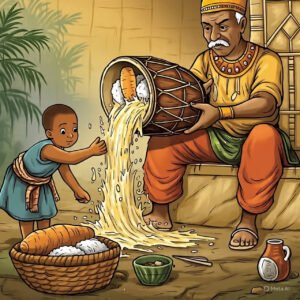
Long ago, in a kingdom where prosperity depended on more than just hard work, there was a king who owned a remarkable magic drum. This drum was unlike any other—it had the power to summon food and drink whenever its owner beat its surface. During famines, the king would gently play the drum, and baskets of yams, bowls of soup, and jugs of palm wine would appear, feeding his people and keeping their spirits high.

The king used this gift wisely, knowing that such power was a heavy responsibility. He would often play the drum during times of celebration, and the kingdom would be filled with an abundance of delicious food and drink. The people would rejoice, and the kingdom would be filled with laughter and music.
But the king had a son, young and eager, who watched the drum with wide eyes. One day, driven by impatience and curiosity, the prince decided to try the drum himself. Without understanding the delicate balance required, he struck it hard and fast, demanding food and drink without pause.

At first, the magic answered, and the kingdom was flooded with endless feasts. But soon, the gifts became too much—overflowing plates, spilling drinks, and chaos in the palace. The uncontrolled magic overwhelmed the kingdom and threatened the very order the king had preserved.

Seeing the chaos, the king intervened, taking the drum from his son’s hands. He sat the young prince down and shared a vital lesson: that true power must be tempered with respect and care.
It is not enough to want something; one must also understand the responsibility that comes with it.
The king explained that the drum’s magic was not just a tool for providing sustenance but also a symbol of the kingdom’s prosperity and stability. He told the prince that the drum’s power was not to be taken lightly and that it required a deep understanding of the kingdom’s needs and limitations.

The prince listened intently, realizing the gravity of his mistake. He saw how his impatience had caused chaos and understood that he had a lot to learn about wielding power responsibly.
From that day on, the prince learned to be patient, to observe, and to wield power only with wisdom. He spent many hours studying the drum’s magic and learning how to use it effectively. He practiced playing the drum, starting with small, gentle beats and gradually increasing the intensity.

As the prince grew older, he became more confident in his ability to wield the drum’s magic. He used it to help the kingdom during times of need, and the people began to see him as a wise and responsible leader.
The prince’s newfound wisdom and responsibility also earned him the respect of his father, the king. The king saw that his son had learned from his mistakes and was now using the drum’s magic for the greater good.
✧ Commentary:
The story of the king’s magic drum teaches us that power and gifts, no matter how extraordinary, come with responsibilities. The young prince’s impatience and misuse of the drum’s magic show how easily blessings can turn into chaos without respect and wisdom. True strength lies not just in having power but in knowing how to use it wisely and patiently.
✧ Moral:
Great power demands great responsibility, and patience is key to wielding it well.
✧ Questions & Answers:
1. Q: What made the king’s drum special?A: It had the magic power to summon food and drink whenever it was played.
2. Q: Why did the prince misuse the drum? A: He was impatient and did not understand the careful balance needed to control the drum’s magic.
3. Q: What happened when the prince played the drum without care? A: The magic caused an overwhelming flood of food and drink, leading to chaos in the kingdom.
4. Q: What lesson did the king teach his son? A: That power must be used responsibly and with patience, not recklessly.
5. Q: How did the prince change after his mistake? A: He learned to be patient and to use power wisely and respectfully.
6. Q: What is the moral of the story? A: Great power demands great responsibility, and patience is key to wielding it well.