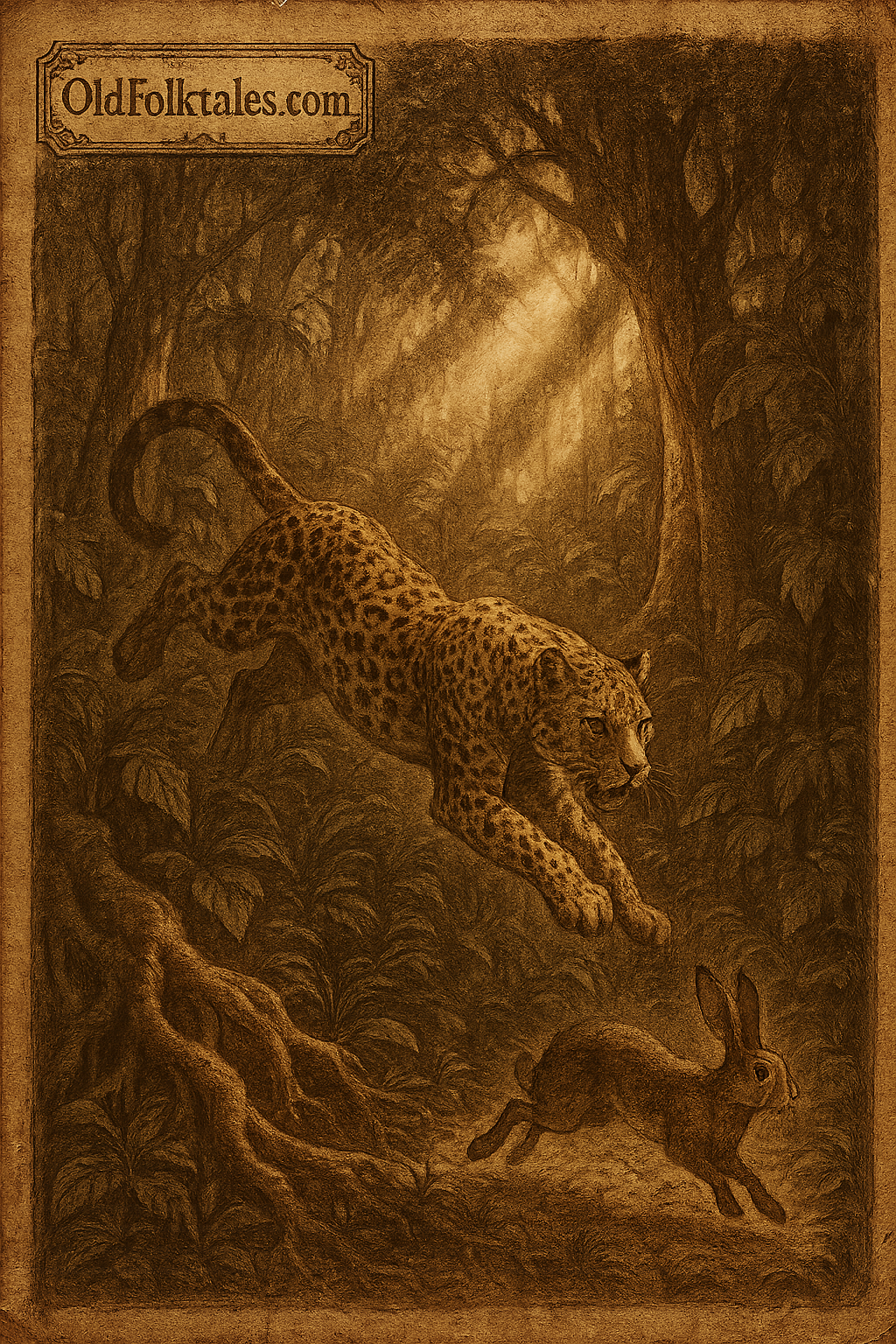
In the days when animals still spoke like humans, there lived a leopard whose golden coat shimmered in the sun. His name was Oloma, and he was feared throughout the land for his strength and speed. Wherever Oloma walked, the forest went silent, for every creature knew his sharp claws and powerful jaws left no escape.
In the same forest lived a small hare named Ube. He was not strong, nor could he run faster than the wind, but his mind was as quick as a flash of lightning. While Oloma ruled by fear, Ube survived by wit, always finding clever ways to escape danger. For many moons, they had stayed out of each other’s paths, but fate, as the elders say, never lets two spirits avoid their destined meeting.
One hot afternoon, Oloma sat beneath the shade of a great iroko tree, licking his paws after a heavy meal. His eyes narrowed when he saw Ube hopping nearby, chewing on tender grass. “Little one,” Oloma growled, “you have been lucky for too long. Today, I will make you my meal.”
Ube froze, but only for a heartbeat. His ears twitched, and his mind began to spin. “Great Oloma,” Ube said, bowing slightly, “surely a king such as you deserves a feast fit for your greatness. My small body would hardly fill your belly. But if you spare me, I will lead you to a place where food is plentiful and you may eat until you can eat no more.”
Oloma tilted his head, intrigued. “Where is this place?”
“In the valley beyond the hill,” Ube replied, his eyes bright with false innocence. “There lies a deep pit filled with the juiciest goats from the village. The people cannot guard them well, for they fear to come near at night.”
The leopard’s mouth watered at the thought. “Lead the way,” he commanded, rising to his feet.
They walked together until they reached the hill. As they climbed, Ube pretended to stumble, slowing Oloma down while secretly glancing at the sky. The sun was dipping lower, painting the clouds with orange fire. “We must hurry, Great Oloma,” Ube urged, “before the villagers return to take the goats away.”
At last they came to the valley, and in its center was indeed a deep pit. Inside were several plump goats, bleating in confusion. What Oloma did not know was that the pit belonged to the villagers, who used it to trap wandering animals.
“Behold, your feast,” said Ube, stepping back.
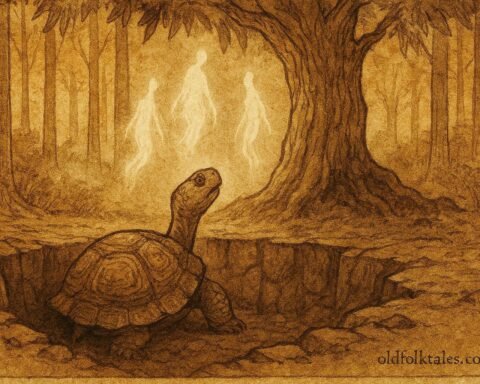
Oloma leapt into the pit with a roar of triumph. The goats scattered to the edges, but Oloma’s paws could not find a firm grip on the steep walls. Each time he tried to jump out, the loose soil crumbled beneath him. Above, Ube peered down with a sly smile.
“Enjoy your meal, Great Oloma,” Ube said, “but remember that greed often digs its own hole.”
At that moment, the sound of drums echoed from the village. The people were coming with ropes and spears. Oloma’s eyes widened in fear. He leapt again and again, but the walls were too high. By the time the villagers arrived, Ube was already far away, his small feet carrying him swiftly through the forest.
The villagers captured Oloma and, seeing his strength, decided to keep him in a wooden cage to show their bravery. Days later, Ube passed by the village and saw Oloma lying in the cage, his once-proud eyes now dull.
“Ube,” Oloma growled weakly, “you tricked me.”
“I only showed you the truth of your hunger,” Ube replied. “It was you who leapt without thinking.”
From that day on, Oloma never hunted Ube again. In fact, the leopard learned to pause before acting, for even the strongest can be brought low by their own desires. And so, the forest lived a little more in balance, with wit and strength both having their place.
Moral Lesson
The story of The Leopard and the Hare teaches that wisdom can be a greater shield than strength. In life, those who rush into action without thought often find themselves trapped by their own desires. True strength lies not only in muscle but in the ability to think, to see beyond the moment, and to act with patience and foresight.
Knowledge Check
1. What is the main lesson from The Leopard and the Hare folktale?
The folktale shows that clever thinking can outmatch physical power, and that acting without thought can lead to downfall.
2. How does the hare outwit the leopard in the story?
The hare tricks the leopard into jumping into a pit by pretending it is a place filled with easy prey.
3. What cultural tradition does The Leopard and the Hare reflect?
It reflects African oral storytelling traditions that use animal fables to teach moral lessons about life and human behavior.
4. Why does the leopard fail to catch the hare?
The leopard is too focused on his hunger and greed, causing him to ignore caution and fall into the trap.
5. What does the pit in the story symbolize?
The pit symbolizes the dangers of greed and acting without wisdom or foresight.
6. Why is the hare considered a trickster figure in African folklore?
The hare uses intelligence, quick thinking, and deception to survive and overcome stronger opponents, a hallmark of trickster figures in African folktales.
Cultural Origin: Baganda folktales, Uganda