
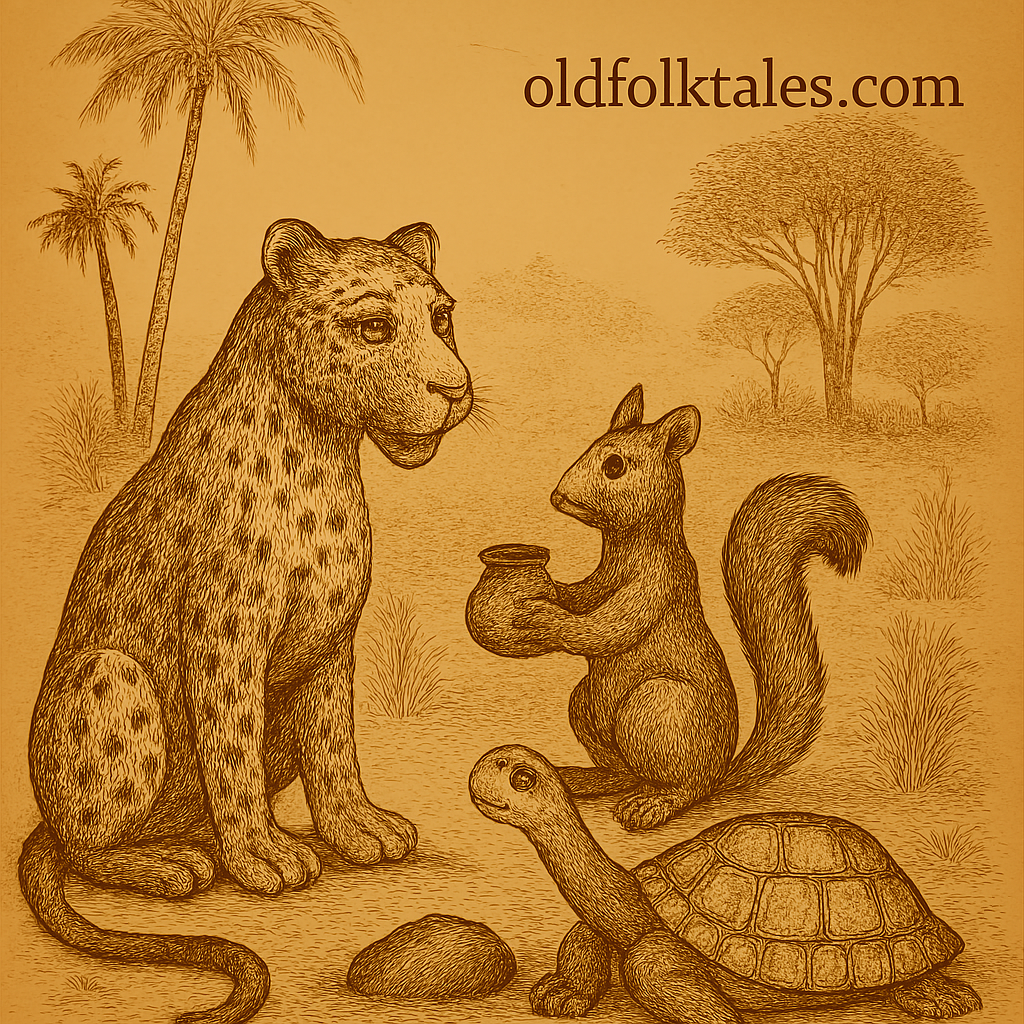
In the lush green forests of Nigeria, where towering palm trees swayed gently in the warm tropical breeze and the air hummed with the songs of countless birds, there lived three very different creatures whose paths would cross most tragically.
High in the canopy lived Squirrel, a small but industrious creature with bright, intelligent eyes and a bushy tail that twitched with constant energy. Squirrel had worked tirelessly for many seasons, carefully tending to his palm tree farm. Each morning, he would scamper from tree to tree, checking the ripeness of the palm fruits and skillfully extracting the sweet, potent wine that flowed like liquid gold from the trees. His small storage gourds were always full of the finest palm wine in the entire forest, a testament to his dedication and hard work.
Near the forest floor, in a quiet clearing beside a babbling stream, lived Tortoise, ancient and wise, with a shell that bore the scars and patterns of countless years. Tortoise was known throughout the forest for his magnificent yam farm. The rich, dark soil of his carefully tended plots produced the largest, most nutritious yams for miles around. His underground storage chambers were filled with these precious tubers, which he had cultivated with patience and traditional farming wisdom passed down through generations.
And prowling through the shadows of the dense forest was Leopard, magnificent yet menacing, with his distinctive spotted coat that helped him blend seamlessly with the dappled sunlight filtering through the leaves. Leopard was blessed with strength, speed, and cunning, but cursed with a character flaw that would prove to be his defining trait: he was lazy and unwilling to work for what he desired. Unlike his neighbors, Leopard had no farm, no stored food, and no honest means of acquiring the luxuries he craved.
One particularly hot afternoon, as the forest shimmered in the oppressive heat, Leopard found himself with an overwhelming craving for palm wine. The thought of the cool, sweet liquid sliding down his parched throat consumed his thoughts. But rather than undertake the laborious work of cultivating his own palm trees, Leopard decided to approach Squirrel with a request.
“My dear friend Squirrel,” Leopard called out in his most charming voice, his golden eyes gleaming with false sincerity. “I find myself in need of some palm wine for a special occasion. Would you be so generous as to lend me some from your abundant stores? I promise to repay you handsomely when my own crops come in.”
Squirrel, perched high on a branch, looked down at the imposing predator with some hesitation. But his generous nature overcame his natural caution. After all, neighbors in the forest traditionally helped one another in times of need, and Leopard’s request seemed reasonable enough.
“Of course, Brother Leopard,” Squirrel replied, his voice warm with kindness. “Community members should support each other. Take as much as you need.”
Squirrel scampered down and led Leopard to his storage area, where numerous gourds of palm wine were carefully arranged. He selected several of his finest containers, filled with wine that sparkled like amber in the filtered sunlight. Leopard’s eyes gleamed with satisfaction as he accepted the generous offering, making elaborate promises of future repayment and eternal gratitude.
But Leopard’s desires did not stop with palm wine. As he thought about the feast he could prepare, he realized he needed substantial food to accompany his drink. His thoughts turned to Tortoise and his renowned yam farm.
The next morning, Leopard made his way to Tortoise’s dwelling, his manner once again transformed into that of a humble supplicant. He found the ancient creature slowly making his morning rounds, inspecting his precious yam plants with the careful attention of a master farmer.
“Wise Tortoise,” Leopard began, bowing his head in a show of respect, “I come to you in my time of need. I am preparing for an important celebration, but I lack the proper food to make it worthy. Could you find it in your generous heart to lend me some of your magnificent yams? Your reputation for growing the finest tubers in all the forest is well-deserved.”
Tortoise, flattered by the praise and moved by what appeared to be genuine need, considered the request carefully. His ancient eyes studied Leopard’s face, searching for any sign of deception, but Leopard’s performance was convincing.
“Very well,” Tortoise said slowly, his voice carrying the weight of his years. “In the spirit of forest fellowship, I shall share my harvest with you. But remember, Brother Leopard, that trust once broken is difficult to repair.”
Tortoise led Leopard to his storage chambers and selected several of his largest, most perfect yams. These were tubers that had taken months to grow, nurtured with careful watering, weeding, and protection from pests. As he handed them over, Tortoise felt a small pang of unease, but he pushed it aside in favor of maintaining the bonds of community.
Now possessing both the palm wine and the yams, Leopard’s mind turned to the final phase of his plan. Rather than simply enjoying his ill-gotten gains in private, he decided to invite both his benefactors to what he called a “feast of gratitude.” His true motivation, however, was far more sinister.
“My generous friends,” Leopard announced when he visited both Squirrel and Tortoise, “I am so overwhelmed by your kindness that I must host a celebration in your honor. Please join me tomorrow evening for a grand feast where we can enjoy the fruits of your labor together.”
Both Squirrel and Tortoise were touched by this apparent gesture of appreciation. They agreed to attend, looking forward to an evening of community fellowship and shared enjoyment.
As the sun began to set the following day, painting the forest in brilliant shades of orange and gold, Squirrel and Tortoise made their way to Leopard’s dwelling. They found their host in seemingly high spirits, having prepared an elaborate spread using the very palm wine and yams they had so generously provided.
The feast began with great merriment. The palm wine flowed freely, its sweet taste enhanced by the satisfaction of friendship and community sharing. The yams, roasted to perfection over Leopard’s fire, filled the air with their rich, earthy aroma. Stories were shared, laughter echoed through the trees, and for a time, the three very different creatures seemed to embody the best spirit of forest life.
But as the evening progressed and the effects of the palm wine began to take hold, Leopard’s true nature began to emerge. His laughter became more forced, his eyes grew cold and calculating, and a sinister smile played at the corners of his mouth.
“My dear friends,” Leopard said, his voice taking on a dangerous edge that made both his guests suddenly alert, “this has been such a wonderful evening. In fact, it has been so perfect that I think it should be your last.”
Before either Squirrel or Tortoise could react to this ominous statement, Leopard sprang into action with the lightning speed that made him such a feared predator. His powerful claws and crushing jaws made quick work of his unsuspecting guests, their cries of betrayal and terror echoing briefly through the forest before being silenced forever.
As dawn broke over the forest the next morning, Leopard sat alone among the remains of his feast, his belly full and his debts permanently erased. In his twisted logic, he had solved the problem of repayment in the most final way possible. He would never have to return the palm wine or the yams, never have to face the expectations of his generous neighbors, and never have to work for what he desired.
But Leopard’s satisfaction was short-lived. Word of the disappearance of Squirrel and Tortoise spread quickly through the forest community. Other animals began to avoid Leopard, sensing the danger he represented. His requests for help were met with suspicion and fear. The forest, once alive with the sounds of cooperation and community, became a lonely place for the treacherous predator.
Moreover, Leopard discovered that his crime had solved nothing. Without the friendship and trust of his neighbors, he found himself more isolated than ever. The palm wine was gone, consumed in a single night of betrayal. The yams were eaten, leaving him hungry again within days. And now, having revealed his true character, he had no hope of receiving help from anyone else in the forest.
Moral Lesson
This somber tale serves as a powerful warning about the dangers of misplaced trust and the true nature of evil. It teaches us that generosity, while a noble virtue, must be tempered with wisdom and careful judgment of character. Those who would betray trust for temporary gain ultimately destroy not only their victims but also their own future prospects for genuine relationship and community support. The story reminds us that true prosperity comes through honest work and maintaining the bonds of trust that hold communities together, not through deception, theft, and violence.
Knowledge Check
Q1: What does the leopard represent in this Nigerian folktale, and why is this characterization significant? A: The leopard represents the predatory nature of those who exploit others’ generosity without intention of reciprocation. His characterization as powerful yet lazy reflects the danger posed by those who use their advantages to harm rather than contribute to their community.
Q2: How do the squirrel and tortoise embody traditional African values in this folktale? A: The squirrel and tortoise represent the African values of hard work, generosity, and community cooperation. Their willingness to share their harvests demonstrates the traditional emphasis on mutual aid and collective prosperity that characterizes many African societies.
Q3: What role does palm wine play in Nigerian culture as depicted in this folktale? A: Palm wine serves as a symbol of hospitality, celebration, and social bonding in Nigerian culture. Its presence in the story highlights how something meant to bring people together can be corrupted by those with malicious intent.
Q4: What is the central moral lesson of “The Leopard, the Squirrel, and the Tortoise”? A: The folktale teaches that generosity must be balanced with wisdom in judging character. It warns against lending to or trusting those who show signs of dishonesty, as such misplaced trust can lead to the loss of both possessions and life.
Q5: How does this Nigerian folktale reflect traditional African storytelling techniques? A: The story uses animal characters to represent human traits and behaviors, employs a clear moral lesson, and reflects community values about work, sharing, and trust. These elements are hallmarks of traditional African oral literature designed to teach important life lessons.
Q6: What does the tragic ending of this folktale suggest about the consequences of betraying community trust? A: The leopard’s ultimate isolation demonstrates that betraying community trust destroys not only immediate victims but also the betrayer’s future prospects. The story suggests that those who violate social bonds face permanent exclusion from the benefits of community life.

