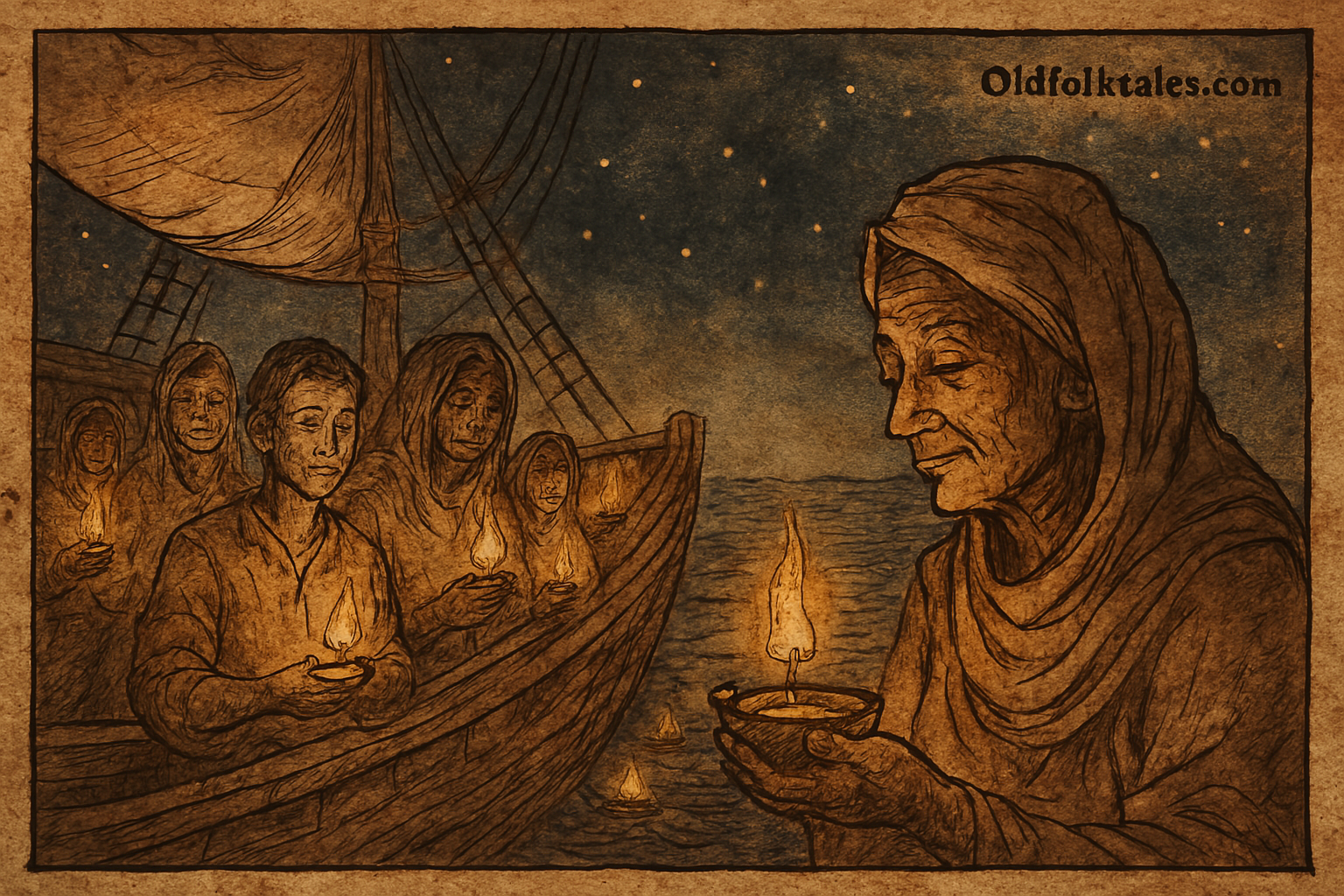
Long, long ago, when the world was younger and the sea spoke in whispers to those who listened, there lived an old woman named Kamala on a small ship crossing the vast Indian Ocean. Her weathered hands clutched a tiny clay lamp a diya, that had belonged to her grandmother, and her grandmother’s grandmother before her.
The other passengers on the crowded ship noticed that no matter how fierce the storms or how dark the nights, Kamala’s little lamp never went out. Its flame danced bravely against the howling winds, casting golden shadows on the wooden walls of their humble quarters.
“Old mother,” asked a young man named Dev one evening, as the ship rocked violently in a storm, “how does your lamp stay lit when even the ship’s lanterns blow out?”
Also read: Suren and the Magical Red Hen
Kamala smiled, her eyes twinkling like stars. “Ah, child, this is no ordinary flame. Let me tell you the story my grandmother told me, as her grandmother told her, stretching back through time like links in a golden chain.”
The passengers gathered around her as thunder crashed overhead, hungry for a story to chase away their fears.
“Once upon a time,” Kamala began, her voice steady as a heartbeat, “there lived a prince named Rama who carried the light of righteousness in his heart. He was banished to the forest for fourteen long years, forced to leave behind his beautiful kingdom and his beloved people.”
As she spoke, her diya seemed to glow brighter, and the storm outside seemed less frightening.
“During his exile, the demon king Ravana, whose heart was as black as the deepest night, stole Rama’s wife Sita and carried her away to his fortress across the sea. But Rama, with the help of brave allies, fought a great battle against the forces of darkness. When he finally defeated Ravana and rescued Sita, he began his journey home.”
A child pressed closer to the warm light. “But how did his people know he was coming back?”
“Ah!” Kamala’s eyes sparkled. “That is the magic of it! On the darkest night of the year, when no moon shone in the sky, the people of Ayodhya lit thousands upon thousands of little lamps just like this one. They placed them on their rooftops, in their windows, along every path and road. The light was so brilliant that Rama could see his way home from miles away, a river of golden flames welcoming their righteous king.”
Just then, as if by magic, the storm began to calm, and through the small porthole, they could see the first stars appearing.
“But grandmother,” whispered a little girl, “that was so long ago and so far away. Why do you keep this lamp burning now?”
Kamala reached out and gently touched the child’s cheek. “Because, my little lotus blossom, light has a memory. This flame carries the same hope that guided Prince Rama home. We are like him now far from our homeland, crossing dark waters, facing storms and uncertainty. But this light reminds us that no matter how long the night, how fierce the storm, or how far we must travel, righteousness and hope will always guide us home.”
The ship continued its journey, and each night, more passengers began lighting their own small lamps. Soon, their humble vessel looked like a floating constellation, carrying precious light across the black ocean.
When they finally reached the emerald shores of Mauritius, the passengers had become like family. As they built their new homes near the sugarcane fields and beneath the tropical stars, they remembered Kamala’s story and her unwavering flame.
That first year in their new land, when the darkest night came, the same night that Diwali was celebrated in their distant homeland they lit their lamps again. But something wonderful happened. Their neighbors from other lands people who had come from Africa, China, and Europe saw the beautiful lights and asked about their meaning.
“Come,” said Dev, now a father with children of his own, “let us share the story of the light that crossed the ocean.”
And so they did. They told the tale of Prince Rama, of Kamala’s lamp that never died, and of the hope that light brings to all who are far from home. They shared their sweet treats and their joy, and their neighbors began lighting lamps too.
Years passed, and the story spread throughout the island like roots of a mighty tree. Children of all backgrounds learned to make rangoli patterns with colored sand, grandmothers taught everyone to roll perfect ladoos, and fathers showed their sons and daughters how to light diyas safely.
The magic continued to grow. Soon, entire villages glowed with thousands of lights each Diwali night. The festival became a time when all Mauritians, Hindu, Christian, Muslim, Creole, Chinese, and Tamil, came together as one family, sharing food, stories, and the warmth of friendship.
And they say that if you walk through any Mauritian neighborhood on Diwali night, you can still see Kamala’s original flame dancing in every diya, carrying its ancient message: that light shared is light multiplied, that hope carried in the heart can cross any ocean, and that the greatest victory is not conquering enemies, but bringing people together in joy and understanding.
The old storytellers say that even today, when the children of Mauritius light their Diwali lamps, they are not just celebrating a festival, they are keeping alive the light that crossed the ocean long ago, ensuring that no darkness will ever be complete as long as there are willing hearts to kindle hope.
And so the light that began in ancient Ayodhya, that traveled with brave Kamala across the churning seas, continues to shine in Mauritius, brighter now than ever before, warming the hearts of all who call this beautiful island home.
The Morals of the Tale
Kamala’s single flame inspired an entire ship, then a community, then a whole island. When we share what brings us joy whether it’s a tradition, a skill, or simply kindness, it grows beyond what we could ever imagine alone.
Knowledge Check
Q1: What was special about old Kamala’s diya (clay lamp) during the ocean voyage? A1: Kamala’s lamp never went out, no matter how fierce the storms or how dark the nights. Its flame danced bravely against the howling winds while even the ship’s lanterns would blow out.
Q2: What is the legend of Prince Rama that Kamala told to the frightened passengers? A2: Prince Rama was banished to the forest for fourteen years. During his exile, the demon king Ravana stole his wife Sita. After defeating Ravana and rescuing Sita, Rama returned home. On the darkest night, his people lit thousands of lamps to welcome him back and guide him safely home.
Q3: How did the other passengers on the ship respond to Kamala’s story and her lamp? A3: The passengers were inspired by Kamala’s story and began lighting their own small lamps each night. Soon their ship looked like a floating constellation, carrying precious light across the black ocean.
Q4: What happened when the Hindu families first celebrated Diwali in Mauritius? A4: When they lit their lamps, their neighbors from other lands people from Africa, China, and Europe, saw the beautiful lights and asked about their meaning. The Hindu families shared their story and traditions with them.
Q5: How did the Diwali celebration change and grow in Mauritius over time? A5: The festival spread throughout the island as people of all backgrounds, Hindu, Christian, Muslim, Creole, Chinese, and Tamil, began participating. They learned to make rangoli patterns, shared sweet treats, and lit diyas together, making it a celebration for all Mauritians.
Q6: What does the folktale say about Kamala’s original flame today? A6: The storytellers say that Kamala’s original flame can still be seen dancing in every diya lit during Diwali in Mauritius, carrying its ancient message that light shared is light multiplied and that hope can cross any ocean.
Remember: Every time we light a lamp, share a story, or welcome a neighbor, we become part of the endless chain of light that connects all hearts across time and distance.