Long ago in the heart of Angola, where red earth stretched wide beneath the sun and the savanna trembled with the roars of prowling beasts, two men lived as close companions. They were more than neighbors; they were inseparable friends who passed their days in laughter, conversations, and shared meals. No day seemed complete unless they had sat together, speaking of the world, of hunting, and of the dangers of the wild.
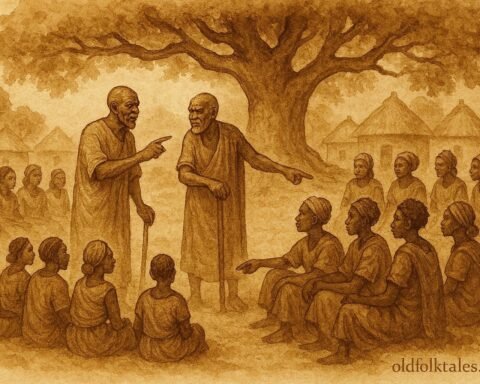
One afternoon, as they sat in the shade of a tree near one friend’s home, the subject of lions arose. One man leaned close and spoke with seriousness:
“My friend, the lions are near these parts now. When you are at home, always keep the door shut. Do not shout or make noise, for the lion will come.”
The other, puffing up his chest with pride, laughed at the warning.
“The lion cannot enter my house,” he boasted. “I have my gun, and I have my spear.”
His friend shook his head and chuckled at the claim.
“You lie, my friend. You cannot fight with the lion.”
But the proud man insisted. “I can fight him, and I will defeat him.”
Their laughter echoed across the open land, playful yet edged with challenge. After the talk, silence fell. Eventually, the two parted ways, though the words lingered between them like smoke in the air.
The Lion-Man’s Secret
Unbeknownst to his friend, the cautious man had acquired a powerful medicine, one known to transform a person into a lion. He kept this secret close to his heart, but the memory of their conversation festered. Weeks passed, and the urge to test his friend’s proud words grew stronger.
One moonlit night, he set out to visit his friend. Before he reached the house, he swallowed the medicine. His body trembled, his form shifted, and his human frame melted into that of a great lion. A deep roar erupted from his chest, shaking the ground beneath him.
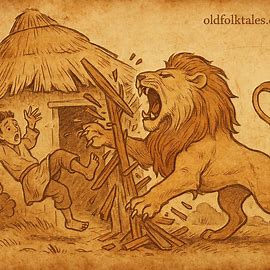
He roared once. He roared twice. Then, with a single blow of his paw, he forced open the door of his friend’s house. Inside, his companion slept soundly, unaware of the danger approaching. The lion-man seized him, lifting him as though he were a bundle of grass, and hurled him outside.
The beast did not stop there. He smashed the partitions, clawed at the walls, and tore apart the house until it stood ruined, nothing but scattered timbers and dust beneath the moon. When his fury was spent, he slipped away into the night and returned to his home. There, under the cover of darkness, he became a man again and went to sleep.
The Morning After
At sunrise, the lion-man walked calmly to his friend’s place, as though nothing unusual had happened. He found him standing amidst the ruins, staring at the broken remains of his house. The proud man’s face was pale with fear and exhaustion.
“Alas!” he cried. “The lion came in the night. He destroyed my house, and he threw me outside like a child’s toy.”
The lion-man forced back a smile and asked slyly, “My friend, why did you not shoot him? Why did you not pierce him with your spear?”
The man looked away, ashamed and shaken. His weapons had been useless against the terror of the night.
The lion-man laughed softly, though his heart was heavy with the truth both now understood.
Strength Tested, Friendship Preserved
When the shock had quieted and words could be spoken again, the humbled man said slowly, almost as though confessing to the earth itself:
“My friend, the lion is strong. But friendship, friendship is strong also.”
And with those words, the quarrel that had once divided them dissolved. The two men no longer argued about lions or weapons. They understood that the true strength between them was not found in spears or guns, nor in the ability to boast, but in the bond of their companionship.
Moral Lesson
This tale from Angola teaches that no matter how powerful or fearsome an enemy may seem, pride and arrogance cannot stand against reality. The lion represents danger and strength greater than any single man’s ability to overcome. Yet in the end, the true lesson is not about weapons or courage in battle, it is about the enduring power of friendship.
Friendship, like a lion, has its own strength. It can withstand trials, temper arrogance, and humble even the proudest heart. To walk with a true friend is to share a force that surpasses even the terrors of the night.
Knowledge Check
1. Who are the main characters in the folktale?
Two close friends living in Angola who test each other’s words about lions.
2. What warning did one friend give the other?
He advised him to always keep his house shut and avoid noise, as lions were nearby.
3. How did one man turn into a lion?
He used a special medicine known to transform a man into a lion.
4. What happened when the lion entered his friend’s house?
The lion threw his friend outside, destroyed the house, and left it in ruins.
5. What key truth did the humbled man admit after the attack?
He confessed that “the lion is strong, but friendship is strong also.”
6. What cultural origin does this folktale belong to?
It is a traditional Kimbundu folktale from Angola.
Source: Kimbundu folktale, Angola