In the ancient days when the world was young and magic flowed freely through the desert winds, all beasts possessed the gift of speech. They could converse as easily as humans, sharing thoughts, dreams, and boasts under the vast African sky. During this mystical time, the mighty lions those golden rulers of the wilderness had developed a peculiar habit of referring to all humans as “sons of women,” a term that carried both dismissal and a hint of mysterious respect they did not yet understand.
In the heart of the North African wilderness, where acacia trees cast long shadows across sun-baked earth, lived a magnificent young lion whose mane had just begun to darken with the first touches of maturity. His muscles rippled beneath his golden coat like liquid sunlight, and his roar could shake the very stones of the desert. This young prince of the savanna had grown proud of his strength, spending his days practicing his hunting prowess and perfecting the art of the kill.
One scorching afternoon, as the heat shimmered in waves across the landscape, the young lion found himself in the company of his wise mother. With chest puffed out and eyes gleaming with confidence, he began to boast of his incredible strength and unmatched prowess. He spoke of how swiftly he could run, how powerfully he could strike, and how no creature in all the land could match his might.
His mother, a seasoned lioness whose amber eyes held the wisdom of many seasons, listened patiently to her son’s proud declarations. When he finally paused for breath, she fixed him with a knowing gaze that seemed to pierce straight through his bravado. “My son,” she said in a voice that carried the weight of ancient knowledge, “despite all your strength and skill, you will one day meet your master in a ‘son of woman.'”
These words struck the young lion like a bolt of lightning. His pride wounded and his curiosity ignited, he could not fathom how any “son of woman” these strange, seemingly weak creatures he had heard whispered about could possibly pose a threat to his magnificent power. The very suggestion felt like an insult to his royal lineage and natural supremacy.
Determined to prove his mother wrong and restore his wounded pride, the young lion set forth immediately on a quest to find one of these mysterious “sons of women.” He had never actually encountered a human before, having lived his entire life in the deep wilderness far from any settlements. His golden paws carried him across rocky terrain and through thorny scrubland as he searched for this supposedly superior adversary.
The first creature he encountered was a towering camel, its long neck swaying gracefully as it picked its way across the desert sand. The camel’s dark eyes regarded the approaching lion with cautious alertness. Drawing himself up to his full impressive height, the young lion demanded in his most commanding voice, “Are you a ‘son of woman’?”
The camel, recognizing the dangerous gleam in the lion’s eyes and having no desire to engage in combat with such a formidable predator, hastily shook its great head. “No, no!” it protested, its voice filled with nervous energy. “I have no relation whatsoever to the human species!” Satisfied that this was not the opponent he sought, the lion allowed the camel to continue on its way unharmed.
His quest continued as he encountered a massive bullock, its powerful frame and sharp horns making it a potentially worthy opponent. Again, the lion posed his crucial question, and again, the animal quickly denied any connection to humanity. The bullock, though strong enough to put up a fierce fight, was clearly not the “son of woman” the lion was seeking.
This pattern repeated itself as the young lion questioned numerous other creatures throughout his journey. Each animal, whether large or small, fierce or gentle, adamantly denied being a “son of woman” when confronted by the determined lion. Some trembled with fear, others stood their ground with dignity, but all gave the same negative response.
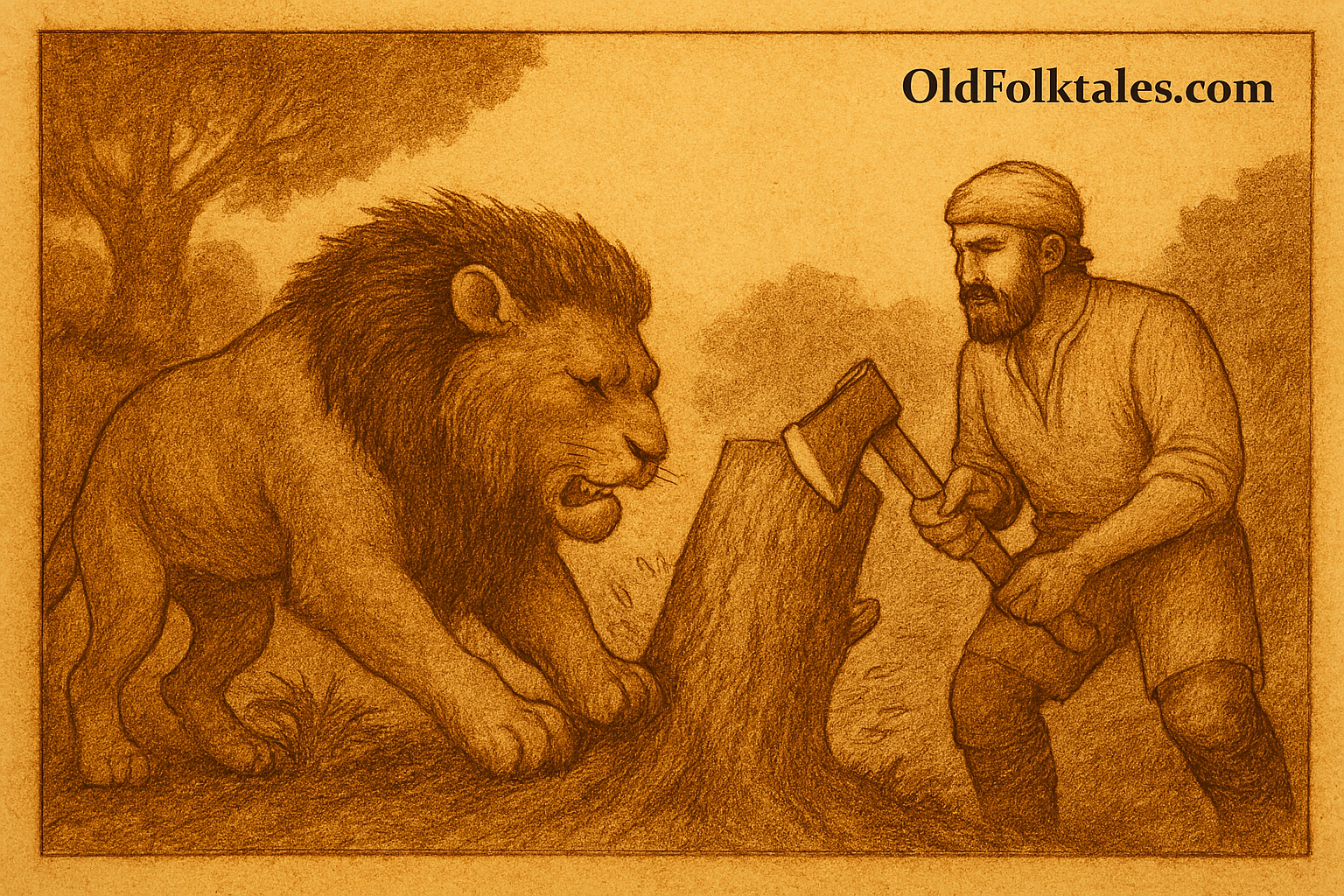
Finally, as the sun began to cast longer shadows across the landscape, the lion’s keen hearing detected a rhythmic sound echoing through a grove of ancient trees. Following the noise, he discovered a man engaged in the laborious task of felling a massive tree. The human wielded a sharp axe with practiced skill, each strike sending chips of wood flying and the steady thudding reverberating through the forest.
The lion approached with measured steps, his golden eyes fixed intently on this strange, upright creature. When he posed his familiar question “Are you a ‘son of woman’?” the man paused in his work, wiped the sweat from his brow, and nodded calmly. “Yes,” he replied without hesitation, “I am indeed a son of woman.”
At last! The young lion’s heart raced with excitement and anticipation. Here stood his destined opponent, the one his mother claimed would be his master. Drawing himself up to his most imposing posture, the lion issued his challenge: “Then I defy you to mortal combat! Let us see who truly deserves to rule!”
The man considered this bold challenge thoughtfully, his weathered hands still gripping his axe. After a moment, he nodded his acceptance but added a single condition. “I accept your challenge,” he said in a steady voice, “but first, you must help me complete this task of felling this tree. Surely a creature of your magnificent strength won’t object to such a small request?”
The young lion, eager to demonstrate his power and confident in his inevitable victory, readily agreed to this reasonable condition. The man then explained that he needed the lion to insert his powerful claws into the cut he had already made in the thick trunk. “Your claws are far stronger than my tools,” the man explained. “If you could just hold the cut open while I make the final strikes, we can finish this quickly and then settle our contest.”
Proud of being recognized for his superior strength, the lion approached the partially cut tree and carefully inserted his sharp claws deep into the groove the man had carved. The moment his claws were firmly embedded in the wood, the man moved with surprising speed and cunning. He knocked away the axe that had been serving as a wedge to keep the cut open.
The trunk, released from the tool that held it apart, snapped shut like a powerful vice around the lion’s trapped claws. The young lion roared in shock and fury, struggling desperately to free himself, but the wood held him as firmly as iron shackles. Helpless and unable to escape, he could only watch as the man calmly raised his axe and delivered the final blow.
Thus ended the young lion’s quest to prove his superiority over the “sons of women.” Through this hard-learned lesson, all lions came to understand and respect the power of human intelligence and cunning, recognizing that strength alone is not always enough to ensure victory.
Even today, the great Emir Abd el-Kader observed that the native peoples of Algeria claim to hear in every lion’s roar the words “ahna ou ben el mera”meaning “I and the son of woman”repeated over and over, as if the lion eternally acknowledges that man remains his only true superior in the natural world.
The Moral Lesson
This North African folktale teaches us that intelligence and cunning often triumph over brute strength and pride. The young lion’s arrogance blinded him to the dangers of underestimating his opponent, while the human’s wisdom allowed him to turn the lion’s own strength against him. The story reminds us that true power lies not in physical might alone, but in the ability to think strategically and use our minds to overcome seemingly impossible challenges.
Knowledge Check
Q1: What does the term “son of woman” mean in this North African folktale and why do lions use it? A1: “Son of woman” is how lions in this folktale refer to all humans. They use this term during the ancient time when beasts could speak, and it reflects both dismissal and an unconscious recognition of humanity’s special nature that lions don’t yet fully understand.
Q2: Who is the main character in this folktale and what motivates his quest? A2: The main character is a young, prideful lion who becomes motivated to seek out a human after his wise mother tells him he will meet his master in a “son of woman.” His wounded pride and desire to prove his superiority drive him on this fateful quest.
Q3: How does the human defeat the powerful lion in this North African legend? A3: The human uses cunning and strategy rather than brute force. He tricks the lion into inserting his claws into a cut tree trunk, then removes the wedge holding it open, trapping the lion’s claws so he can defeat him with an axe.
Q4: What cultural significance does the phrase “ahna ou ben el mera” have in this story? A4: According to Emir Abd el-Kader, Algerian natives believe they can hear “ahna ou ben el mera” (meaning “I and the son of woman”) in every lion’s roar, suggesting that lions eternally acknowledge humans as their only superior through this ancient memory.
Q5: What does this folktale teach about the relationship between physical strength and intelligence? A5: The story demonstrates that intelligence and cunning can triumph over raw physical power. While the lion possessed superior strength, the human’s strategic thinking and ability to use the lion’s strength against him proved more valuable in determining the outcome.
Q6: How does this North African folktale explain the origin of lions’ respect for humans? A6: The tale provides an origin story for why lions show respect or wariness toward humans, suggesting that this respect stems from an ancient encounter where human intelligence overcame leonine strength, creating a lasting memory passed down through generations of lions.