Long ago, in the vast stretches of the Somali landscape where the golden grasslands met the dusty roads that wound between villages, there lived the animals that have always shared this land with the people, sheep grazing in peaceful flocks, and hyenas prowling in the shadows, always hungry, always watching for an opportunity.
On this particular day, a sheep found herself in a predicament that would test her wisdom and survival instincts. Through some misfortune, perhaps she had wandered too far while grazing, or perhaps she had become separated during a sudden storm, this sheep had become lost from her owner and the safety of her flock. Now she walked alone along an empty road, her hooves kicking up small clouds of dust with each uncertain step.
The sheep’s heart was heavy with worry. She knew the dangers that lurked for animals without protection. Her eyes scanned the horizon, searching for anything familiar, the sight of her flock, the sound of her owner’s voice, or the welcoming smoke from a village fire. But there was nothing. Just the endless road stretching before her and the harsh sun beating down from above.
Don’t stop yet! See our complete East African folktales collection
A Dangerous Encounter
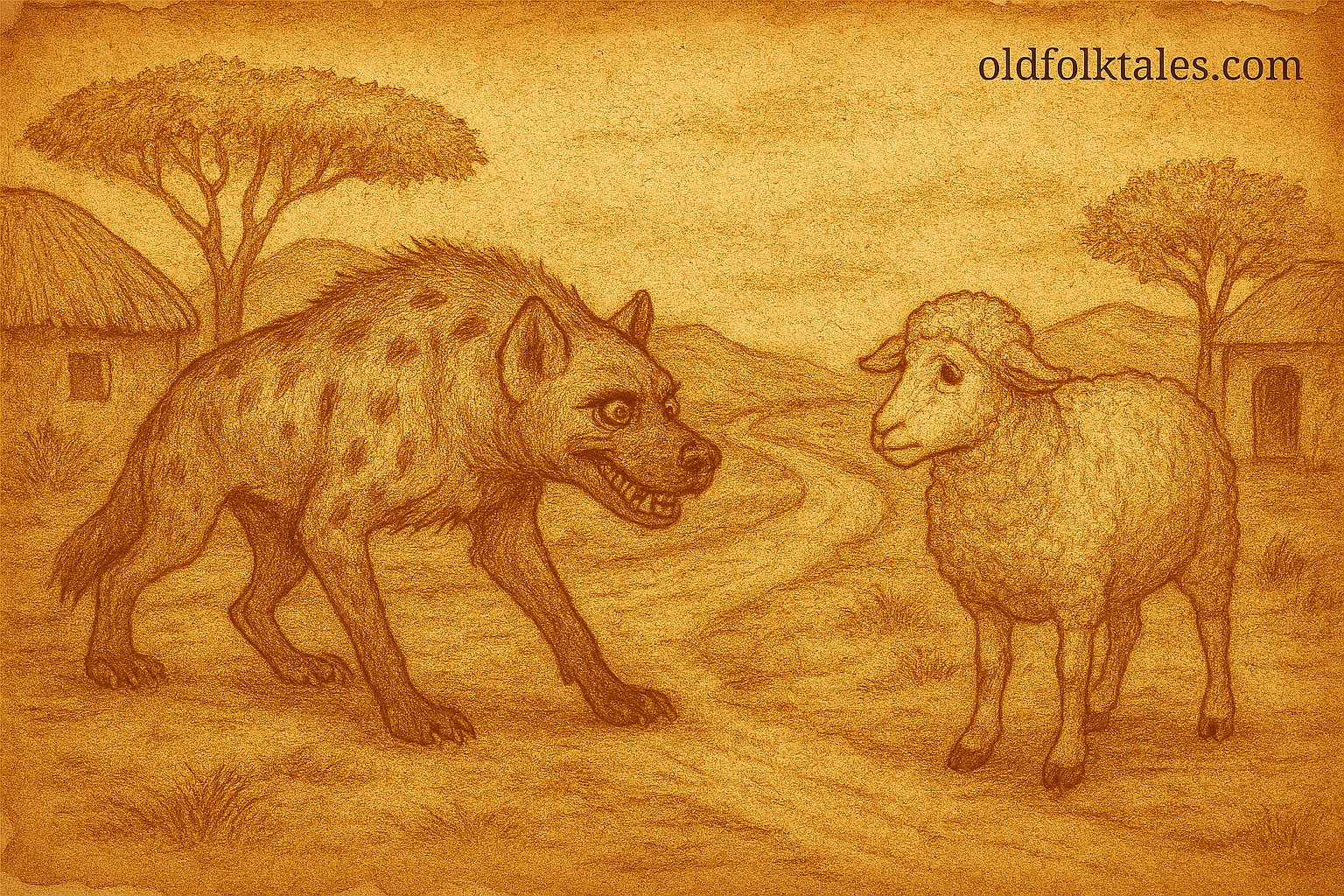
As the lonely sheep made her way along the road, her ears suddenly caught the sound of approaching footsteps. She looked up to see a figure in the distance, and as it drew closer, her body tensed with instinctive fear. It was a hyena, walking with that distinctive slouching gait that all hyenas possess, his eyes sharp and alert, his powerful jaws capable of crushing bone.
The hyena spotted the sheep at almost the same moment she saw him. His eyes lit up with immediate interest, and he stopped in his tracks. Here was a sheep, apparently alone on the open road, a sight that seemed almost too good to be true for a predator always on the hunt for his next meal.
But the hyena was cunning, as hyenas are known to be. He understood that if he showed his true intentions too quickly, the sheep might bolt before he could get close enough to strike. So he adopted a casual, almost friendly demeanor, though his eyes betrayed the hunger that gnawed at his belly.
The hyena’s head swiveled from side to side as he made a show of looking around the area, scanning the landscape as if genuinely curious. Then, in a voice that attempted to sound innocent and conversational, he called out to the sheep. “Hey, sheep!” he said, his tone deceptively light. “Who is with you today?”
The question hung in the air between them like a trap waiting to be sprung.
The Truthful Answer
The sheep, in her innocence and distress, answered honestly. Perhaps she was so relieved to see another living creature that she didn’t immediately recognize the danger. Perhaps her loneliness made her careless. Whatever the reason, she replied without hesitation.
“No one is with me,” she said, her voice carrying the sadness of her situation. “I am lost, and I don’t know where I am.”
The moment those words left her mouth, the hyena’s entire demeanor changed. His eyes grew wider with excitement, and his body practically trembled with anticipation. He could hardly believe his extraordinary good fortune. A lost sheep, all alone, with no shepherd to protect her, no dogs to chase him away, no flock to witness what was about to happen—it was a predator’s dream come true.
Unable to contain his eagerness, the hyena pressed further, wanting to be absolutely certain of his luck. “Is it true that you are all alone?” he asked again, his voice now edged with barely suppressed excitement.
The sheep, still not fully grasping the gravity of her mistake, confirmed what she had already revealed. “Yes, it’s true,” she said. “I’m all alone. I am lost from the other animals and the people that own me.”
The Hyena’s Fatal Mistake
What happened next would seal the hyena’s fate and demonstrate the difference between cunning and wisdom.
The hyena, overcome with joy at this perfect opportunity, could no longer maintain his pretense of casual interest. He closed his eyes tight, threw back his head, and began to laugh, that distinctive, whooping laugh that hyenas are famous for, a sound that echoes across the African plains and sends shivers down the spines of all who hear it. He laughed and laughed, his whole body shaking with mirth and anticipation, completely absorbed in his own cleverness and good fortune.
But that laugh was the hyena’s undoing.
The sheep, despite her earlier naivety, was not completely foolish. The sound of the hyena’s laughter struck her like a bolt of lightning, awakening every survival instinct that had been passed down through generations of her ancestors. She knew that sound. Every animal knew that sound. It was the laugh of a predator who believed he had already won, the sound of danger and death.
In that instant, clarity flooded through the sheep’s mind like cold water. She suddenly understood the terrible mistake she had made by revealing her vulnerability to a stranger. She realized that the hyena’s friendly questions had been nothing but a trap, designed to confirm that she was defenseless prey.
Without a moment’s hesitation, the sheep turned and ran. Her legs, which had been weary from wandering, suddenly found new strength born of pure fear and the will to survive. She ran faster than she had ever run before, her hooves pounding the hard earth, her breath coming in desperate gasps, putting as much distance as possible between herself and the laughing predator.
The Predator’s Realization
The hyena laughed and laughed, his eyes squeezed shut in his delight, imagining the feast that awaited him. But when his laughter finally subsided and he opened his eyes, ready to claim his prize, he was met with a shocking sight or rather, with nothing at all.
The sheep was gone.
The hyena’s expression changed instantly from joy to confusion, then to anger. He spun around, searching desperately for any sign of the sheep, but she had vanished. His easy meal had escaped while he had been too busy celebrating his own cleverness.
Rage and frustration boiled up inside him. “Sheep, come back!” he yelled into the empty landscape, his voice now desperate rather than friendly. “I won’t eat you!”
But his words were lies, and both he and the fleeing sheep knew it.
The sheep continued running, not slowing her pace, not looking back. As she ran, she spoke to herself, her words mixing determination with relief. “The hyena can find someone else to trick,” she said between breaths, “but he won’t trick me.”
And indeed, the hyena had missed his chance. His moment of overconfidence, his premature celebration, had cost him dearly. He was left standing alone on that dusty road, hungry and foolish, having learned that even the most perfect opportunity can slip away through carelessness.
The Moral Lesson
This powerful Somali folktale teaches us vital lessons about vulnerability and trust. First, we must be cautious about revealing our weaknesses or lonely situations to strangers, as there are those who seek to exploit the vulnerable. The sheep’s initial honesty about being alone nearly cost her life. Second, we learn to trust our instincts, when something feels dangerous, it usually is. The sheep’s recognition of the hyena’s laugh as a threat saved her life. Finally, the story reminds us that predators often disguise their true intentions with friendly words and casual questions, and we must develop the wisdom to recognize danger even when it presents itself in a seemingly harmless form. True safety comes from awareness, discernment, and the courage to flee when danger reveals itself.
Knowledge Check
1. What dangerous situation did the sheep find herself in at the beginning of this Somali folktale? A: The sheep had become lost from her owner and separated from her flock, leaving her alone and vulnerable on an empty road in the Somali landscape. This isolation made her an easy target for predators who might take advantage of her defenseless state.
2. How did the hyena initially approach the sheep? A: The hyena adopted a cunning strategy, approaching the sheep with casual, friendly questions rather than immediately attacking. He asked “Who is with you today?” while looking around, pretending to be merely curious rather than revealing his predatory intentions. This deceptive approach was designed to confirm the sheep was alone and vulnerable.
3. What critical mistake did the sheep make when first encountering the hyena? A: The sheep honestly revealed her vulnerable situation to a stranger, admitting that she was completely alone, lost from her flock, and didn’t know where she was. This truthful disclosure gave the predator exactly the information he needed to know she was defenseless and easy prey.
4.What warning sign awakened the sheep’s survival instincts? A: The hyena’s distinctive laugh served as the crucial warning sign. When the hyena closed his eyes and began laughing in anticipation of an easy meal, the sheep recognized this sound as the unmistakable signal of danger, awakening her instinctive understanding that she was in mortal peril.
5. What does the hyena symbolize in this traditional Somali tale? A: In Somali folklore, the hyena represents cunning predators and dangerous strangers who disguise their harmful intentions with friendly behavior. The hyena symbolizes those who exploit vulnerability and take advantage of the isolated or weak, teaching listeners to be wary of seemingly helpful strangers who ask probing questions about one’s circumstances.
6. What important cultural wisdom does this East African folktale convey? A: This Somali folktale conveys the critical wisdom that vulnerability should never be casually revealed to strangers, especially when alone. It teaches children and adults alike to be cautious about sharing personal information with unknown individuals, to trust their instincts when something feels wrong, and to recognize that predatory people often disguise their intentions with friendly questions and false promises.
Source: Traditional Somali folktale