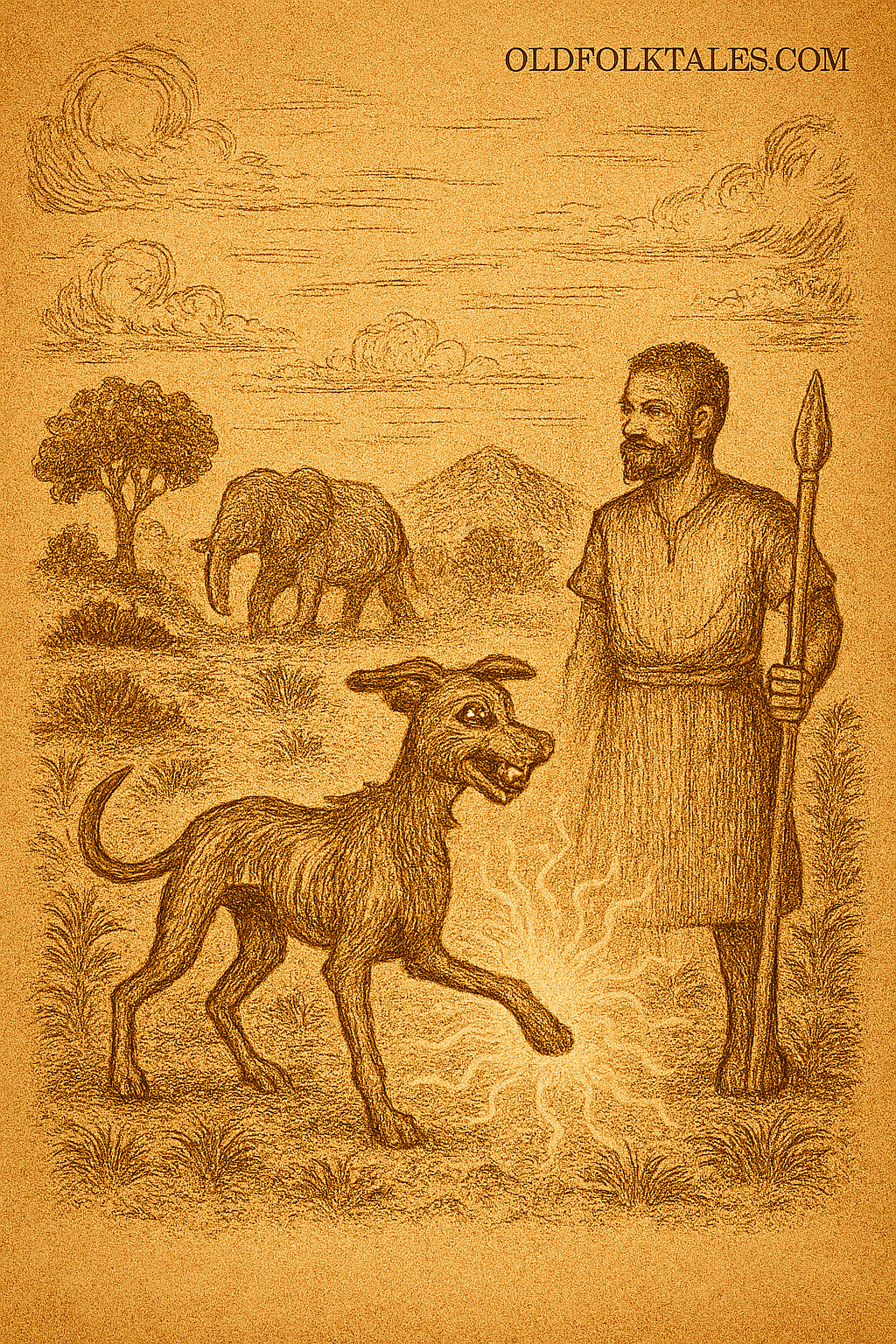
In a time when elephants roamed freely through the vast African wilderness, there lived a hunter named Adieh whose reputation echoed through every village and hamlet. He was known far and wide as the greatest elephant hunter in all the land, a man whose skill with bow and spear was matched only by his wisdom in the ways of the forest. Yet his most prized possession was not his weapons or his knowledge, it was a scraggy, ill-tempered dog that looked as though it had never eaten a proper meal in its life.
This cantankerous creature was worth more than an army of the finest hunting dogs, though few understood why. The dog’s ribs showed through its patchy coat like the frame of a poorly thatched hut, and its temperament was as sour as palm wine left too long in the sun. It ate enormous quantities of food yet remained as thin as cattle grazing on sparse hills during the harshest dry season. But Adieh knew the secret of his companion’s power, and he always carried the right portions of food when they ventured into the wilderness together.
Elephant hunts were rare and precious events, undertaken only when the village faced special celebrations that demanded the finest meat. On the eve of one such important festival, Adieh prepared for another expedition. Before they departed, he cooked great quantities of fufu-corn and bitter-leaf soup, filling his dog’s belly to satisfaction. This was essential, for the demanding creature would refuse to cross even two streams or climb two hills without asking for nourishment.
Also read: The Sacred Door Mystery
Deep in the hunting grounds, where ancient trees stretched their branches toward the sky like the fingers of sleeping giants, the dog instructed his master to conceal himself behind the massive trunk of a towering mahogany. “Let all the fat elephants pass by,” the dog commanded with the authority of one who knew ancient secrets. “Wait until you see the last one, the skinny elephant that looks like me. That is the one you must shoot.”
With surprising agility for such a scrawny creature, the dog scrambled up into the canopy and began playing enchanting melodies on his nelo, a mystical instrument that seemed to weave magic into the very air:
minser da ko’o mimfo mimfo mimfo de ko’o minser minser
When elephants approach buffaloes buffaloes When buffaloes approach elephants elephants
The haunting music drifted through the forest like morning mist, and soon the earth began to tremble with the approaching thunder of massive feet. Adieh watched in awe as elephants emerged from the green depths, magnificent behemoths that crushed plants and small trees with every step. First came the largest giants, their tusks gleaming like ivory spears in the dappled sunlight. Behind them followed moderately sized elephants, then smaller ones, then thin ones, all moving in stately procession.
Any ordinary hunter would have released arrows at the sight of such magnificent prey, but Adieh was more than skilled, he was obedient to wisdom. He waited patiently until the very last elephant appeared, a skinny creature that mirrored his dog’s gaunt appearance. Taking careful aim, he fired. Twaaah! The arrow found its mark, and Kpwuum! the skinny elephant crashed to the forest floor. Like dominoes falling in sequence, every elephant that had passed before it also collapsed, struck down by the magical power unleashed by shooting the chosen one.
Adieh returned home with his dog and gathered the villagers to help butcher the fallen giants. The abundant meat was shared throughout the community, and the thanksgiving celebration that followed was the grandest anyone could remember.
Time flowed like a lazy river, and eventually Adieh’s younger brother Manoji announced his intention to marry. Desperate to prove his worth to his future in-laws, Manoji approached his famous brother with a request that made Adieh’s heart heavy with foreboding. As a hunter, Manoji possessed no talent whatsoever, his arrows flew wide of their targets, and his footsteps frightened away game from great distances. Yet blood runs thicker than river water, and Adieh could not refuse his brother’s plea to borrow the magical dog.
“Give the dog as much food as it asks for, and feed it whenever it demands,” Adieh warned sternly, knowing his brother’s impatient nature. But Manoji dismissed these instructions as the ramblings of an overly cautious elder brother. During the journey, he complained bitterly each time the dog requested food, feeding it only three meager portions less than one-third of what the creature normally consumed on hunting expeditions.
At the hunting grounds, the underfed dog gave the same instructions as always: “Do not shoot the first animals you see. Wait for the last one, the skinny elephant that resembles me.” The dog climbed wearily into the tree and began its magical song, though hunger had weakened its voice.
When the elephants appeared, Manoji’s eyes bulged like those of a man seeing spirits. Never had he witnessed such enormous beasts! The first elephant was a colossus beyond imagination, its tusks gleaming like twin lightning bolts. His hands trembled like leaves in an August rainstorm as the giant stomped past, followed by a second, then a third massive creature.
“Why should I wait for a skinny one when these magnificent beasts are within my reach?” he muttered to himself, his greed overwhelming his judgment. Unable to restrain himself any longer, he raised his double-barrel gun, took aim, and fired.
Twaaah! The shot rang out like thunder, and the first three elephants crashed to the earth. But instead of the complete magical victory his brother had achieved, chaos erupted. The remaining elephants stampeded back through the forest in terror, their trumpeting calls splitting the air like war cries. Wild winds began whirling through the trees, and a fierce storm broke over the forest with supernatural fury.
Ancient trees were uprooted and hurled through the air like twigs. Branches were ripped away and flung in every direction as if thrown by angry ancestors. In the midst of this chaos, powerful winds seized the weakened dog from its perch and hurled it into a pool of murky, stagnant water where it disappeared beneath the dark surface.
Manoji searched frantically but found no trace of his brother’s precious companion. With shame burning in his chest like swallowed fire, he returned home to confess his failure to Adieh. His brother’s fury was terrible to behold—eyes blazing like coals, voice trembling with rage. “Return to that forest,” Adieh commanded, “and do not come back without my dog.”
For eight long days and nights, Manoji summoned every expert in mystical arts from across the land. From Nkpezah to Ntobah, from Ndzembebeh to Ndokuh, from Nshialah to Webloh to Bamidzetoh to Bamikoh, they came herbalists and diviners, masters of leaves and moons and ancestral wisdom. Each one boasted of their supernatural knowledge, but none could free the dog from its watery prison.
Finally, Adieh announced to all who would listen: “Whoever brings my dog back by the next Nshialah, when the land and people rest, will receive a handsome reward.”
On the appointed day, crowds gathered at the cursed pool to witness what everyone expected would be the medicine men’s greatest spectacle. Some threw rare herbs into the murky water, others chanted invocations in languages that hurt the ears to hear. Still others pronounced incantations never before heard in any village. Yet the pool remained as dark and silent as a grave.
Just as hope began to die like embers in rain, a thin man rose from the crowd. His collarbones protruded like broken branches, and his feet were covered with jiggers that made walking painful. Someone whispered that he resembled the missing dog, but few found humor in the observation.
Onlookers watched with skepticism as this unlikely figure approached the pool. In his hand he carried nothing but a simple twig no rare herbs, no sacred amulets, no ceremonial tools. The crowd murmured with scorn. If the greatest experts had failed, what could this diminutive man possibly accomplish?
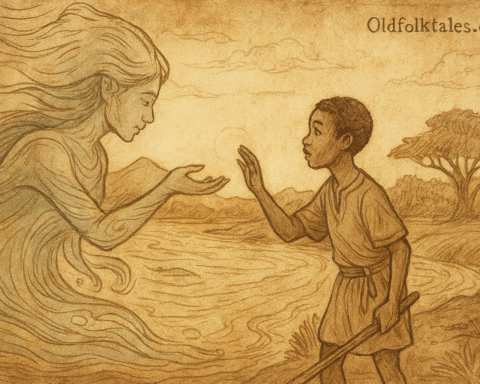
Yet they stepped aside, making way as he cautiously approached the water’s edge. He held the twig to his lips, whispered words too soft for human ears, and plunged it into the dark pool. When he withdrew it, there was the dog, clinging to the simple branch as if it were a lifeline thrown by the ancestors themselves.
A roar of amazement erupted from the forest as Adieh rushed forward to embrace his returned companion. The humble man claimed his reward while Manoji became the laughingstock of every village, most especially among his intended in-laws who quietly began reconsidering their daughter’s engagement.
Moral Lesson
This tale teaches that true power often lies in humility and obedience to wisdom, while greed and disobedience lead to destruction. It reminds us that magical gifts come with responsibilities, and those who ignore the conditions of supernatural blessings will lose everything they hope to gain. Sometimes the greatest solutions come from the most unexpected sources.
Knowledge Check
Q1: What makes Adieh’s scrawny dog so valuable in this African hunting folktale? A1: The dog possesses supernatural hunting powers that can kill entire herds of elephants through magical music and specific instructions, making it worth more than an army of ordinary hunting dogs.
Q2: Why does Manoji fail where his brother Adieh succeeded in the elephant hunt? A2: Manoji failed because of his greed (shooting the first elephant instead of waiting for the skinny one) and disobedience (not feeding the dog properly), violating the magical conditions required for success.
Q3: What role does the magical song play in this African folktale? A3: The dog’s enchanting nelo music (minser da ko’o, mimfo mimfo) serves as a supernatural hunting spell that calls and controls elephants, demonstrating the power of mystical knowledge in traditional African beliefs.
Q4: What does the humble man’s success symbolize in this hunting story? A4: The thin, jigger-infested man’s success represents the triumph of humility and spiritual insight over elaborate displays of supposed expertise, showing that true power often comes from unexpected sources.
Q5: How does this folktale reflect traditional African values about brotherhood and responsibility? A5: The story shows that family bonds create obligations (Adieh lending his dog despite knowing Manoji’s flaws) but also demonstrates that individual actions have consequences that affect the entire family’s reputation.
Q6: What cultural significance do the specific day names (Nkpezah, Ntobah, etc.) have in this tale? A6: These traditional day names reflect indigenous African time-keeping systems and emphasize that the magical rescue must occur on Nshialah, a sacred rest day, highlighting the spiritual importance of timing in supernatural events.
Source: The sacred door and other stories, Cameroon folktales of the Beba (1st ed.). Ohio University Press.