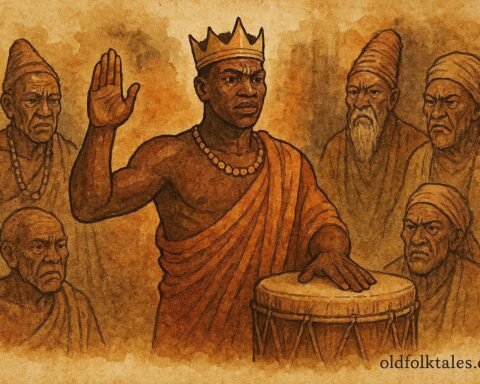
Long ago, in the highlands of the Merina people of Madagascar, there lived a man who thought himself cleverer than anyone alive. He carried pride in his chest as though it were a shield and believed his wit sharper than a blade. Yet above all, he dreamed of proving himself more cunning and deceitful than the legendary tricksters, Kotofetsy and Mahaka, whose names were spoken with both fear and awe. Convinced that his cleverness would outshine theirs, he set out upon the roads to find them.
The Encounter on the Road
One afternoon, while the man wandered through the countryside, he came upon a figure walking slowly along the dusty path. The stranger carried a hoe slung over his shoulder, his steps heavy, his clothing worn, as if he were a humble farmer returning from the fields.
The proud man halted and called out, “Sir, do you know where those sly companions, Kotofetsy and Mahaka, live? I have been searching for them, for I wish to match my wits against theirs.”
The stranger looked at him with calm eyes, hiding the spark of laughter that burned within. For this was none other than Kotofetsy himself, disguised as a farmer. He adjusted the hoe on his shoulder and answered in a slow, steady voice, “If you want to see them, stand at the foot of that tomb yonder. I will go fetch them and bring them to you.”
Grateful and unsuspecting, the man bowed his head slightly and walked toward the tomb. He planted himself firmly at its base, ready to wait.
The Trick Unfolds
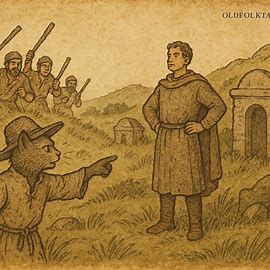
Kotofetsy, suppressing a grin, left the man there and hurried toward the village. He sought out the elders and cried, “There is a sorcerer by the tomb! He is preparing to dance upon it, mocking the resting place of our ancestors!”
Now, among the Merina, to dance upon a tomb was no small matter. It was considered a grave insult to the dead, a sure mark of sorcery. Sorcerers were feared for their dark powers and despised for their disregard of ancestral respect. At Kotofetsy’s alarm, the elders rallied the villagers. With heavy sticks in hand and anger in their eyes, they rushed toward the tomb.
READ THIS: The Cat and the Water Rat: A Madagascan Folktale That Teaches Lessons on Betrayal and Vengeance
There, they found the man standing, exactly as Kotofetsy had said. Without question, without hesitation, they fell upon him. Blows rained down like a storm. The man cried out in pain, but no one listened. They beat him so fiercely that he fell to the ground, broken and bruised, his pride shattered along with his body.
When at last the villagers tired, they spat curses at the “sorcerer” and returned to their homes, certain they had defended their community from evil.
The Tricksters’ Lesson
When silence returned to the tomb, Kotofetsy and his ever-present companion Mahaka approached the battered man. They stood over him as he groaned in the dust, and their words cut sharper than the villagers’ sticks.
“If you are not sharper than this,” Kotofetsy said coldly, “do not dare to challenge Kotofetsy and Mahaka. You will never withstand us. Our minds are as deep as the sea, and your cleverness is but a pebble on its shore.”
Mahaka chuckled, his voice like a whip. “Take this lesson, fool, and carry it home with your wounds.”
The man could not raise his head. Shame wrapped around him heavier than his bruises. He crawled away from the tomb, dragging his battered body back toward his home. His dream of glory dissolved into silence, replaced by the bitter taste of humiliation.
And so he learned: no one who walks in pride can match the cunning of Kotofetsy and Mahaka.
Moral Lesson
This Merina folktale teaches that pride blinds the eyes and weakens the spirit. The man’s arrogance led him to challenge masters of cunning, and his downfall was swift and brutal. By seeking to exalt himself, he invited humiliation, for those who boast of their cleverness often reveal their folly.
The tale reminds us that humility protects where arrogance destroys. Wisdom is not found in proclaiming one’s greatness, but in recognizing the limits of one’s understanding. The proud man sought glory, but instead he earned disgrace, a warning to all who place pride above respect.
Knowledge Check
1. Who are the legendary tricksters in this Merina folktale?
Kotofetsy and Mahaka.
2. What did the proud man believe about himself?
That he was more cunning and deceitful than Kotofetsy and Mahaka.
3. How did Kotofetsy trick the man by the tomb?
He told the villagers the man was a sorcerer preparing to dance on a tomb.
4. Why was dancing on a tomb considered a serious offense?
Because it was seen as sorcery and disrespect to the ancestors.
5. What happened to the man as a result of Kotofetsy’s trick?
The villagers beat him severely, mistaking him for a sorcerer.
6. What is the central lesson of the story?
That pride and arrogance lead to downfall, while humility guards against shame.
Source: Merina folktale, Madagascar.