In the time of the ancestors, when people still listened to the language of the wind and the spirits of trade walked among the living, there was a tale told among the Serer people of Senegal. It was the story of a market that appeared only once in a hundred years, a place where no coin jingled, where the price of things was measured in character, not gold.
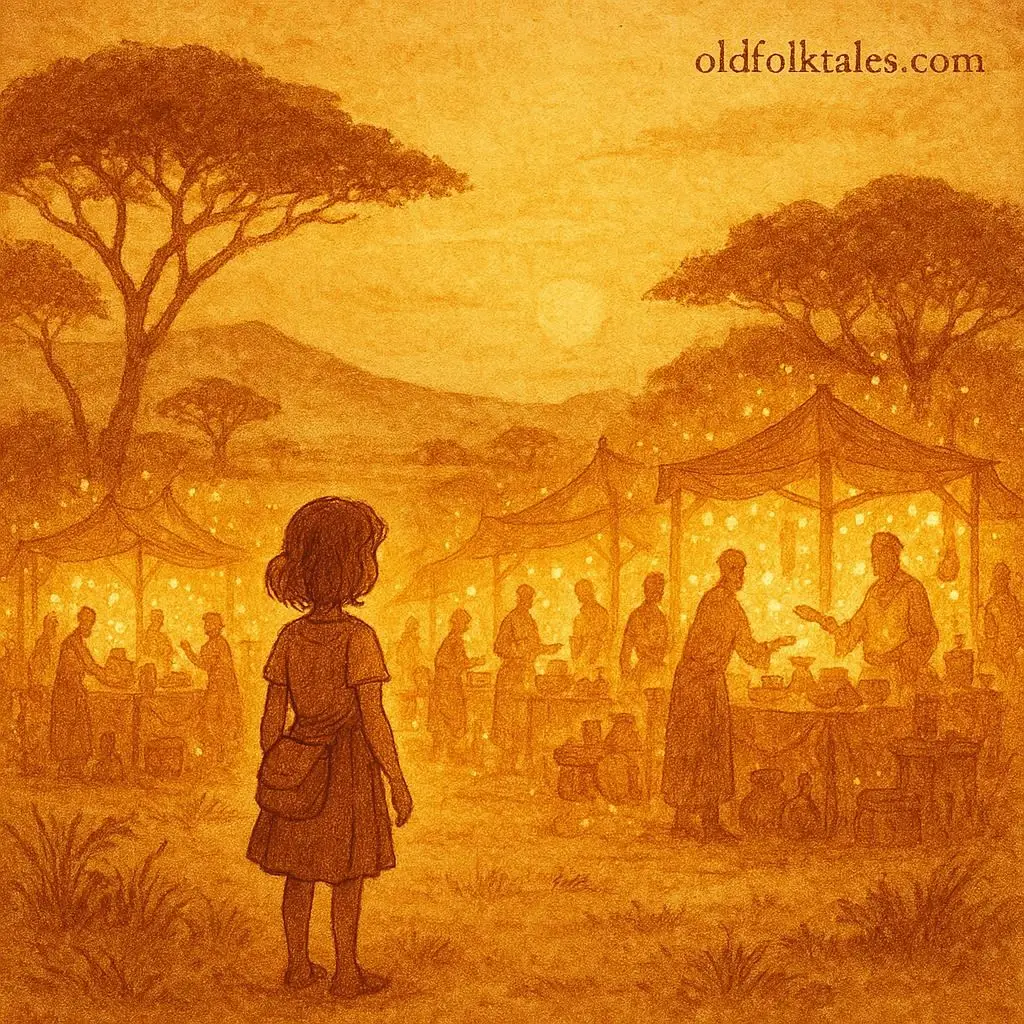
This market was said to rise from the heart of the savannah, between the great trees where spirits were known to rest. No map could mark its place, for it belonged to time, not land. When the season was right, the sky would shimmer, the ground would hum, and by dawn, stalls of woven straw and carved wood would bloom like flowers after rain.
Those who saw it said that every item sold there carried wisdom. Some left with knowledge, others with silence. A few never returned at all.
If you enjoyed this story, explore our full West African folktales collection
Among those who grew up hearing this story was a girl named Ndeye. She lived in a small Serer village near Fatick, known for its traders and storytellers. Her grandmother, Lingeer Ndaté, was a wise woman who had seen many seasons pass. She often reminded Ndeye, “Patience is a trader’s first wealth. The impatient seller loses more than he earns.”
But Ndeye was not patient. She wanted to see everything, do everything, and know everything. When others waited for harvest, she wanted to plant early. When the women wove baskets, she rushed her hands and spoiled the pattern.
One evening, as the moon rose full over the millet fields, the village gathered around the fire. The elders spoke of the old market, for word had spread that one hundred years had passed since it last appeared. Some laughed it off as myth. Others prayed quietly, for such a market was said to test the heart more than the eyes.
That night, Ndeye could not sleep. The words of her grandmother echoed within her: “The impatient seller loses more than he earns.” But her curiosity was stronger than her caution. When the first rooster crowed, she left her hut and walked toward the open savannah.
The land stretched endlessly before her dry grass, acacia trees, and dust glowing under the early light. She walked until her legs ached, and just as she began to doubt, a warm wind swept past. In its wake, the air shimmered, and there it was: a market unlike any she had ever seen.
Hundreds of stalls lined the plain, glowing with soft light. The traders did not shout. They sat quietly, each surrounded by goods that pulsed faintly as though alive. One woman sold calabashes filled with laughter. A man polished mirrors that reflected not faces but futures. Another offered grains that could grow anywhere, even on stone.
A calm voice spoke behind Ndeye. “Welcome, child of the Serer. You have found what many seek but few are ready to see.”
She turned to find an old trader in a robe of faded red. His eyes were bright but gentle. “What do you sell?” she asked.
“I sell time,” he said.
She frowned. “Time cannot be sold.”
He smiled. “You are sure?”
On his mat lay three objects: a seed, a shell, and a stone. He gestured to them. “The seed will teach you patience. The shell will teach you listening. The stone will teach you endurance. Each will change how you live, but each has a price.”
“What price?” Ndeye asked eagerly.
He looked at her kindly. “Whichever you take, you must give away something you love most.”
Ndeye hesitated. Around her, others bartered silently. Some left smiling, others weeping. She thought of her grandmother, of the stories she had told, of her own restless heart.
Finally, she pointed to the seed. “I will take patience,” she said.
The trader nodded. “Then give me your haste.”
At once, she felt a stillness wash over her. The noise of the market softened. She looked down to find the seed glowing gently in her palm. “Plant it,” said the old man. “When it grows, it will remind you that everything ripens in its season.”
Ndeye blinked, and the market was gone. The savannah stood quiet under the sun. In her hand, the seed remained, small but warm.
She returned to her village and planted it near the baobab tree. Days passed, then weeks. Nothing grew. Some mocked her, others forgot. But Ndeye waited.
Seasons turned. Her grandmother passed away, and Ndeye became one of the village’s traders. With each passing year, she grew wiser, calmer. She taught others how to weave slowly, how to plant carefully, and how to wait for rain.
Then, one morning, when she was old and her hair white as ash, she woke to find a small tree blooming beside the baobab. Its leaves shimmered silver in the sunlight, and its fruit glowed softly. She smiled and whispered, “You have taken your time, my friend.”
When children asked her the secret of her peace, she would smile and say, “I once bought patience at a market that appears only once in a century. But you need not go that far. The true market lives in your choices every day.”
And when the wind rose over the savannah, carrying the sound of distant drums, the elders said it was the spirits reopening their market for the next hundred years waiting for another heart brave enough, and patient enough, to enter.
Moral Lesson
Patience is the true wealth of the wise. Time rewards those who wait with open hearts and humble hands.
Knowledge Check
Where did the magical market appear?
In the savannah near the Serer villages of SenegalWho was the main character of the story?
Ndeye, a curious young girl who learned patienceHow often did the market appear?
Once every hundred yearsWhat did Ndeye choose to buy from the old trader?
A seed that taught her patienceWhat was the price of the seed?
She gave up her haste and impatienceWhat is the main lesson of the story?
True wisdom and peace come from patience and understanding the rhythm of life
Source
Serer folktale, Senegal. Compiled by Fatou Niang in Serer Stories of Magic and Trade (1977)