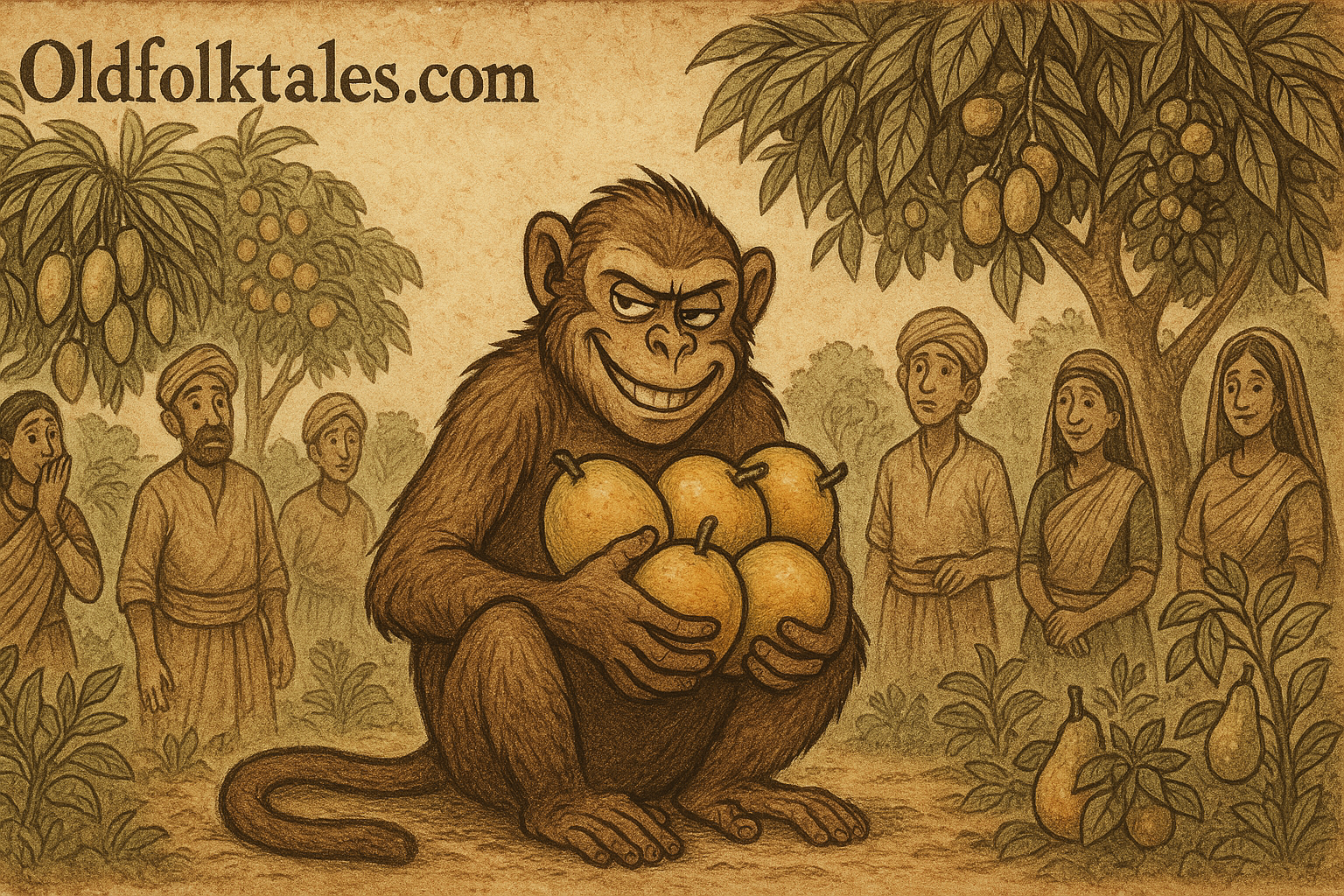
Long ago, when the world was young and the animals still spoke with voices like men, there lived a monkey whose mischief was known across the forests. This monkey was clever, but his heart was restless. He always wanted more than his share, and he never cared if others went hungry. His fur was golden brown, his eyes sparkled with cunning, and he lived high among the trees where the sun touched the leaves first at dawn.
One season, the great mango trees ripened by the river. Their branches bent low with golden fruit that glowed like little suns. The scent drifted across the forest, making every creature’s mouth water. Birds sang of the sweetness, antelopes stretched their necks to sniff the air, and even crocodiles slid quietly to the river’s edge hoping some fruit might fall. But no one loved mangoes more than the monkey. He thought of nothing else.
One morning, he climbed to the very top of the largest mango tree, where the fruit grew most golden and sweet. He stuffed his cheeks, swallowed, then grabbed more. He filled his arms, his legs, even tied mangoes with vines to carry them back to his tree hollow. Still, he was not satisfied. The monkey looked around and thought, “These mangoes belong to me alone. I will keep them from all the others. If I eat them all, I will be the happiest in the forest.”
But as he hoarded, a tortoise watched from below. The tortoise was slow, wise, and known to speak little until his words could teach a lesson. He called up, “Monkey, the fruit belongs to the earth, not to one mouth. Share, and you will never lack.”
The monkey laughed. “What do you know, old shell? You crawl on the ground while I fly among the trees. These mangoes are mine!” He turned away and stuffed himself until juice ran down his fur.
Days passed, and the monkey’s hollow filled with rotting fruit. He had too many to eat, and yet he kept climbing for more. Soon the sweet smell turned sour. Flies gathered, and his tree became a place of stench. His belly grew heavy, and he could no longer leap from branch to branch as before. One day, while trying to carry yet another load of mangoes, he slipped. His arms were too full, his body too heavy. He fell into the river with a loud splash.
The crocodiles, who had long waited, rushed forward. The monkey cried out, dropping his mangoes in panic. By luck, he grabbed onto a hanging branch and pulled himself out, gasping and shaking. All around him, the mangoes floated away down the river. The crocodiles swallowed them whole, smacking their jaws with joy.
Ashamed and hungry, the monkey climbed back to his hollow. There, he found only rotten fruit, too foul to eat. His hoarding had brought him nothing but sickness and emptiness. Weak and sad, he remembered the tortoise’s words. The next morning, he climbed the tree again, but this time, when his belly was full, he dropped mangoes down for the other animals. Birds pecked, antelopes chewed, and even the tortoise enjoyed a piece. To his surprise, the monkey felt lighter, freer, and truly happy for the first time.
From then on, whenever mangoes ripened, the monkey no longer kept them for himself. He shared with the forest, and in return, the animals watched over him. No crocodile dared attack, for they too received their share. The monkey learned that greed fattens the belly but starves the spirit, while sharing nourishes all.
Moral Lesson of The Monkey and the Mangoes
The story of the monkey teaches that greed blinds us to the joy of community. By hoarding, we may lose everything, but through sharing, we gain lasting friendship and peace. True wealth lies not in what we keep but in what we give.
Knowledge Check
- What is the main lesson from The Monkey and the Mangoes folktale?
The folktale teaches that greed leads to loss, while sharing brings happiness and harmony within the community. - Why did the monkey hoard the mangoes in The Monkey and the Mangoes story?
The monkey hoarded the mangoes because of his selfishness and belief that happiness could only come from keeping everything for himself. - How did the tortoise contribute to The Monkey and the Mangoes folktale?
The tortoise acted as the voice of wisdom, reminding the monkey that the fruit belonged to the earth and should be shared with all. - What happened when the monkey tried to carry too many mangoes?
He slipped, fell into the river, dropped his mangoes, and nearly became food for the crocodiles. - What change did the monkey undergo in The Monkey and the Mangoes?
The monkey transformed from being greedy and selfish to becoming generous, learning that sharing brings real joy. - Why is The Monkey and the Mangoes an important folktale for children?
It teaches children the values of generosity, community, and the dangers of greed in a simple and memorable way.
Cultural Origin: This folktale comes from the Sanga people of the Central African Republic, whose oral traditions often use animals to teach wisdom, caution, and community values.