In the rugged landscapes of Algeria, where the Atlas Mountains cast their ancient shadows across valleys carved by countless generations of wind and water, there lived a wealthy Arab merchant whose prosperity had blessed him with more gold than he could easily count. This fortunate man had spent years building his fortune through shrewd trading and careful investment, accumulating enough precious metal to secure his family’s comfort for generations to come.
The merchant’s most trusted companion in all his journeys was a sturdy mule, a patient and reliable beast whose sure feet had carried valuable cargo across treacherous mountain passes and scorching desert expanses without fail. This faithful animal had become far more than mere transportation it was a partner in prosperity, a four-legged guardian of the merchant’s wealth whose steady gait had never faltered even under the heaviest loads.
On one particular day, when the North African sun blazed mercilessly in a cloudless sky, the wealthy Arab prepared for what should have been a routine journey across familiar terrain. He carefully loaded his mule with a precious cargo of gold, securing the gleaming metal in sturdy saddlebags that had weathered many previous expeditions. The weight was considerable, but both man and beast had handled such burdens many times before, and neither felt any concern about the task ahead.
The merchant attached the strong chain bridle to his mule’s head with practiced efficiency, testing the links to ensure their integrity. This particular bridle had served him faithfully for years, its metal links forged by skilled craftsmen and tested by countless miles of travel across Algeria’s challenging landscape. He had complete confidence in its strength and reliability.
Their destination lay beyond a range of imposing mountains whose peaks pierced the brilliant blue sky like ancient sentinels. To reach it, they would need to cross the dry bed of a seasonal stream that wound its way through the foothills, a route the merchant had taken numerous times without incident. During most months of the year, this watercourse remained nothing more than a dusty depression in the earth, marked only by scattered stones and the occasional thorny bush that had managed to sink its roots deep enough to find moisture.
As the merchant led his heavily laden mule across this seemingly harmless streambed, the silence of the desert afternoon was broken only by the soft clinking of the gold in the saddlebags and the rhythmic sound of hooves against the hard packed earth. The man walked with the confident stride of someone intimately familiar with the terrain, while his mule plodded steadily behind, accustomed to the weight of its precious burden.
But the mountains of Algeria, as any native of the region knows well, are capable of sudden and dramatic transformations. High in the peaks above, where the merchant could neither see nor hear what was happening, heavy rains had begun to fall with the fierce intensity that characterizes North African storms. These torrential downpours, though invisible from the valley floor, were creating a situation of mounting danger with each passing moment.
The water cascading down the mountainsides began to gather in the countless gullies and ravines that carved their way toward the valley floor. What started as individual streams quickly merged into rushing torrents, and these torrents combined into a mighty flood that surged downward with irresistible force, carrying with it tons of mud, rocks, and debris torn from the mountainsides.
Without warning, this massive volume of water came thundering into the streambed where the merchant and his mule were peacefully making their crossing. The roar of the approaching flood gave them only seconds to comprehend the magnitude of their peril before the full fury of the mountain waters struck with devastating power.
The peaceful, dry watercourse instantly transformed into a raging river of brown water that swept everything before it with terrifying force. The merchant, realizing immediately that his mule was in mortal danger, desperately grasped the chain bridle and attempted to pull his faithful companion to safety. But the power of the flood was beyond anything human strength could resist.
The mule, weighted down by its heavy load of gold and caught completely off guard by the sudden deluge, was swept away by the churning waters despite the merchant’s frantic efforts to save it. The man pulled with all his might on the chain bridle, his muscles straining against the incredible force of the flood, but the relentless current proved stronger than the finest craftsmanship.
With a sharp crack that cut through the roar of the waters, the chain bridle snapped under the immense strain, and the merchant watched helplessly as his beloved mule disappeared beneath the brown torrent, carried away along with the fortune in gold it bore. In a matter of moments, years of careful accumulation and his most trusted companion had vanished into the raging waters.
The merchant stood alone on what remained of the dry bank, staring at the broken chain in his hands and the furious river that had claimed his wealth. The flood continued for hours, a relentless brown torrent that gradually began to subside as the mountain rains ended and the accumulated water finally flowed toward distant seas.
Eventually, the waters receded completely, leaving behind the same dry streambed the merchant remembered, though now it was covered with a thick layer of mud and debris deposited by the flood. For several days, the heartbroken man wandered along the banks, hoping against hope that he might find some trace of his lost mule and precious cargo.
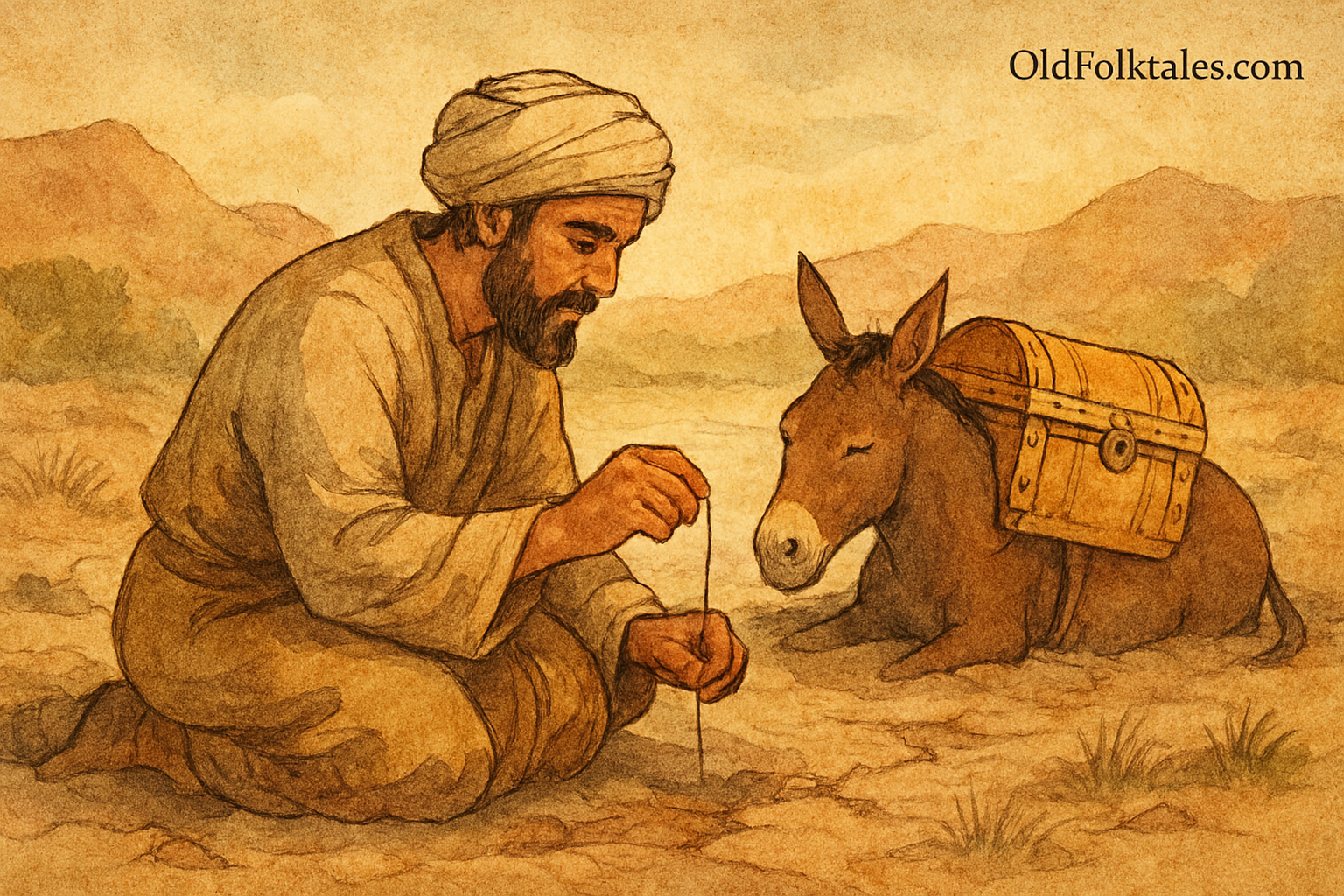
When the mud had finally dried and hardened under the desert sun, the merchant began a systematic search of the streambed, examining every mound and depression for any sign of what the flood had taken from him. His persistence seemed futile until, in one particular spot, he noticed something unusual protruding from the hardened mud a single hair, barely visible against the brown earth.
With nothing to lose and everything to hope for, the merchant gently grasped this solitary hair and began to pull. To his amazement, the hair held firm, suggesting that it was attached to something substantial buried beneath the dried mud. Working carefully to avoid breaking this fragile connection to whatever lay below, he began to clear away the hardened earth with his bare hands.
As he dug deeper, his excitement grew, for the hair clearly belonged to an animal buried in the flood deposits. Layer by layer, he removed the mud until finally, incredibly, he uncovered the body of his lost mule, perfectly preserved by the thick clay that had encased it. Even more miraculous, when he examined the saddlebags, he discovered that his entire load of gold remained intact, every precious piece exactly as he had packed it.
This extraordinary experience became the source of a profound piece of Arab wisdom that spread throughout Algeria and beyond. The merchant’s story taught the desert people a fundamental truth about the nature of fortune and fate: while a man may lose his wealth despite the strongest chains when misfortune strikes, sometimes the smallest and most fragile connection even a single hair can restore everything he thought was lost forever.
And so, to this day, the Arabs say with the wisdom born of desert experience: “Fortune comes to a man at the pull of a hair, but when it leaves him, even a chain will not avail to check its flight.”
The Moral Lesson
This Algerian folktale teaches us about the unpredictable and paradoxical nature of fortune. Despite our best efforts to secure and protect our wealth and blessings, they can be swept away by forces beyond our control. Yet hope should never be abandoned, for sometimes what seems lost forever can be recovered through the most unexpected and delicate means. The story reminds us to remain humble in prosperity, persistent in adversity, and always aware that fate operates by its own mysterious rules.
Knowledge Check
Q1: Who is the main character in this Algerian Arab folktale and what was he transporting? A1: The main character is a wealthy Arab merchant who was leading his mule across a dry streambed. The mule was carrying a heavy load of gold, representing the merchant’s accumulated wealth and prosperity.
Q2: What natural disaster occurs in this North African folktale and why does it happen? A2: A sudden flash flood strikes the dry streambed where the merchant and mule are crossing. This occurs because heavy rains fall on the mountain peaks above, creating a massive volume of water that rushes down to the valley floor, as frequently happens in Algeria.
Q3: How does the merchant attempt to save his mule and what happens to his efforts? A3: The merchant desperately grasps the chain bridle and tries to pull his mule to safety from the raging floodwaters. However, the force of the flood is too powerful, and the chain bridle breaks under the immense strain, causing him to lose both his mule and gold.
Q4: How does the merchant eventually recover his lost fortune in this legend? A4: After the flood subsides and the mud dries, the merchant searches the streambed and finds a single hair protruding from the hardened mud. When he gently pulls this hair, he discovers his buried mule with the gold load completely intact.
Q5: What famous Arab proverb originates from this Algerian folktale? A5: The story gives rise to the Arab saying: “Fortune comes to a man at the pull of a hair, but when it leaves him, even a chain will not avail to check its flight,” illustrating the paradoxical and unpredictable nature of fate and wealth.
Q6: What does this North African tale teach about the relationship between human effort and fate? A6: The folktale demonstrates that despite our strongest efforts to secure our fortunes (symbolized by the chain), external forces can sweep them away instantly. However, it also shows that sometimes the most delicate connection (the single hair) can restore what seemed permanently lost, teaching us about perseverance and the mysterious workings of destiny.